Editor’s note: This commentary is by Rob Lehmert, of Berlin, a Democratic candidate for the Washington-1 House seat.
On Sept. 9, the Vermont House passed H.688, the Vermont Global Warming Solutions Act by a veto-proof majority. The bill required 74 yeas out of 147 votes to pass. It actually received 102 yeas.
Gov. Phil Scott, as expected, vetoed the bill Sept. 15.
Of the 45 nays, all were cast by Republican representatives. Several commentators have explained their votes in a virtually identical fashion, making standard points that include:
— We need to pass this bill and move forward with aggressive leadership: as individuals, and as a state, as rapidly as possible. But I vote no on moving it forward.
— Covid-19 has preoccupied the Legislature, and we can’t invest state resources until the emergency is resolved.
— The bill is bad because it cedes power to the executive branch, and over-delegates the Legislature’s fundamental responsibility to write rules.
I have difficulty accepting these explanations. The bill’s financial impact will be nominal — nearly zero — until details and rules are worked out, which may require years. State employees already earn budgeted salaries and a new budget will fund a standard per diem for experts. But there is no budget required for implementation of any plan, because there is no plan yet. Therefore, the “we can’t afford it now because of the pandemic” excuse is a convenient fig leaf.
One representative said “our legislative process has impaired the possibility that this bill would have been more responsible in its over-delegation of our own fundamental responsibilities.” This refers to an oft-repeated assertion that H.688 transfers constitutional powers from the Legislature to agencies of the executive branch, which can then write rules without legislative oversight. That’s simply not true. The bill calls for frequent checkpoints and reviews.
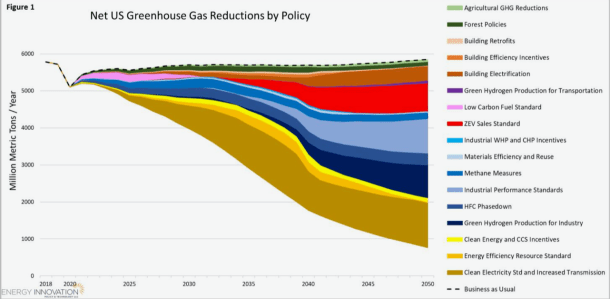
In fact, there is nothing unusual about agencies writing complex and specialized rules. We have a part-time citizen Legislature from all walks of life. The idea that legislators should become experts (and stay up to date) in arcane technical matters is silly. I’m attaching a graph that categorizes major targets of opportunity for reducing greenhouse gas emissions over the next 30 years. I doubt there is a single legislator who could discuss the high-level significance of the categories.
If the agencies and subject matter experts don’t do this work, no one will, which is perhaps the larger point of the Republican objection.
The “nay camp” also ignores the actual wording of the bill which states: “The General Assembly may repeal, revise, or modify any rule or amendment to any rule, and its action shall not be abridged, enlarged, or modified by any subsequent rule.” In other words, if the committee recommended that we put nuclear power plants in every town, the General Assembly can repeal it or revise that – or any rule.
H. 688 is about accountability and supporting climate recovery — about accepting responsibility and stewardship to restore the climate that can sustain our species and our complex civilizations. As Jonas Salk once said, it’s about being good ancestors.
Recovery will take a very long time, but like Covid-19, we can’t just sit on it and expect that “one day – it’s like a miracle – it will disappear.”
Some may believe that Vermont can exist as an island, maintaining “business as usual,” retaining dirty technologies that the world no longer supports, ignoring the cost while the rest of the world adapts. Fossil fuel interests will gladly take our money out of state as long as we permit it.
The cost of that strategy is higher than the cost of stepping up to the challenge. Indifference may doom Vermont to declining living standards and declining population.
We should take a moment to consider the level of disruption caused in Vermont by mismanagement of the Covid-19 pandemic from far away — and consider what ancient viruses and bacteria are being introduced to the 21st century by a melting Arctic tundra.
Fixing this is a matter of intergenerational equity, as well as a matter of survival. Let us step forward to face “the fierce urgency of now.”