


Three families are suing the state in federal court, arguing that Vermont is violating a recent U.S. Supreme Court decision by not allowing publicly funded vouchers to pay for religious schools.
The families are being represented by the Institute for Justice, a libertarian law firm that has successfully litigated several precedent-setting cases before the U.S. Supreme Court, including this summer’s Espinoza v. Montana Department of Revenue.
In the 5-4 decision, the court held that Montana’s ban on families applying state tax credit scholarships at religious schools unconstitutionally violated religious freedom. The case was expected to have major implications for school choice programs nationwide.
“Our primary reason for bringing this lawsuit was to ensure that Espinoza is applied in every state in the country,” said Tim Keller, a senior attorney at the Institute for Justice. The group has also filed similar lawsuits in Maine and New Hampshire.
If a school district in Vermont does not operate its own school for some or all grades, it can instead offer families a voucher to attend the public or secular private high school of their choice. There are 81 towns in the state where families can access vouchers, according to the Vermont Independent Schools Association.
One of the plaintiffs is Michael Valente, a resident of Mount Holly, a choice town, whose son attends Mount St. Joseph Academy, a Catholic school in Rutland.
“Vermont has some great public schools, but the ones available to us weren’t a great fit for our son,” Valente said in a statement. “And I know we are not alone. Families across the state send their kids to private religious schools for a variety of reasons. The state should not discriminate against those families for doing what’s best for their kids.”
The state’s dual enrollment program is the subject of another similar, pending legal challenge. The Alliance Defending Freedom, a Christian legal group, is suing the state, and arguing the program is discriminatory because it doesn’t allow students at parochial schools to participate.
In late May, the state initially prevailed. But citing the Espinoza ruling, the U.S. Circuit Court of Appeals in August ordered Vermont to allow the plaintiffs – students at Rice Memorial in South Burlington – to access the program.
The Espinoza ruling was hailed by religious freedom groups as a landmark victory – and denounced by teachers’ unions and those advocating for a separation of church and state.
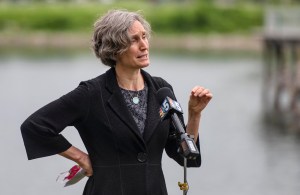
“This lawsuit is a raid on the public education fund,” Rebecca Holcombe, Vermont’s former secretary of education, said Friday.
“It is deathly easy to get approved to be a publicly funded private school in Vermont,” she added. “And in other states like North Carolina, these vouchers to religious schools have compelled taxpayers to fund programs that are aggressively anti-LGBTQ.”
Peter Teachout, a constitutional law professor at Vermont Law School, said the Institute had “good grounds for bringing this challenge.” But he also thinks the state can mount a strong defense.
The Espinoza case knocked down so-called Blaine amendments in state constitutions, which prohibit taxpayer-funded benefits flowing to religious entities – solely because they are religious. The Vermont Constitution instead includes a “compelled support clause,” Teachout said, which blocks public dollars from supporting religious instruction or indoctrination.
That means that while the state can’t bar entities from receiving public funds based on their status as religious institutions, it can put restrictions on what the money can be used for.
In a landmark Vermont Supreme Court case – which also involved Mount St. Joseph Academy – the judges ruled that the Chittenden Town school district violated the compelled support clause when it reimbursed a family for MSJ tuition “in the absence of adequate safeguards against the use of such funds for religious worship.”
“The state would make a mistake if it simply folded its cards and said the Espinoza decision governs Vermont’s tuition support law,” Teachout said.
Still, if the suit does wind up in front of the U.S. Supreme Court, Teachout thinks the Institute is likely to find a sympathetic audience.
“There are five members on the court that seem hell bent on striking down state constitutional provisions that provide for a measure of separation of church and state, and the Espinoza case is just one case in that line of decisions,” Teachout said.
Keller, for his part, argues the Institute doesn’t need to challenge Vermont’s compelled support clause to win its case, since the state hasn’t tried to implement such guardrails, and instead has a blanket ban on families using vouchers at religious schools.
But he added he’s not sure how such safeguards could look in the context of a Catholic school, where religious instruction is part-and-parcel of the general curriculum.
“If there were restrictions placed on the use of tuition such that religious schools could not participate under those guidelines – if it was essentially a proxy for excluding religious schools – I do believe that those sorts of restrictions would have to be struck down as unconstitutional,” he said.
Charity Clark, chief of staff for Vermont Attorney General TJ Donovan, said that the Agency of Education had only just received a copy of the summons.
“The State’s litigation counsel is currently in the process of reviewing the complaint and will respond at the appropriate time,” she wrote in an email.
