

When Covid emerged in March, nobody knew much about containing the virus. So Kristi Theise, who manages Rutland-area office cleaning crews for a company based in Albany, New York, didn’t know what to tell the workers who were cleaning medical office buildings about avoiding infection.
“The patients are gone for the day and the staff is gone for the day. Is there still the virus in the air? No one knew for at least three to four weeks, if not more,” Theise said. The cleaners sprayed “the living heck” out of every surface in the building.
“I even was telling staff that if they were worried about droplets in the air to spray it in front of them as they were walking down the hallway,” Theise said. “It was really scary, because, you know, there was a lot of misinformation coming out at that point in time.”
These days, enough research has come out to give cleaning workers some guidelines on avoiding infection. But for all the weeks this winter and spring that workers stayed on the job without clear information, Theise and other employers would like to see some sign of appreciation. She’s calling for lawmakers to expand the hazard pay program that’s available to front-line medical workers and others.
All essential workers who kept going to work despite the fear and uncertainty of the pandemic’s early weeks deserve the same recognition, Theise said.
“Were it not for us, those buildings would not have been able to open. People would not have been able to get gas at Cumberland Farms,” she said “People would not have been able to get toilet paper, regardless of whether there was some on the shelves or not.”
Vermont’s hazard pay program
Vermont’s hazard pay legislation was adopted this summer in an effort to compensate workers who stayed on their jobs during the most intense months of the pandemic in late winter and spring. Employers, policymakers, and the public were looking for ways to correct some of the inequities that sprang into view as the pandemic emerged.
While some people were able to continue at their jobs in the safety of their homes, others stayed in positions that brought them into close contact with others.
Many employers also said that the federal unemployment supplement of $600 per week was making it difficult for them to attract and retain employees. They said hazard pay would help.
Initially, lawmakers sought to compensate front-line employees in an array of industries such as groceries, child care, and nursing homes. But the bill that eventually passed included only public health, public safety, health care and human services workers.
The money started going out the week of Aug. 31. Through the first phase of the $28 million program, 70 health and human services businesses will receive checks for their workers in the next several days.
More than 6,000 employees will receive a bonus of $1,200 or $2,000 in the initial round of funding, said Mike Smith, secretary of the Agency of Human Services. The amount depends on the hours worked between March 13 and May 15, and the degree of the worker’s exposure to the virus, according to the agency’s guidelines.
Nearly 500 employers have submitted applications for the first-come, first-served program. The first batch of checks this week was for $10 million. Applications are being accepted until Oct. 31, but Smith said he expects the money to run out by mid-September.
“The money is starting to go fast,” he warned on Sept. 1.
A second hazard pay fund
Some lawmakers are talking about creating another fund to continue the program when the money runs out. They’d like it to include the grocery store workers and others who were left out.
Senate President Pro Tem Tim Ashe, D/P-Chittenden, noted that in the early days of the pandemic, grocery workers stayed in their jobs without the protection of masks or the plexiglass shields that have since become standard.
“It’s completely unfair that the only people who will have not received any support from the federal or state government will be people who were required to work at the highest level of risk at the most stressful time in modern Vermont history,” Ashe said.
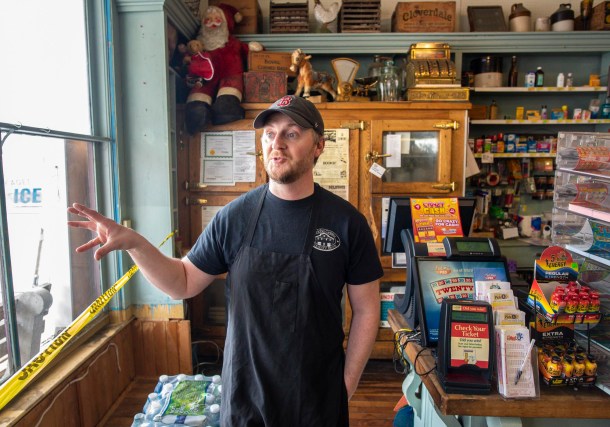
Jon St. Amour, who manages the Jericho Center Country Store, said his workers deserve hazard pay for sticking around and struggling to adapt as the business responded to new safety rules starting in March. The store never closed down, although about 10 of its 22 employees were laid off in March until business fully rebounded in May.
St. Amour thinks some of those who didn’t return to work chose to stay home because they wanted to receive the enhanced unemployment benefits.
“It was hard on my workers who stayed here through it all,” St. Amour said on Sept. 2. “They came to work every day, they worked their butts off, they had great attitudes … but they saw people at home, spending money.”

The Vermont Senate initially proposed using $60 million from the state’s share of the federal CARES Act emergency funding for hazard pay. House lawmakers reduced that to $20 million, raising concerns that the larger measure would make the spending ineligible for the $1.25 billion in Covid-19 funding because it is being paid retroactively.
In late August, Ashe noted that Pennsylvania’s $50 million hazard pay program included people in grocery stores and food manufacturing. The fact that the hazard pay would be retroactive “does not negate the fact that these people put their necks on the line and their lives on the line, their health on the line back in March and April and into May,” Ashe said. “It haunts me to think that they will be left behind.”
It bothers Theise that the people who stayed at work made less money, in many cases, than those who chose to leave.
“There are a few members of my team that are very angry, actually, that they kept working and they know of people who … it ended up making twice or three times as much, literally sitting on their couch,” she said. “It was not our understanding at that time that people could just quit and go on unemployment.”
Xander Landen contributed reporting.
