


As this year’s apple season gets underway, Vermont growers are struggling with problems that have plagued them for years. The good news: It doesn’t appear that the Covid-19 pandemic is likely to worsen those problems.
“It was dire enough already pre-Covid,” said Terry Bradshaw, director of the University of Vermont’s Horticulture Research and Education Center. “But I wouldn’t say Covid has changed a lot. We’ll find out.”
When it comes to crop value, apples are behind only dairy and maple in Vermont. But wholesale profits and market share have been declining for years, and the growing cider sector doesn’t pay enough to offset the losses.
Bradshaw helped to write a sector report that the Agency of Agriculture issued in January, describing a 50% loss in the state’s apple acreage between 2001 and 2017.
Vermont growers started picking the first apples of the season the week of Aug. 17. The report said consumer tastes are shifting away from traditional apple varieties that used to make up the bulk of Vermont’s orchards. It’s becoming more difficult for growers to secure convenient storage, packing and shipping facilities. It calls for more marketing support and other technical assistance.
“Wholesale apple producers are presently experiencing very difficult economic circumstances,” the report said.
However, like farmers in other sectors, apple growers are diversifying to take advantage of consumer preferences for local food and experiences by adding farm stands, pick-your-own apple operations and other amenities. Operations in populous areas can significantly supplement the harvest with retail sales, Bradshaw said.
“They are the face of what an orchard more and more looks like in Vermont,” he said of orchards that have branched into retail sales and attractions. “A garden center and a farm stand probably cash far more than the orchard, and are open nine months of the year.”
Bradshaw thinks the conditions of the pandemic, which encourage outdoor activity, might send more people to pick-your-own operations. He added that Vermont operations have had the benefit of watching how orchards in other states, with earlier harvests, handled pick-your-own visitors.
“I think they’re going to do OK because, by all accounts, people are itching for an outdoor experience.”
Greg Burtt, who grows 40 varieties of apples in Cabot, said he had read in industry publications that pick-your-own sales would be high this year.
“It sounds like that is happening in other places,” he said.
Bradshaw’s not as sure about sales to schools, another big outlet for Vermont growers who sell directly to the districts. But he noted that, while many schools are operating under limits, they’re still providing to-go meals for which apples are a good fit.
Cidermaking has grown enormously in Vermont in recent years. There were fewer than 10 hard cider makers in the state in 2010, and 24 in 2019, according to the Agency of Agriculture report. But cidermakers pay from one-sixth to one-half the price for apples as retailers.
“It’s not the savior of the industry,” Bradshaw said.
Another concern: Many apple growers rely on migrant labor from Jamaica. Along with travel difficulties, there are questions about how to house the crews, who are working on H-2A visas and who in prior years have shared housing.
The pandemic delayed the arrival of harvest workers this spring, but they will be available to help with the harvest. About 200 Jamaican workers on H-2A visas will be picking apples in Vermont this season, said Alyson Eastman, deputy secretary of the Agency of Agriculture. That number is down about 70 from last year, but that’s related to changes at two orchards, not to the pandemic, she said.

A family collects pick-your-own apples at Burtt’s Apple Orchard in Cabot on Tuesday, August 25, 2020. Photo by Glenn Russell/VTDigger 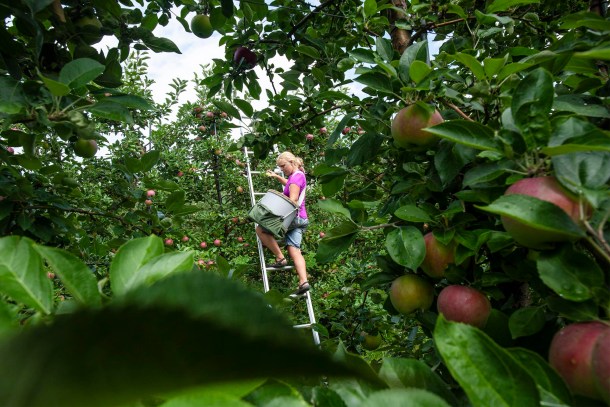
Stefani Burtt of Burtt’s Apple Orchard picks MacIntosh apples in Cabot on Tuesday, August 25, 2020. Photo by Glenn Russell/VTDigger 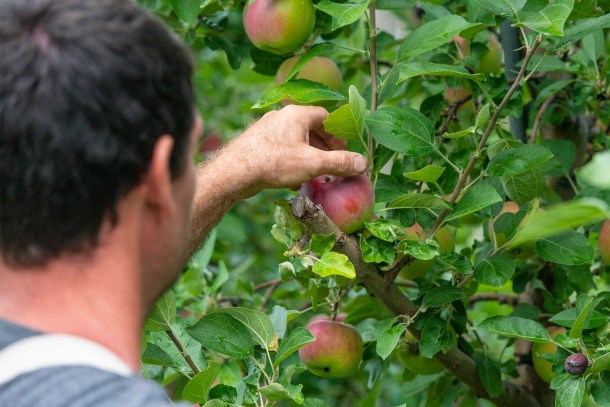
Greg Burtt of Burtt’s Apple Orchard in Cabot picks MacIntosh apples on Tuesday, August 25, 2020. Photo by Glenn Russell/VTDigger 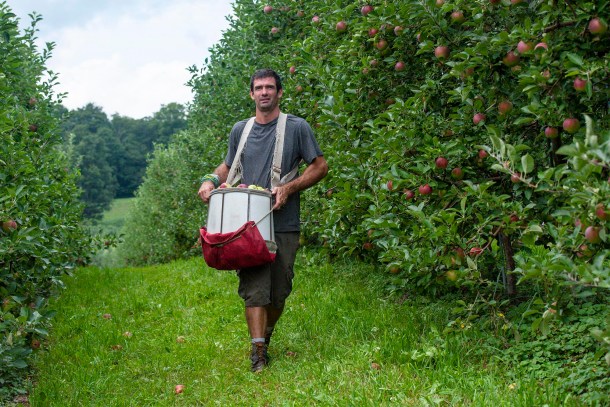
Greg Burtt of Burtt’s Apple Orchard in Cabot brings in a load of MacIntosh apples on Tuesday, August 25, 2020. Photo by Glenn Russell/VTDigger
