


As the Vermont Legislature reconvened remotely Tuesday for a special session focused on passing a budget amid the Covid-19 crisis, legislative committees began to discuss what priorities would be moved in the condensed month-long assembly.
Before the Legislature adjourns for the year, lawmakers are expected to also continue work on legislation for a legalized marketplace for marijuana, policing reforms, an overhaul of the state’s land use law Act 250, and a proposal to make housing more affordable.
Although a number of the Democratic-controlled Legislature’s goals remain on the table, the leaders of the House and Senate stressed Tuesday that as soon as the state budget is complete, both chambers will adjourn for the year.
Senate President Pro Tempore Tim Ashe, D/P-Chittenden, told his colleagues Tuesday that lawmakers will be taking care of legislative business no later than Sept. 25, but that it could potentially be sooner.
“Some people assume that means we will go to September 25, but when the budget is done, we are out of here,” Ashe said.
House Speaker Mitzi Johnson, D-South Hero, echoed those comments.
“Our timeline for this session will be determined by the budget,” Johnson said. “When the budget is finished, we will be wrapping up.”
The outgoing Senate leader, who lost a bid to be the Democratic nominee for lieutenant governor, added that for this reason it is “absolutely critical” that committees prioritize coronavirus funding measures and only work on bills that “were nearing the finish line and for which both House and Senate have agreed will finish.”
Gov. Phil Scott presented his budget proposal to lawmakers last week.
Typically, the Legislature would have passed and the governor would have signed a budget into law in May, weeks before the start of the new fiscal year on July 1.
But the pandemic complicated this year’s budget process. In the spring, lawmakers and the governor crafted a partial budget to fund the first quarter of fiscal 2021, which began July 1, and scheduled a legislative session for August and September to come up with a budget for the remaining nine months.
Throughout the spring, lawmakers met remotely and focused on passing measures related to the Covid-19 pandemic. In June, the day they adjourned, they approved nearly $600 million in relief spending on the crisis.
Lawmakers and the governor wanted to give state economists the summer months to estimate how the pandemic would impact state revenues, and to see if the federal government would provide states with additional aid, which so far, it has not.
The House and Senate appropriations committees have started going through Scott’s budget, which Rep. Kitty Toll, D-Danville, chair of House Appropriations, called a “fairly steady state budget.”
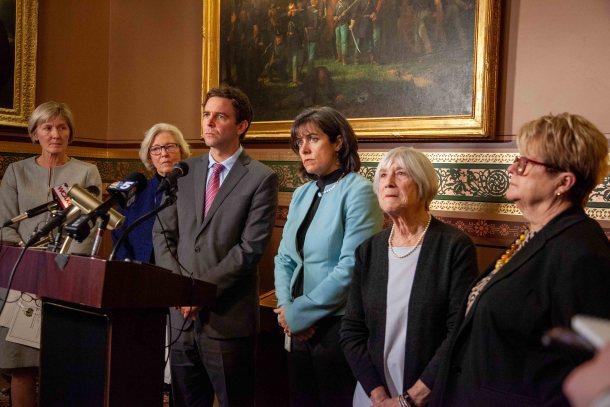
When Scott administration pitched the spending bill last week, officials said it was able to close a roughly $180 million budget gap without making any cuts to “essential services.”
But Toll noted that under Scott’s proposal, some state departments cut their budgets by 3%, and that her committee is still looking at how the governor achieved those savings.
“We were told there’s no critical changes, no programmatic changes, but we want to understand what that 3% fully means,” Toll said.
The Democratic leaders of the Statehouse have expressed concern that Scott’s budget doesn’t directly include additional funding for the struggling Vermont State Colleges System.
Two reports released in June found that state colleges need $30 million in “bridge funding” in the current fiscal year to cover a budget shortfall.
Toll said Tuesday that the estimate for that number is now about $23 million.
The governor has proposed using federal dollars to pay for the bridge funding. But Vermont doesn’t currently have flexibility from the U.S. Treasury to use the dollars for this purpose.
In the House Education Committee on Tuesday, the Scott administration discussed the governor’s decision to not directly include the additional money.
Vermont Finance Commissioner Adam Greshin said Scott isn’t willing to commit additional dollars to the state colleges until the task force, which was appointed in June to make recommendations to improve the sustainability of the system, proposes a plan.
“To the extent that that requires appropriation and requires additional money to be put in, we will be happy to listen,” Greshin said.
“But at this point, we’re not willing to make that commitment until we see a plan.”
The task force released a preliminary set of recommendations this month, and is expected to deliver an update in October.
Sophie Zdatny, the chancellor of the VSC, said that without the funding, the colleges would have to take action that is “comparable to what was proposed back in the spring.”

In April, former chancellor Jeb Spaulding recommended closing three of the state college campuses to keep the system afloat.
Senators also received some good news about the state’s education fund.
As the coronavirus crisis shut down the economy this spring, projections for fiscal year 2021 education fund were that there might be a $170 million deficit.
However, after tax revenue came in well above what was expected in July, the projected shortfall in the education fund is $66 million while the fiscal year 2020 fund reserve is almost completely intact.
Sean Brown, the commissioner of the Department for Children and Families, also briefed a joint Senate and House committee on the Scott administration’s proposal to create online education “hubs” at child care centers for K-6 aged kids.
Brown said there are 40,000 children across the state who fall into that age group who will be asked to do some form of online learning throughout the school year and that out of that number there are potentially 7,000 who could need an additional place to go during the day for online learning throughout the week.
The creation of these “hubs” would be funded by $12 million from the federal Covid-19 relief money given to the state in April.
Through the federal funding, each of the 73 hubs around the state will receive a startup grant of $95,000 to become operational in the first month. After that, each child care center that becomes an online learning hub must charge tuition of $125 per student each week.
“This is truly uncharted territory for us,” Brown said.
Senate Health and Welfare Chair Ginny Lyons, D-Chittenden, said the proposal raises a number of questions that both chambers will have to consider in the coming weeks.
“There seem to be a lot of policy issues embedded in everything that I’ve heard so far,” Lyons said.
