

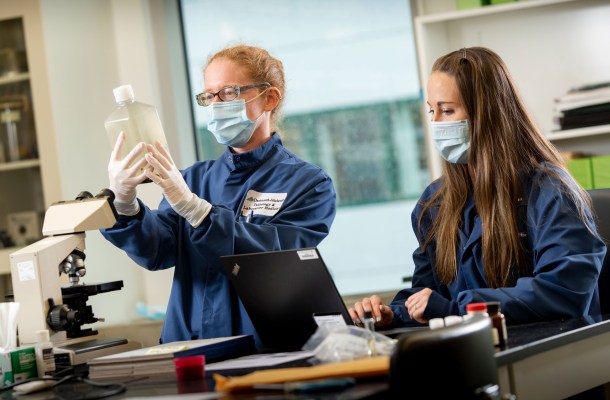
Researchers at Dartmouth-Hitchcock Medical Center are studying a new way to detect the coronavirus — one that’s cheaper, faster, and less invasive than typical diagnostic testing. And it all starts in the sewers.
Jacqueline Hubbard, who has a doctorate in clinical chemistry, and Isabella Martin, a physician who’s a medical microbiologist, have spent the last two months researching the presence of SARS-CoV-2, the virus that causes Covid-19, in municipal sewer systems as a potential way to track the spread of the virus.
About 60% of Covid-19 patients shed the virus in their waste, research shows, meaning that testing sewage for the virus can provide a good indicator of outbreaks at the municipal level — with results coming back about seven days before a city might otherwise see a spike in cases.
The testing method far predates the coronavirus, and was actually a key technique in monitoring the eradication of polio in the United States.
Hubbard and Martin got the green light to begin their research in June, after an anonymous donor read their proposal and decided to provide the start-up funds.
“It’s not necessarily ready to replace any sort of diagnostic testing,” Hubbard said. “But we’re trying to have this be an additional piece of information.”
The project has three phases, though Martin said things are going so quickly that the phases are starting to blend together. First, the researchers honed their testing methods, and established relationships with local sewage-treatment facilities and state public health experts. Next, they’ll test wastewater from three municipalities every day for two weeks to refine their testing methods. And finally, they’ll expand their surveillance across New Hampshire and Vermont to include more sites, including institutions such as nursing homes, prisons and colleges.
The past two months involved a lot of legwork in the lab, Martin said, figuring out how to most accurately collect and test samples from the wastewater. So far, there is no national standard for that work.
It’s tricky, too, Martin said: “The virus is so dilute in a wastewater specimen. So much flush goes down the drain that the concentration of virus is quite small.”
The researchers said that, despite the small concentrations, the samples can tell a lot about a community. A municipality or institution that is regularly testing its wastewater for Covid-19 levels could see a spike coming a full week before they might otherwise identify it, and then strengthen public health measures to keep people safe.
“With this wastewater testing, you get a really good snapshot of your whole community all at once, and you’re getting an idea for trends in viral load in both symptomatic and asymptomatic people, because both can shed virus in the stool,” Hubbard said.
Hubbard said this makes a big difference, because for the most part, people are usually tested only after they develop symptoms, meaning a huge sector of the population is being missed in conventional Covid numbers.
“If you see a small rise, maybe you just remind people to wear their masks and social distance and put out more advertisements,” Hubbard said. “If it’s a really quick, fast rise, maybe you start to shut down some restaurants or malls and go from there, depending on how severe it is.”
So far, the research has focused mostly in the Upper Valley, but Martin said they’ve also reached out to a few bigger municipalities in Vermont and New Hampshire, where caseloads are higher, to get more diverse data for their research.
The federal Centers for Disease Control also recently announced its own national plan to track Covid in wastewater. The new National Wastewater Surveillance System will collect data like Martin and Hubbard’s for a centralized database. Martin said that, unlike the CDC, they hope to bring their work down to a much more local level, taking samples at colleges, nursing homes and any other institutions that might want to track their exposure on a smaller scale.
However, “the logistics of obtaining a sample at a given facility are actually quite challenging,” Martin said. “It might mean popping manholes, and dropping specimen samplers down, leaving them for 24 hours, and then coming back and collecting the sample.”
Martin said she thinks this research will ultimately provide a “powerful tool in our toolbox” for stopping the spread of Covid-19.
“But i don’t think we see it replacing human diagnostic testing anytime soon,” she said.
