

Despite new financial constraints and struggles to adapt to online learning, Vermont college students are still eager to work on their degrees. Nearly 90% of the students who answered a Vermont Student Assistance Corp. survey said they plan to return to school this fall.
Among first-year students who applied for VSAC loans or grants, 90% planned to enroll in college; among returning students who applied for the loans or grants, 85% planned to enroll.
That survey was administered from June 17 through July 2, and the higher education outlook has changed rapidly since then. It’s expected to evolve further as Vermont colleges prepare for move-in days with one eye on the Covid-19 infection rate regionally and nationally.
Right now, college takes many forms. At Castleton University, classes are online-only, but the school offers room and board for students who want to live on campus anyway. The University of Vermont, the state’s largest institution of higher education, offers remote learning, in-person learning, or a combination of the two. Schedules have changed dramatically at all colleges to reduce the risk of infection.
VSAC, a state entity that administers student financial aid, surveyed nearly 5,000 students who applied for financial assistance this year, and received 675 replies. The questionnaires were completed between June 17 and July 2. Then, as now, it wasn’t possible to know for sure which classes would be presented online and which would be available in person.
But the VSAC report, based on that early summer survey, shows that while online-only instruction is not highly popular, students are pressing ahead with their educational plans — especially if there’s a chance to take some classes in person. Nearly 20% of survey respondents said they would delay or cancel their enrollment if they had to take most of their classes online.
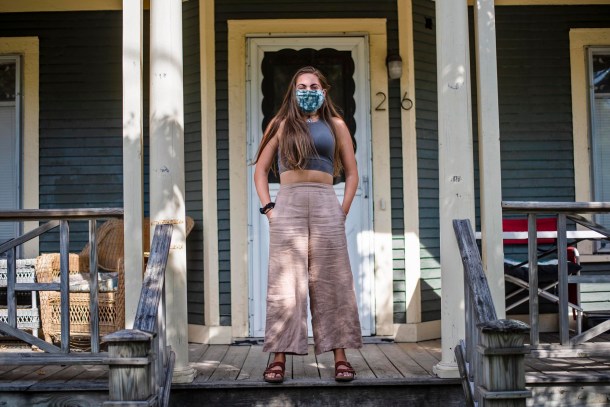
“I want to have as much in-person instruction as possible,” said Tulley Hescock, 20, who is going into her junior year at the University of Vermont. Hescock has chosen to take a mix of online and in-person classes to minimize her risk of exposure to the virus. She said her shared off-campus housing gives her the confidence to venture into some classrooms.
“If I was living in a dorm, I would definitely consider staying home” and taking classes online, said Hescock, whose family lives in Cornwall. The online instruction that UVM students switched to last spring was “a struggle,” she said.
“They hadn’t been set up to be online,” she said.
At Castleton University, expected fall enrollment is down by perhaps 6% to 10%, said James Lambert, associate dean of advancement. He said it’s difficult to compare this year to last, because Castleton last year took students from several nearby colleges that closed. Last fall, 2,400 full- and part-time students enrolled at Castleton. About 1,000 people moved into the dorms last year; this year, about 550 plan to, Lambert said, even though classes are online.
“We are about where we expected to be,” said Lambert. “We have what we consider to be a healthy class. Some colleges or universities are reporting really large declines that can be attributed to Covid, but we haven’t seen it.”
Financial worries
Even more than online enrollment, concerns about financial security are shaping Vermonters’ plans, said Scott Giles, the CEO of VSAC.
Financial concerns were a critical factor in students’ enrollment plans long before Covid-19. But students with three or more Covid-19-related financial “events,” such as a parent’s job loss, were significantly less likely to report that they planned to enroll than students who had zero or one such financial stressor, the VSAC report said.
“Taken together, these findings suggest that the need for campus support and student financial aid will be greater than in previous years,” the authors said.
More than 85% percent of the survey respondents said financial aid is “highly” or “critically” important to their ability to pursue higher ed. First-generation college students, women, and first-year students were significantly more likely to say that, according to a statement released with the survey.
First-generation students — those whose parents don’t have a four-year degree — reported family incomes that were less than half those of students whose parents had attended college, and they were less confident about being able to attend college than second-generation students were, the report said. Female students were less confident about paying for college than male students were, and students of color and independent students were less confident about affording higher ed than were white or dependent students.
Online learning is the only thing that will allow Sidney Bewlay, 21, to graduate from UVM next spring.
“I have a bit of a mixed relationship” with online learning, said Bewlay. She has cystic fibrosis, which puts her at high risk of dangerous complications if she is infected with Covid-19.
“On the one hand, it does take longer,” said Bewlay of online classes. She prefers in-person instruction. “But from a health standpoint, this has made school so much more accessible. When I’ve been sick or have to do treatments or need a doctor’s appointment, it means I don’t have to miss a day or week of school anymore. I can still be in class.
“It’s the one nice part of all this,” she said. “I’m not missing as much physical classroom time or work as I used to.”
Survey update is on the way
The 675 survey respondents came from a randomly selected group that had completed the Free Application for Financial Student Aid form to receive financial assistance for the 2020-21 academic year, VSAC said. They had a mean age of 22, and reported their parents’ adjusted gross income as $97,660. About one-third were first-generation students, and 68% of those who chose to respond to the survey were female. The respondents were 90% white.
VSAC carried out a second survey between July 23 and Aug. 5 to examine changes over time. Those results are not yet available.
Correction: The photo caption in this story has been updated to correct the spelling of Sidney Bewlay’s name.
