


For some Vermont Democrats, Tuesday’s primaries provided suspense and late jubilation in tight races.
But for the Democratic Party’s four incumbent statewide officeholders — Attorney General TJ Donovan, Auditor Doug Hoffer, Treasurer Beth Pearce and Secretary of State Jim Condos — there wasn’t much to stay up late for.
All four candidates coasted through the primary without much effort. Only Hoffer faced a challenger, and he easily beat Rep. Linda Joy Sullivan, D-Dorset, who he may face again in the general election because she received write-in votes for the Republican nomination.
Since being first elected, all four of the lower-tier statewide officeholders have won with little effort. Republicans and Progressives fielding challengers only intermittently.
“Those four offices are, to varying degrees, regarded as less political than others,” said former Gov. Jim Douglas, who served as both the secretary of state and treasurer before becoming governor. “And as a result, the people who hold the offices are generally reelected for as long as they choose to run.”
In 2018, all four of the lower-tier statewide Democrats won with more than 60% of the vote in November, and none of them faced a primary challenge.
Douglas says that Vermont — a state that already favors incumbents heavily (no sitting governor has lost in Vermont since the 1960s) — is even more inclined to keep reelecting lower-tier statewide candidates, “absent some glaring reason to feel otherwise” given their lower profile and less partisan duties.
The trend, though, has left some to worry whether statewide officeholders have their feet held to the fire enough.
“Being a Vermonter, I’ve kind of grown used to this dynamic where [incumbents] are not challenged strongly,” said Sen. Anthony Pollina, P/D-Washington. “But I do think it’s unfortunate that people are not more challenged in primaries because I think it better defines the party and better defines the issues.”
Despite making gains around the state and seeing young progressives knock off several longtime incumbents in Burlington, the state Progressive Party opts not to focus on many statewide races.
“We’re not deferring,” said state Progressive Party Executive Director Josh Wronski. “But we recognize that our path to being a successful party and coming as far as we’ve come — which is one of the most successful non-traditional parties in the country — has not been through challenging every statewide incumbent. It’s been through challenging a lot of local races, state races, and kind of being strategic in where we run candidates.”
The Progs, Wronski said, still hope to push the incumbents to the left on key issues. But, he said, “We don’t focus on just putting any old person up against these higher-office races.”
The Republicans, for their part, have struggled to put up viable candidates in statewide races below the top of the ticket in recent years. This year, H. Brooke Paige — a perennial conservative candidate for statewide office — will clinch the GOP nomination for secretary of state and attorney general.
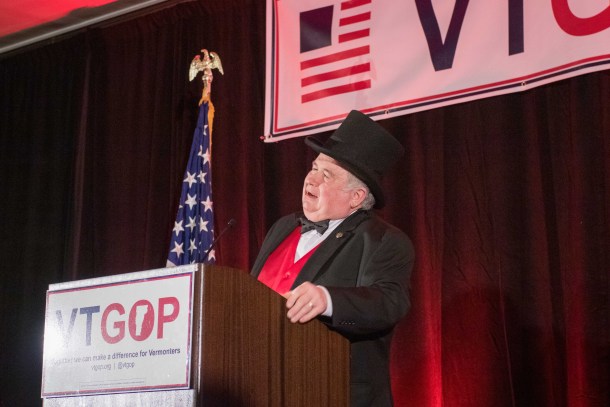
Paige won the GOP nomination in six statewide races in 2018 before withdrawing from five of them. He told VTDigger Wednesday morning that he intends to stay on the ballot in both races he won this year because he thinks Condos and Donovan are vulnerable.
Pearce, however, will face a seasoned opponent in November: former state legislator Carolyn Branagan, who clinched the GOP nomination for treasurer on Tuesday. Branagan previously served eight terms in the House and one in the Senate.
“I was encouraged to run, and I decided that I’d do it,” Branagan said. The encouragement, however, was not from state party officials with whom she’s had little contact.
“I think the fact that there’s been no candidate really taking them on in past elections has to do with the poor organization of the Republican Party,” Branagan said. “The Republican Party has difficulty recruiting anyone, and that’s just a fact of life. There are people out there who could run for statewide office, but they’re not encouraged to do so.”
Paige was initially on the ballot for all four of the lower-tier statewide races, but said he withdrew from the treasurer’s race after Branagan jumped in and from the auditor’s race so that Linda Joy Sullivan could mount a write-in campaign.
Sullivan could not be reached Wednesday morning, but she received north of 80 write-in votes, according to results from the Secretary of State. Paige said he expects her to clinch the nomination and face Hoffer again in November.
“From the start, it was my intention to run for the offices the Republicans did not have a strong, viable candidate that I might consider bending to,” Paige said.
Deb Billado, the executive director of the Vermont Republican Party, said the party does recruit candidates for the lower-tier statewide races, but interest has been.
“I think we’re more focused on House and Senate seats and retaining the governor’s office and picking up the lieutenant governor’s position,” she said, though she conceded that the party “could do a better job with our bench-building.”
Asked if the party backs Paige, Billado said, “we support all of our candidates.”
The lack of competition is not surprising to longtime observers. In Douglas’ four terms as secretary of state, he was challenged by Democratic opponents just twice, in 1984 and 1986. In his four elections as treasurer, Douglas ran as a Republican/Democrat, and faced only third-party challenges.
Douglas’ predecessor in the treasurer’s office, Jeb Spaulding, won with over 90% of the vote in four of his five elections. Pearce assumed the office after she was appointed by former Gov. Peter Shumlin in 2010 when Spaulding became his secretary of the Agency of Administration. She prides herself on not using the job as “a stepping-stone to something else.”
“It gives us a chance to debate the issues,” Pearce said of having a general election opponent. “I think that we’ve got a great agenda, we’ve got a great story to tell. I’m proud of the work we’ve done and I think that that will speak for itself.”

Condos said Tuesday he credits the lack of competition to his non-partisan work in office.
“I’ve done everything in my power within this office — including running the elections — to be as non-partisan as I possibly can,” he said. “Do I run as a partisan? Yes, I run as a partisan. But I really operate the office in a non-partisan way.”
Paige said he thinks Condos’ push for vote-by-mail will make him beatable in November. He faced Condos in the 2018 general election but received under 30% of the vote.
The last major primary challenge in one of the lower-tier statewide races came in 2012, when longtime incumbent Attorney General Bill Sorrell barely held off TJ Donovan, who was Chittenden County state’s attorney at the time. Sorrell, who was mired in controversy during his last years in office, retired four years later, clearing the way for Donovan to run again and win.
“They’ve all done a great job and Vermont generally likes incumbents,” said Democratic State Committee member Tim Jerman. “These people really enjoy the jobs that they do, so several of them are not looking to go higher. And so I think people realize it’s a real uphill struggle to run against them and people are generally happy with the job they do.”
