

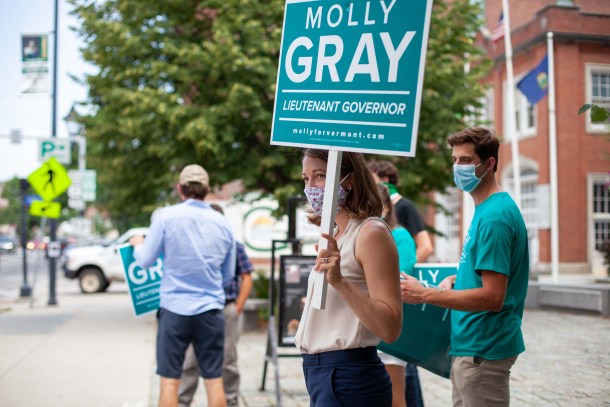
Just after 10 p.m. on Tuesday evening, Molly Gray, the 36-year-old assistant attorney general and political newcomer, won the Vermont Democratic nomination for lieutenant governor.
After she declared victory, Gray made her way to Church Street to meet the gaggle of TV reporters waiting to speak with the first-time office seeker.
“I’m incredibly thankful for the support from Vermonters across the state — in many ways I’m not surprised because we’ve been articulating the issues that Vermonters are facing every single day,” Gray said in a rushed phone interview with VTDigger later that night.
After a resounding win in the Democratic primary, which showed dominance throughout the state and not just in Chittenden County, Gray has her sights set on the general election and becoming the state’s fourth female lieutenant governor.
Former Democratic Gov. Howard Dean, who did not endorse a candidate in the race, said Gray’s strong statewide showing stood out and that it should be a warning to Scott Milne, the Republican nominee for lieutenant governor, not to underestimate Gray in the general election.
“Scott Milne better watch his butt,” Dean said.
Gray received 43.6% of the vote, handily beating a competitive field that included Senate President Pro Tem Tim Ashe (32.9%), former gubernatorial candidate and activist Brenda Siegel (9.1%) as well as Sen. Debbie Ingram, D-Chittenden (8.7%).
“Molly Gray’s campaign was one of the best organized and best funded campaigns by a first-time candidate which I’ve seen in Vermont in a long time,” said Eric Davis, professor emeritus of political science at Middlebury College and longtime observer of Vermont politics.
“I think that’s the main reason she won,” Davis added.
Gray, who grew up in Newbury, carried the majority of towns in the state. The only exceptions were Chittenden County and a cluster in southern Vermont along the New Hampshire border.
However, even in Chittenden County — considered a stronghold for Ashe, who has spent 14 years representing the county in the Senate — Gray was neck and neck with the outgoing Senate leader.
In Burlington, Ashe’s home turf, Gray fell just 1,286 votes short of the longtime state senator’s total.
Dean said the Gray campaign must have known winning the cities and towns of Chittenden County outright was a longshot and must have made a concerted effort to manage the losses and make it up in the rest of the state.

“There’s a lot of Chittenden County politicians who have done well here — they’ve piled up huge margins in the county that is 3-4 times bigger than every other place,” Dean said. “Molly didn’t do it that way and when a politician comes out with her numbers like that throughout the state, you better watch out.”
Dean said it was similar to a strategy he used when he campaigned across the state that he called “shoot the circuit.” Once or twice a week he would drive Rutland to Bennington, to Windham, to Windsor “and then stop in Washington County on the way.”
Seven months ago, Gray entered the race as an unknown but quickly built up a formidable fundraising apparatus which raised $213,680 — more than double Ashe’s total haul — and a strong campaign ground game across the state, buoyed by the support from a number of high profile Vermont Democrats.
Gray received endorsements from former Govs. Madeleine Kunin and Peter Shumlin, along with former Lt. Gov. Doug Racine, Matt Dunne — who ran for governor in 2016 — and many others.
With impressive backing and using her experience in Congress with Rep. Peter Welch, D-Vt., at the Vermont attorney general’s office, coupled with working and living abroad, she built a small but effective campaign team.

Gray’s ground game
Gray’s effort was headed by campaign manager Samantha Sheehan, who along with the candidate took part in the 2020 Emerge Vermont training for Democratic women.
David Kunin, Madeleine Kunin’s grandson, fresh off Pete Buttigieg’s campaign for president in New Hampshire, joined Sheehan, focusing on Gray’s statewide ground game, which evolved with the Covid-19 pandemic.
In the runup to the Aug.11 primary, Freeland Ellis, who ran regional communications for Sen. Bernie Sanders’ 2016 and 2020 presidential bids, also joined Gray in a part-time role.

Racine, the former lieutenant governor, said Gray quickly defined the contest as a two-person race between herself and Ashe, and then outworked her opponents.
“She just has to continue doing what she did, which is present herself as a fresh face — somebody who represents the future of politics in Vermont,” Racine said.
“I think Vermonters are looking for some diversity in their political leadership, and I think they’re looking for younger people and I think that’s her major advantage,” he said. “We don’t have many women in our top elected offices in Vermont and I think folks are looking to diversify our representation at that level.”
Previous women who served as lieutenant governor include: Consuelo Bailey, Madeleine Kunin and Barbara Snelling.
Gray’s political network has also been forged by her connection to Emerge Vermont, and its many graduates in recent years. “Molly was able to tap into that network and that is still going to be very strong for her in the general,” Racine said.
Kunin, who is the only woman to serve as governor in Vermont, has played an integral role with Emerge Vermont. She said Gray was able to overcome the disadvantage first-time candidates face by coming across as authentic to voters.
“I think that’s something people are looking for in politicians. There’s no hidden agenda. She comes across as really being somebody who is in politics for the right reasons,” Kunin said.
While Gray received a resounding victory Tuesday, the political novice did not coast to the primary victory — she had to fend off attacks from opponents throughout the summer.
In July, Ashe critiqued Gray for running a campaign funded by “political and donor elites” and asked why she felt the lieutenant governor’s office was the right place to start her political career.
In debates this summer, Gray answered questions about her residency status and the constitutional requirement that candidates for governor and lieutenant governor “reside” in Vermont for four years before holding the office.
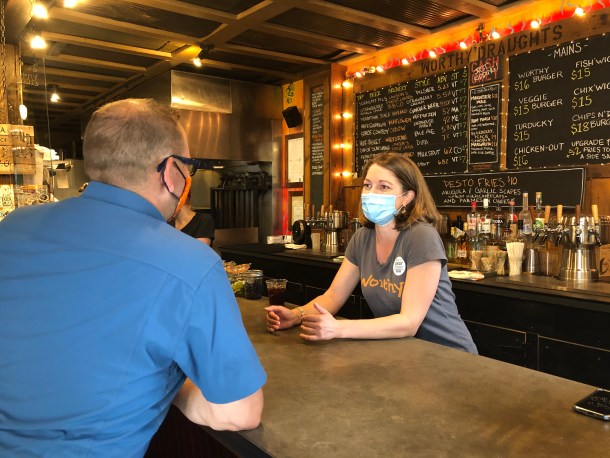
In a VPR-Vermont PBS debate, Ingram targeted Gray’s eligibility, citing reporting by VTDigger that for 15 months between 2017 to early 2018, Gray had lived in Switzerland working for a human rights nonprofit focused on private military contractors.
Gray maintains she legally retained Vermont residency and that she would not be running for lieutenant governor if she were not eligible to do so.
Then, in the final weeks before the primary she was dogged by reports that she had not voted for four election cycles between 2008 and 2018, which drew criticism from Vermonters across the political spectrum.
Milne, her Republican opponent, hasn’t counted out challenging Gray’s residency in court. On Tuesday night, Gray would not discuss how she plans to respond to attacks from Republicans about her decision to not vote for that stretch of time.

“I wouldn’t be running if I wasn’t eligible and I certainly plan to discuss the future of this campaign and the issues at the forefront but probably not more tonight,” she said.
Racine said he is sure Milne will look to exploit this possible weakness and that Gray must have an answer ready.
“It’s a negative attack, but I think it’s a question that she needs to answer. When that came out, it was disturbing to a lot of her supporters and I think she needs to address it,” he said.
Kunin added that Gray should admit failing to vote was an error — which Gray has done, while also saying that she tried to vote — and move the conversation back to what she will do as lieutenant governor.
“She just has to be honest about that and say she made a mistake and that she’s committed to doing a good job as lieutenant governor,” Kunin said. “I don’t think there’s any excuse for that, it’s just a mistake and I think in her answers she has expressed regret.”
Former Republican Gov. Jim Douglas, who is a close friend to Milne, said he has little doubt that Gray is eligible to serve as lieutenant governor, but that her voting history is “fair campaign fodder.”
“Why hasn’t she voted in a decade if she’s now so interested in democracy and participatory politics?” Douglas said.
However, Gray supporters do not see the voting issue as a fatal blow, especially in a presidential election year that will be a referendum on the Trump White House.
“People who want to see Trump gone are going to be voting this year,” Racine said. “If they’re voting for Joe Biden and Kamala Harris, they’re probably going to be looking at who to vote for for governor and lieutenant governor.”
Correction: A previous version misstated the number of female lieutenant governors in the state’s history.
