

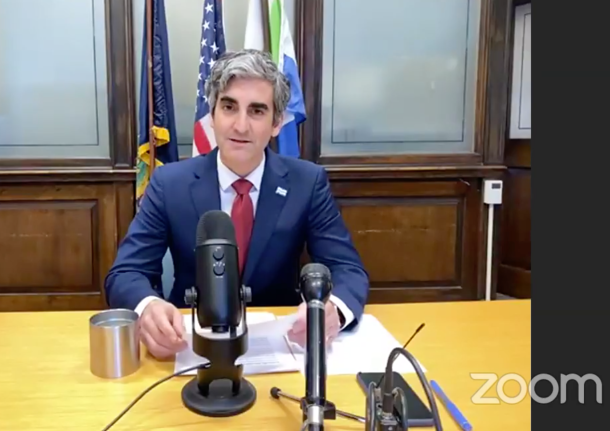
Burlington Mayor Miro Weinberger vetoed a resolution Thursday that would have put ranked choice voting in municipal elections on the November ballot.
It was the first veto he’s issued since becoming mayor.
Weinberger wrote a memo attached to the agenda for Monday’s City Council meeting stating that he would be vetoing the resolution due to its “timing, avoidable expense and substance.” He wrote that he did not take the action lightly.
“This is the first time in more than eight years as mayor that I am vetoing a City Council action,” he wrote. “I am issuing this veto today because the Ranked Choice Voting (RCV) resolution is problematic in multiple respects.”
The City Council passed, in a 6-5 vote on July 13, a resolution that would have put a question on the ballot in November asking voters if the city should reinstitute ranked choice voting for mayoral, city council and school commissioner elections. The effort was opposed by Democratic councilors.
The city had ranked-choice voting in place from 2006 to 2010 for mayoral elections, but the city narrowly voted against the system after the contentious 2009 mayoral election.
In the ranked choice voting system, voters rank candidates in order of preference, and if no candidate receives a majority of votes, the least-popular candidate is eliminated. Votes for that candidate are redistributed to the voter’s second choice, until one candidate receives a majority of the votes.
City Councilor Jack Hanson, P-East District, led the push to get ranked choice voting on the ballot and said he was disappointed in the mayor’s decision.
“I think it’s a very undemocratic decision,” he said. “It’s really unfair to the voters of Burlington. I think it’s really problematic, and it’s a sad day for local democracy in Burlington.”
Weinberger wrote that holding the election would cost the city $45,000, which he said he did not believe would be a good use of municipal resources at this time. The city would have to print a separate ballot for the local measure.
“There is no reason to incur the significant additional expense and staff burden of a special November local election because there is already a budgeted local election planned for March that would achieve the exact same implementation schedule of this charter change if it is approved,” he wrote.
Weinberger also wrote that he believed a community debate over ranked choice voting would be “divisive.”
“An RCV Charter Change this November will divide and distract us at a time when it is critical that the community stay focused on and united in our pandemic response, the multiple other Council declared emergencies, and arguably the most important federal election in the country’s history,” he wrote.
Hanson said that he was curious if Weinberger supports putting ranked choice voting on the ballot in March 2021. He said he questioned Weinberger’s financial explanation, as the city is taking on an additional $10,000 in expenditures on the City Hall Park project.
“If people oppose ranked choice voting, I want them to come out and say it, and I want to have that debate on the merits of the issue, and I want to let the voters decide,” Hanson said. “Coming up with these other reasons to avoid getting into the substance of the debate, it’s not only undemocratic, but it’s also pretty cowardly.”
While the council could override Weinberger’s veto with eight votes, since five councilors voted against the resolution, it does not appear the council will have the votes to do so.
But Hanson said he would continue to push to get ranked choice voting on the ballot. He said he would be pushing for a veto override Monday and if that is not successful, will aim to get it on the ballot in March 2021.
“I firmly believe once voters are allowed to weigh in on it, they will approve it,” he said. “It’s unfortunate that the mayor vetoed the election that would have the most residents weigh in, which is the 2020 presidential election.”
Paul Burns, the executive director of the Vermont Public Interest Research Group, called Weinberger’s veto “absolutely one of the most undemocratic moves by an elected official I’ve seen in the last 20 years.”
“It’s not just that he’s opposing a reform that opens the electoral process up to new voices at a time when they are desperately needed, it’s that he alone is canceling the public’s right to vote on this matter for themselves,” Burns said in a statement. “It is outrageous.”

