

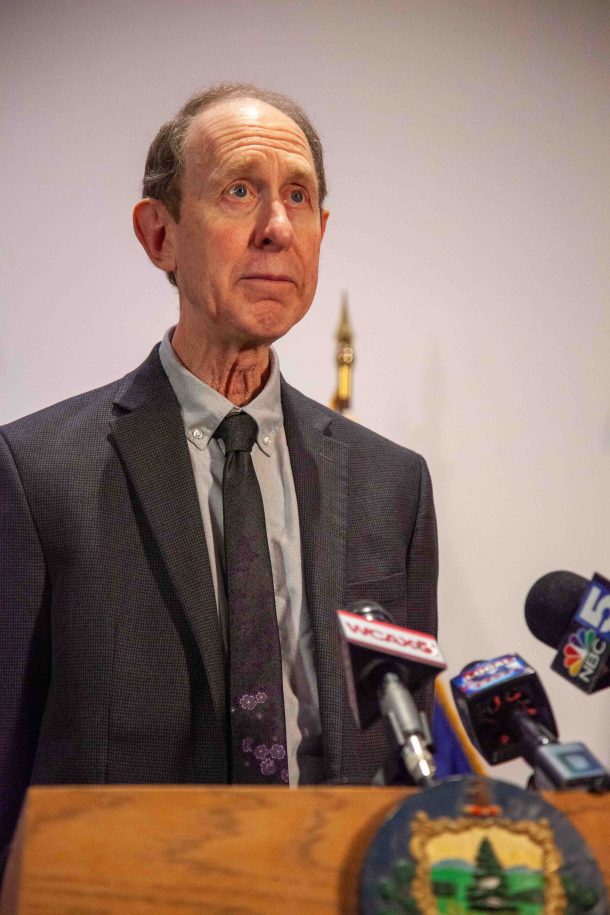
Health Commissioner Mark Levine declared Tuesday that there is no Covid outbreak in Manchester. Meanwhile, the state is trying to figure out what led to test results that previously showed a surge of positive cases.
On Tuesday, the state Department of Health had confirmed only four cases of Covid, out of the 65 who originally tested positive using antigen tests. Forty-eight tested negative in the follow-up testing; all 65 were contacted by the Department of Health and did not report symptoms or spread of the virus, Levine said.
Levine said his announcement was based on regional testing conducted by the state and local hospitals. Only five of 1,613 people in Manchester, Londonderry and surrounding towns have tested positive, Levine said at Gov. Phil Scott’s press conference Tuesday.
The positivity rate in southern Vermont is as low as the rest of the state, Levine said. “Therefore, we do not believe community transmission of Covid-19 is occurred.” The “situation” in Bennington and Windham counties “is not an outbreak,” he said.
At the same time, Gov. Phil Scott described Vermont as a sanctuary in the midst of a national forest fire of rising Covid cases.
Levine’s announcement was the latest twist in a suspected outbreak that initially sparked fear within the community.
On July 13, Manchester Medical Center announced that 35 people had tested positive via antigen testing, a relatively new type of Covid test that provides results within minutes. The antigen tests, which were approved by the Food and Drug Administration in May, are typically accurate when it comes to positive Covid cases, though they may lead to false negatives.
The opposite was true in Manchester. Levine described the number of apparently false positives earlier as “unprecedented.” There was a similar situation in Maine, he added, when people tested positive for Covid-19 with antigen tests.
The Vermont Department of Health only tracks and documents the results of PCR tests, the more common diagnostic nose-swab tests that return results within a couple of days.
Nonetheless, after Manchester Medical Center announced that almost three dozen people had tested positive, shops voluntarily closed their doors and the town postponed its August sidewalk sale.
The state set up pop-up testing sites to run PCR tests to confirm the results and to track the spread of the virus. Those tests confirmed just 7% of the previous positive results.
Levine said the Department of Health is still figuring out the cause of the erroneous results. It could have been due to the way the test was conducted — “the environment, the calibration of the machine, contamination,” Levine posited — rather than the test itself. The inaccurate results may have been partly due to the fact that the Medical Center was testing people without symptoms, Levine said antigen tests are more accurate when patients show symptoms.
If the PCR tests, rather than the antigen tests, were inaccurate, Levine said he would have expected more spread in the community. Contact tracing efforts did not show that the people who tested positive were linked, or had symptoms. With more research, Levine said of the contradictory results, “we’ll learn where the Achilles heel really is.”
Representatives from Manchester Medical Center did not respond to requests for comment Tuesday afternoon. But one proponent of antigen testing in Vermont suggested that perhaps the state’s PCR tests are inaccurate.
Ryan Ferris, CEO of Garnet Transportation Co., has been contracting with Chittenden County employers to provide antigen testing to workers since May. The company has conducted about 800 tests in the last six weeks, Ferris said. Two have been positive — both for the same person.
He said that health officials were jumping to conclusions. “For the Department of Health to jump from ‘Oh, they tested negative to PCR’, to ‘Oh, that test must be bad,’ that doesn’t bear out nationally and it doesn’t bear out over the results of the several hundred we’ve tested,” he said. Ferris worried that the Department of Health would become so cautious so that it wouldn’t make use of all the Covid resources and technology, including antigen tests, available to them.
The state has not taken Ferris up on his offers to help provide testing, he said.
Both Garnet and Manchester Medical Center charge for antigen tests. Garnet charges between $100 and $150 for the company to come to a person’s house; Manchester Medical charges $65 for each test.
Even though the Department of Financial Regulation required insurance companies to cover the cost of the test, doctors or clinics don’t have to file their claims with insurers, said DFR commissioner Mike Piecak. Individuals can pay up front and then get insurance companies to refund them, Piecak said, but the state doesn’t have the authority to force health offices such as a Manchester Medical or Garnet to submit the claims.
It’d be ideal if they did, he added. “We’d like to see as limited amount of friction in the process as possible” for people who want to get tested.
For his part, Levine said the jury is still out on the future of antigen testing in Vermont. State epidemiologists and testing staff are meeting with the Centers for Disease Control and Prevention this week to discuss the contradictory Manchester results.
He urged clinics to halt use of the tests until the state figured out what went wrong in Manchester. Down the road, he added, “I don’t want anyone to think the door is closed to antigen testing.”
Get the latest statistics and live updates on our coronavirus page.
Sign up for our coronavirus email list.
Tell us your story or give feedback at coronavirus@vtdigger.org.
Support our nonprofit journalism with a donation.
