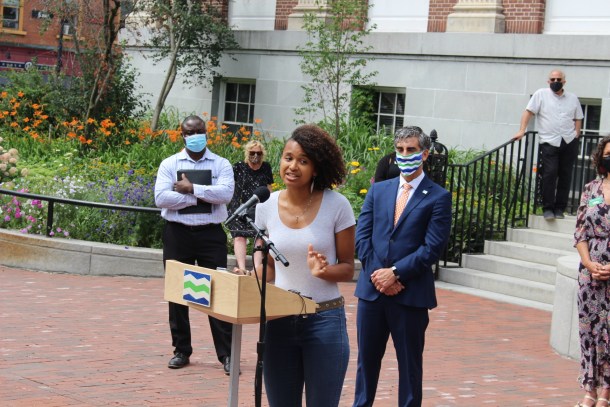
BURLINGTON — City officials and community leaders gathered Thursday to declare racism a public health crisis in the city of Burlington, with more than 30 organizations pledging to take action to fight racism in the community.
Mayor Miro Weinberger made the announcement in front of City Hall Thursday morning, flanked by dozens of community leaders.
“Coronavirus has laid bare for all to see a terrible, longstanding truth of American life,” Weinberger said. “As a result of deeply embedded structural racism, Black and brown Americans experience far worse health outcomes than their white contemporaries.”
The city council voted late last month to reduce police staffing levels, create a community based cultural empowerment center, and provide additional funding to the city’s Racial Equity, Inclusion and Belonging function, among other initiatives.
Mark Hughes, executive director of Justice for All and a member of the Vermont Racial Justice Alliance, reflected on the centuries of racist violence and slavery in the country.
“This is our third attempt at trying to get something right as a nation,” he said. “We are trying to move from a place where folks’ backs are being ridden to a place where we can stand on the shoulders of those same people. There’s hope for the future.”
Hughes thanked supporters of the Racial Justice Alliance for pushing for change in the city, and encouraged the rest of the community to participate in the alliance’s Operation Phoenix initiative.
“There must be a radical redistribution of political and economic power in this nation and in this town,” Hughes said.
The organizations that signed on to the declaration have committed to specific action aimed at eradicating racism within their organizations.
For example, the city will be creating a new Public Health Equity Manager position to work on the city’s racial health equity work, and the school district will review curriculum to ensure it is culturally relevant and anti-racist.
The University of Vermont Medical Center will implement a Workforce Diversity Assessment aimed at increasing recruitment and retention of people of color to its staff and leadership. The Champlain Valley Office of Economic Opportunity will hire a Director of Racial Equity, and the Howard Center will create a data dashboard system to identify health disparities and inform its work.
Other organizations that signed on to the declaration include the Lake Champlain Regional Chamber of Commerce, Champlain College, Cathedral Square, Community Health Centers of Burlington, Champlain Housing Trust, Burton, among others.
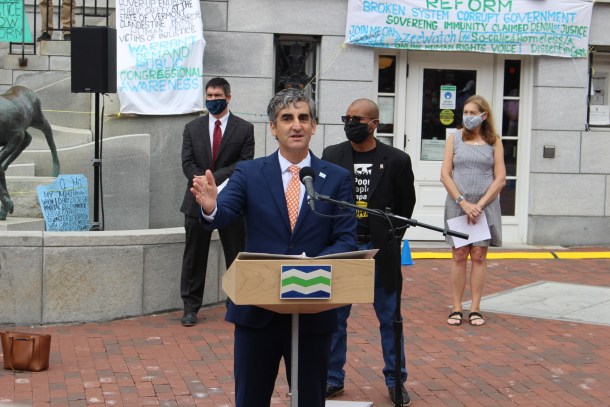
Weinberger said the commitments reflect a community effort to fight racism.
“Our declarations confront this challenge with urgency and substantive commitments to change our practices,” he said. “This work is difficult, and will require sustained focus and energy from our full community to meet the aspiration of being better anti-racist organizations.”
Stephen Leffler, president of the University of Vermont Medical Center, said racism is a public health emergency and that the Black community is disproportionately affected by the coronavirus.
“This is true with other illnesses,” he said. “Coronavirus has just shined a spotlight on the problem.”
Councilor Zoraya Hightower, P-Ward 1, said that racism affects Black Americans in every aspect of American life and every institution.
“Our job is not to be saviors, but to find areas where you have embedded racism in your institution and remove it,” she said.
The council also voted to paint Black Lives Matter on Main Street beginning at 2 p.m. this Sunday, and invited community members to join the effort.