

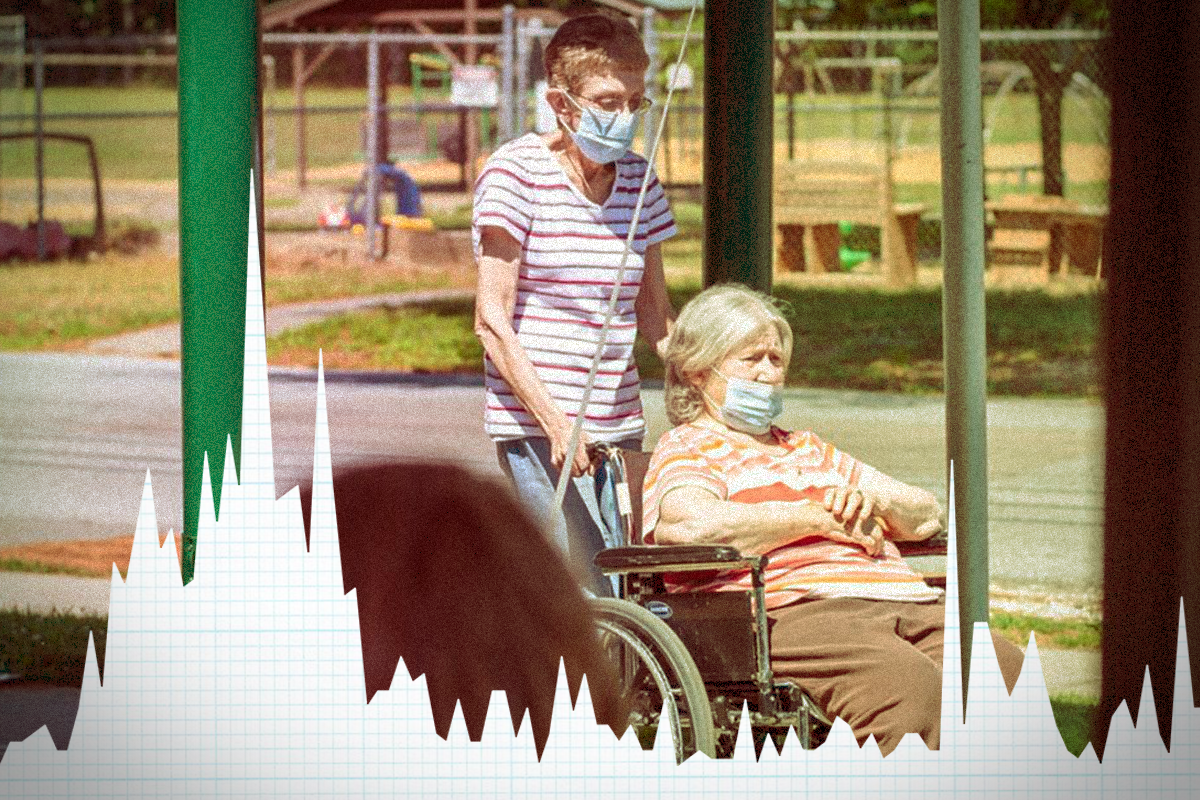
Dick Dodge used to go nearly every day to Berlin Health & Rehab to tuck his wife into bed.
At 3 p.m., the 77-year-old Worcester resident would arrive at the nursing home, where his wife Irene, who suffers from dementia, has lived for the past four and a half years. The couple ate dinner together in the cafeteria. Afterwards, Dick would help Irene get ready for bed, and slip out of the room as she was drifting off to sleep around 8 p.m.
That routine ended on March 12, when Covid arrived in Vermont, and the facility shut its doors to visitors. By March 17, when Gov. Phil Scott’s executive order went into effect, all of the state’s 177 assisted living facilities, nursing homes and residential care facilities were officially closed.

Over the next several weeks, the virus swept through two Burlington elder care facilities; as the death toll mounted, so did the fear of nursing home residents and family members around Vermont. Those who didn’t contract the virus suffered from intense isolation; some were unable to seek medical care or see friends for months. Facilities suffered financially, with increased costs and fewer admissions, as they tried to ward off an outbreak inside the building.
Meanwhile, family members tried to care for their loved ones from a distance.
“This really, really sucks,” Dodge recalled telling members of the family council, where he serves at Berlin Health & Rehab. He said that prognosis applies to everyone at the facility — staff, residents and family members.
But state officials recognize that long-term care facilities will be among the last facilities to reopen, and first to close if cases spike. No visitors were allowed until June 17; residents can currently meet under strict guidelines — with masks, enforced social distancing, no more than two guests, and only outdoors.
As elder care homes across the state gingerly start to reopen, administrators and staff are walking a tightrope: allowing visitors and social events for residents, while still protecting the state’s most vulnerable population. The facilities, which were hit hard financially, are struggling to regain their footing, while preparing for widespread coronavirus testing and surveillance, and planning for a possible next wave of the virus.
Meanwhile, families are facing a similar conflict. They want to see their loved ones, and struggle with anxiety about the increased risks that loosened restrictions will bring.
Last week, Dick Dodge had his first outdoor visit scheduled with his wife. He met with Irene in the courtyard of the Berlin facility, with a staff member on hand, and masks for everyone involved. He adhered to the rules: No hugging, kissing or touching.
It’ll be months, perhaps years, before he can embrace his wife again and put her to bed as he did before.
“Like everybody says, it’ll never be the same,” Dodge said.
High cost in Vermont’s early hotspots
On March 5, just as the novel coronavirus was appearing in Vermont, Scott buttoned down elder care homes, barring visits from family members, requiring personal protective equipment for staff, posting signs, and screening residents and staff. State officials suggested that facilities set aside a separate wing for Covid patients, and many nursing homes stopped admitting new residents.
Elder care homes across the country became hotbeds for the spread of the virus, accounting for 43% of the nation’s Covid-19 deaths, the New York Times reported in June. Vulnerable residents in close quarters, a shortage of protective gear for staff, and limited testing for residents have led to increased transmission and more deadly results.
In Vermont, the impact of the pandemic on elder care homes was concentrated in two Queen City facilities — Burlington Health & Rehab and Birchwood Terrace — that experienced outbreaks affecting dozens of staff members and residents. The two facilities reported a combined 32 deaths, more than half of the 56 Covid deaths statewide; 21 died at Birchwood, 11 at Burlington Health & Rehab.

Seven other facilities in Vermont reported Covid cases among staff or residents, but most elder care homes escaped unscathed.
Even in places without a positive case, residents have been staying in their rooms, with the same regimen of private meals and virtual activities. And all of the state’s facilities were hit hard financially, even if they have managed to keep out the virus.
Vermont’s 36 nursing homes will likely lose a combined $30 million between the start of the pandemic through December 2020, said Laura Pelosi, head of policy and regulatory affairs for the Vermont Health Care Association, the trade group for elder care homes. That figure includes lost revenues and additional expenses. Pelosi hasn’t yet tallied the cost for assisted living and long-term care facilities; with fewer residents and less income across the board, all types of facilities have seen losses, she said.
When the virus hit, many homes stopped accepting new patients. Many nursing homes, including Birchwood and Burlington Health & Rehab, provide short-term rehabilitation stays for patients who require care after a surgery, say, or a hip replacement. Those procedures were halted, except in emergency cases. The influx of new residents slowed to a trickle.
Those who were accepted had to quarantine for 14 days, requiring extra staff help, a single room, and personal bathroom, which was impossible in some facilities.
The Gill Odd Fellows Home, for example, has 46 beds but a census of just 29, said director of nursing January Reichert. Fourteen of those beds are set aside as a separate wing for Covid patients, she added. They’ve sat empty since March.
That’s made a financial dent. “We pay $18,000 a month in bed tax to the state, and to have 14 beds empty …” Reichert said, trailing off.
At Birchwood, the 144-bed facility has 94 residents in late June. Burlington Health & Rehab has just 55 patients in its 126 beds, according to spokesperson Lori Mayer. The facility is staffed for 77 residents.
“That is a significant financial impact,” Pelosi told the joint health care committee last month. “They currently don’t have Covid-positive patients at Burlington Health & Rehab, so you know, there’s much more that needs to be done” to increase revenue and patient numbers, she said.
Meanwhile, costs have increased. Facilities are paying for personal protective gear, which is hard to find and expensive. The cost of a package of 1,000 gloves has risen from $34.72 a package to $110, according to Melissa Jackson, CEO of the Vermont Veterans’ Home in Bennington.
There are other unforeseen expenses as well, such as iPads to allow seniors to video chat with their families. LCB Senior Living, which has three locations in Vermont, bought a pricey electrostatic cleaner that can destroy viruses and bacteria, according to spokesperson Ted Doyle.

Nursing homes are paying staff more, in part because there are more positions to fill and fewer people stepping up to fill them. At the Veterans’ Home, overtime for agency nurses rose from about $190,000 in the 2019 fiscal year to about $350,000 for 2020, according to Jackson. Staff costs are up 25% at the facility as well, largely because they’ve had to hire more travel nurses, which are more expensive than full-time employees.
The state already suffers from a shortage of workers, but with no child care available and health risks for workers, “This was kind of the perfect storm,” said Alecia DiMario, spokesperson for Birchwood Terrace.
Birchwood offered ‘thank you’ pay to staff, roughly $45 per shift, DiMario said. The company also provided housing for six staff members who couldn’t be at home due to the risk of spreading the virus.
Higher risk
As elder care homes closed their doors to new residents, families have shouldered the burden of caring for aging loved ones. Liz Gamache, a St. Albans resident, scrambled to find care for her aging parents, after her mother returned home after a rehab stay at Birchwood Terrace.
Gamache had already lost her mother-in-law, who had also been at Birchwood, to Covid-19.
So on March 24, Gamache left her two sons and husband and moved in with her parents. She scheduled telemedicine visits for the pair, and learned how to inject insulin via a Youtube video. When her mother came down with Covid — she presumably was exposed at Birchwood, Gamache said — Gamache confined her parents to separate parts of the house.
She ultimately provided 24/7 care for two months. “It was hard to keep up with,” she said.
It wasn’t until late May that Gamache moved her parents into assisted living. She thinks she’s happy with the choice, but it’s hard to be sure since she can’t visit, she said. Her father-in-law, who’s about to turn 90, continues to live on his own.
“It’s a hard decision to make anytime,” she said, of the residential options for elderly parents. “In a pandemic situation, it makes it much more complicated.”
Covid-19 has forced family members and those seeking care in elder care facilities to ask a whole new set of questions, said Erin Roelke, director of care & service coordination for Agewell Vermont, where she helps advise older Vermonters and their families. “They want to know, is it safe, how will I be safe while I’m there?”
Covid has brought competing pressures for those deciding whether to age in place at home or to join a facility, Roelke said. Some had heard about the outbreaks in Birchwood Terrace and Burlington Health & Rehab and were worried about Covid-19 exposure, she said. Others have wearied of months of social isolation at home alone and are eager for a more social environment, or have realized their need for help with grocery shopping and other errands, she said.
Gloria Kravetz received excellent care at Birchwood during the pandemic, according to her daughter Amy Saunders. But in the case of a second wave, Saunders said she hoped the state would allow elder care facilities to open up to occasional visitors.
Her mother, who has dementia, may not have much time left, she said.
“I was anxious about her getting Covid…and thinking that she’s suffering without me being there,” Saunders said.
It’s been the major lesson she’s gleaned from the pandemic: “Just really being mindful and present when you’re with your loved one in the time you have together,” Saunders said. “We need to slow down and do the things that are meaningful.”

Predicting an uncertain future
As the number of Covid cases has decreased statewide, elder care homes have cautiously started accepting new residents — with a host of stipulations. For instance, the Residence at Quarry Hill in South Burlington requires that new residents be symptom free for 30 days, get two Covid tests, and then self-isolate for two weeks upon arrival.
On June 17, Scott took the first steps to allow visitors at long-term care facilities. The Centers for Medicare and Medicaid Services has issued national guidance with a four-phase gradual opening.
Each facility gradually loosens restritctions on its own timeline, depending on the spread of the virus in the nursing home and in the community, availability of tests and protective gear, and staffing levels.
A full reopening, with group meals and an open door to visitors, likely won’t happen until there is a vaccine for the coronavirus, said Doyle from LCB Senior Living.
The Department of Health has ordered testing at all of the 36 nursing homes across the state, according to Deputy Commissioner Tracy Dolan. CMS has agreed to pay for the tests. Starting in early July, someone will test staff every other week, and all residents at least once before September.
The Department of Health is still deciding who will conduct the tests and how quickly they can provide the results. Dolan said her colleagues are also developing a similar plan for assisted living facilities and residential care homes.
“We think the facilities have been doing really well,” she said, adding that the state had instituted “really restrictive policies.” Now, with the restrictions loosening, “There’s never no risk. We think it’s a manageable risk.”

Aftermath, and preparing for a surge
Many nursing homes are still recovering from the first wave of Covid as they are preparing for what’s next. Birchwood has offered grief counseling and relaxation classes for its staff, said DiMario, as well as creating an employee assistance program that will cover the costs of mental health therapy, or even legal or financial aid for staff.
In the flurry of caring for residents with the coronavirus, “we were just here, we didn’t have time to process,” DiMario said. “The realization really hit when we were considered Covid clear: …We had a lot of personalities that made up our family and some of those personalities are no longer with us.”
Jackson, of the Vermont Veterans’ Home, said she expects that she may have to reimpose restrictions if there is an uptick in cases. Covid has brought greater focus on cleaning and sanitizing, a change that will likely be permanent, she added.
Facilities across the state are stocking up on personal protective equipment, medical supplies, as well as extra food and water, in the event of an outbreak, said Doyle, the spokesperson at LCB Senior Living. They’re also analyzing income streams, and figuring out how to ensure the business model is sustainable, even if Covid remains a reality for years.
People “are going to assess a community like ours much more carefully before they move in,” Doyle said, adding that the concerns around safety mean they’ll be opening more slowly than other facilities.
That emphasis on safety has been a relief for Justin Lawliss, a 32-year-old St. Albans resident, while he’s been unable to check up on his grandparents living in the Montpelier assisted-living facility Westview Meadows.
His grandparents, who are 89 and 92, have trouble talking on the phone, and don’t have a computer to video chat. But the staff at Westview stop by regularly, and provide plenty of groceries, Lawliss said.
“This plays a major role in keeping them mentally healthy, as they get to see familiar faces daily,” he said. “It gives me peace of mind with them not being home by themselves.”
