BURLINGTON — School Superintendent Tom Flanagan said Tuesday that the district is planning to open on time this fall, after instituting precautions aimed at limiting the spread of Covid-19.
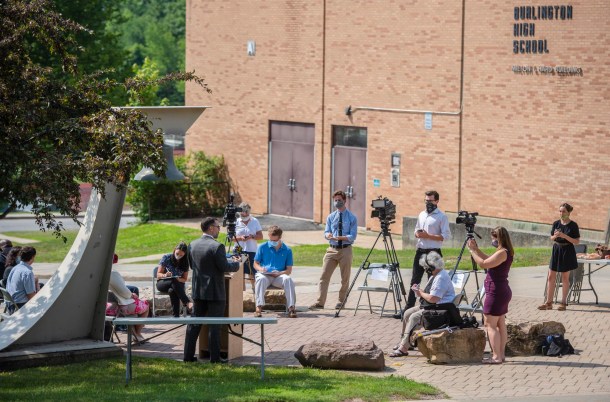
Flanagan, who assumed his new post July 1, held an introductory press conference at Burlington High School where he said that the district was considering an “A/B” schedule. Under that plan, half of the students would be in their classrooms two days a week and the other half would be in school two other days.
The district is on track to be open Aug. 26 for the first day of school, Flanagan said.
A vast majority of parents expressed support for returning to school in a limited capacity in a recent survey, Flanagan said. More than 1,200 families and 500 educators responded to the district’s survey about reopening, Flanagan said, and town halls next week will offer the chance for additional feedback.
“People are really reluctant to come back to school in full, because we know we have to adhere to social distancing guidelines in addition to mask-wearing, handwashing and those other pieces that are very important,” he said. “We need to make sure we have space in our buildings to distance.”
Flanagan comes to the district from Providence, Rhode Island, where he was the district’s chief academic officer. He is replacing Yaw Obeng, who left the district after 5 years and is now the superintendent of a school district in Kansas City.
School districts across the state are planning strategies for reopening this fall amid the ongoing pandemic. Flanagan said Burlington is considering steps to try to ensure that the virus does not spread in city classrooms.
Schools will be cleaned frequently and have multiple entrances staffed with health checks as students arrive at the start of the day, he said. The district will also attempt to keep students together in pods and limit their engagement with those they do not interact with regularly, Flanagan said.
“In some ways, school becomes a lot more like a one-room schoolhouse where you are in your classrooms a lot,” he said.
Students will take outside breaks and eat in their classrooms — not the cafeteria, he said.
Nathan Lavery, the district’s executive director of finance and operations, is leading the reopening task force.
Flanagan also laid out three priority areas for his first three months as he starts his tenure leading the district — equity, engagement and deep learning.
The district will hold race and equity leadership workshops with principals, will continue its focus on restorative justice practices and will host a book study, Flanagan said. The district has also realigned staff to create an office of equity and will review its special education programs, he said.
Flanagan said the district was going to prioritize community engagement and its partnership with the teacher’s union. Victor Prussack, the district’s achievement gap leader, will be reassigned to lead the district’s engagement work, Flanagan said.
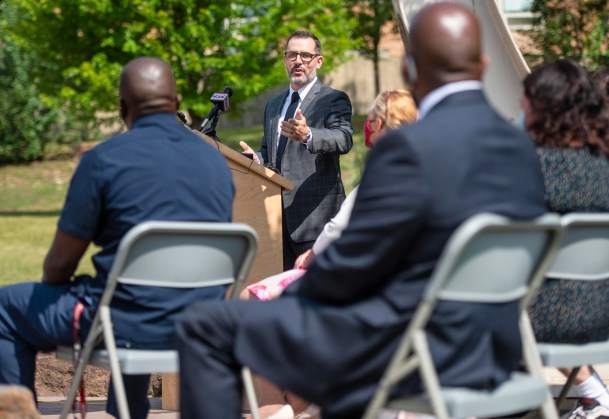
Flanagan said he will be hosting a series of living room chats, which will likely be virtual.
“The idea is to get out in a smaller group with a smaller group of people and for us, as district office leaders, to get into the community and talk to people about what their experience is, and really have a more intimate setting,” he said.
Flanagan said that he and his team would spend significant time in the schools. The district is also working on a professional learning plan, he said.
In the past month, more than 1,000 participants in municipal meetings have echoed the demands of the Vermont Racial Justice Alliance, which includes removing officers from the city’s schools.
The school board voted late last month to continue the school resource officer program during the upcoming academic year. The district has set up a task force to review the future of the program.
Flanagan said that he believed the district’s Memorandum of Understanding with the police department was more progressive than other cities. Since the funding for the SRO program comes out of the city budget, Flanagan said he wanted to preserve that funding source.
“We want to make sure we don’t lose the pieces of that work that are important and keep our schools safe, and we also want to hear from people about what they want,” he said.