


Wendy Mackenzie, the owner of Everlasting Herb Farm in Peacham, got up at 6:30 a.m. Monday to prepare for the 8 a.m. launch of the state’s new business grants program, which is set up to transfer about $150 million to companies that have lost money as a result of the Covid-19 pandemic.
Some 2,200 businesses had applied for the grants by 5 p.m., in a process that received generally positive reviews on its first day. But Mackenzie, who sells her products as a wholesaler to the Vermont Country Store, was prepared for the worst.
Her application for pandemic unemployment assistance was caught in the Department of Labor logjam this spring, she said, and she still hasn’t received a check for a claim she started in May. Mackenzie feared the state’s new grant program would run out as quickly as the money ran out in the first round of federal Paycheck Protection Program loans.
“I was terrified, because they said they had a finite amount of money, and I remembered from previous news stories where the money ran out pretty quickly because the big businesses were gobbling up a huge chunk of the pie,” said Mackenzie.
But things went smoothly with the emergency economic recovery grant program, said Mackenzie, who watched a state webinar about the application process last week and then spent an hour and a half online on Monday filling out her application with the state Agency of Commerce and Community Development.
Other business owners reported a straightforward application process as well.
“I will give the Tax Department credit for how easy it was to get through today,” said Keith Paxman, who co-owns the Cornerstone Group, which has three restaurants in Barre and Northfield. “I was quite impressed with that. It really was flawless.”
Businesses are eligible for grants if they have lost at least 50% of their regular income in a single month of the first half of 2020, and if they have at least one full- or part-time employee. The exception: women- and minority-owned businesses without any employees are also eligible for grants. Grants are based on 10% of 2019 annual revenues, and are limited to no more than $50,000.
Well aware that applications would be considered in the order they were received, and that the money was expected to run out before all Vermont businesses had received requested grants, thousands of Vermonters were similarly ready to go with their documents on Monday morning.

By 5 p.m. Monday, about 1,200 people had filed with the ACCD – which is taking most general business applications as well as applications for women-or-minority-owned businesses with no employees – and about 1,000 with the Tax Department, which is processing applications specifically for businesses such as restaurants, bars, lodging, retail, and entertainment. State officials expect they will eventually receive several thousand applications.
“We’ve gotten some positive feedback from business owners who said it was a relatively smooth process,” said Tax Commissioner Craig Bolio, noting that the average applicant spent 10 minutes filing an application. “We have a call center,” he added. “We are happy to help.”
Jonathan Cooper, a community and economic development specialist with the Bennington County Regional Commission, said local businesses were able to get through on the help line and heard back from ACCD staff with help in filling out the applications.
Business consultant Leo P. O’Reilly, who helped clients submit 32 applications on Monday, said the Tax Department returned a call within 20 minutes to answer a question about an application.
“It has actually gone fairly smoothly for such a fast rollout,” he said Monday afternoon. “We anticipate that it will be oversubscribed and I would not be surprised if at this time tomorrow we are hearing all the funds have been allocated.”
The grants are part of a $600 million Covid-19 relief package that Gov. Phil Scott signed into law over the last few weeks — using money that has come to Vermont as part of the $2 trillion federal emergency stimulus measure signed by Congress in March.
Vermont’s $1.25 billion share of that federal measure includes $300 million for the health care industry, $35 million for farms, $20 million for broadband expansion, and about $150 million in grants for businesses.
The state is expected to lose more than $200 million from the coming year’s budget because of the pandemic and its impact on the economy.
Gov. Phil Scott has said that lawmakers should have acted more quickly on moving the business grants, and should have made more money available specifically to small businesses. Legislators will return in August to craft a budget covering the last three quarters of FY2021, as well as doling out available federal aid.
Paxman, the restaurant owner, criticized a provision in the grant program that limits groups of businesses — like his — that operate under one federal tax ID number to only one grant. Businesses that use several EINs can apply under each number.
“I just don’t get how that is equitable,” said Paxman. “My needs are just as great, but I structured our corporation differently.”
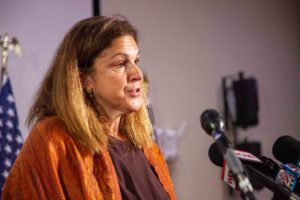
Economic Development Commissioner Joan Goldstein said she had heard from other business owners about that issue. “There was really no way to get ahold of someone’s entire ownership structure, no easy way to ascertain,” she said.
ACCD has also heard from business owners unhappy with the exception made for women and minorities. Paxman said he was fine with that one.
“Absolutely,” he said. “I’m supportive of those movements.”
The money includes $70 million in grants through Act 115 and an additional $96 million through H.966, which will be administered by ACCD and other agencies including the Agency of Human Services, Agency of Administration, and Agency of Agriculture, Food and Markets.
There is money set aside for arts organizations as well.
Goldstein said applicants will start hearing back from the state in a few weeks. Staff from the Vermont Economic Development Authority and the Department of Financial Regulation are helping ACCD process applications.
“If each person does 10 grants a day, we could get through 500 grants a day,” Goldstein said. “We’re all hands on deck and we’re going to do our darnedest.”
Mackenzie said she made about 60% in the first six months of 2020 compared to the first six months of 2019. Her sales 11% in June compared to June 2019. It was her worst month ever.
“It’s depressing,” she said. “I really wanted this to be the year I grew my business.”

