

Adele McClure may be a young professional of color in Virginia, but her schooling on race was no different than what most students receive in the nation’s second whitest state of Vermont.
“All we learned was slavery is bad,” she recalls, “and we moved on.”
But that’s changing, McClure told Green Mountain teenagers plugged into the first-ever online program of the Governor’s Institute on Global Issues and Youth Action, which proved her point by offering a 10-day immersion into issues of identity.
“People who have marched in the civil rights era talk a lot about how this is the first time they’ve seen so many white people with them,” said McClure, who grew up in poverty and periodically homeless, only to become executive director of her state’s legislative Black caucus. “I am very, very hopeful about where we go from here.”
The annual institute thought it had faced its biggest change last year when it moved from its nearly three-decade location at Brattleboro’s World Learning to Putney’s Landmark College. Then the Covid-19 pandemic closed campuses statewide, prompting organizers to turn to the video-conferencing platform Zoom.
“We thought we were going to have 15 students, and we got 30 plus Vermonters and another dozen from elsewhere,” institute director John Ungerleider says. “We’re doing our best, and they’re into it.”
Changing times mean changing topics. Last year, with 2020 presidential candidates swarming neighboring New Hampshire, everyone wanted to talk politics. This year, McClure was one of several speakers answering racial justice questions sparked by the recent Minneapolis police killing of Black resident George Floyd.
Kesha Ram, a former Burlington state representative at age 22 and current candidate for Chittenden County state senator at 33, introduced herself as a rare commodity. It’s not just because, born to a Jewish mother and Hindu father, she’d be the first woman of color in the Vermont Senate. She noted only 5% of all Americans in elected office are under 35 and only a quarter of that number are women.
“We need more women in office, we need more young people in office, we need more people of color in office,” Ram said. “We need more elected officials to reflect who exists in this country.”
Greater diversity, she argued, leads to greater democracy.
“If you keep trying to pass laws, say about policing, and you don’t know what it’s like to be arrested, say like I was at the age of 13, and how traumatic that could be and how common that experience is for people of color, you’re likely to miss a lot of things,” Ram said.
“If you have legislators asking what’s the best way to attract young people into the state, they might give you three to five minutes to speak before their committee, and then you have a lot of older people who end up being the ones making that decision,” she added.
Windham County NAACP President Steffen Gillom told students he was surprised when he moved to Vermont by the lack of advocacy organizations for people of color.
“Here in supposedly a very progressive state,” he said, “there was nothing but a whole lot of white people saying, ‘Look at how liberal we are.’”
So Gillom founded a local branch of the nation’s largest civil rights organization and is a recent graduate of its NextGen leadership training program.
“I thought that I couldn’t make change in a sustainable way all by myself, and I then did,” he said. “My big hope for the future is I see a lot more Black and brown political representation in Vermont.”
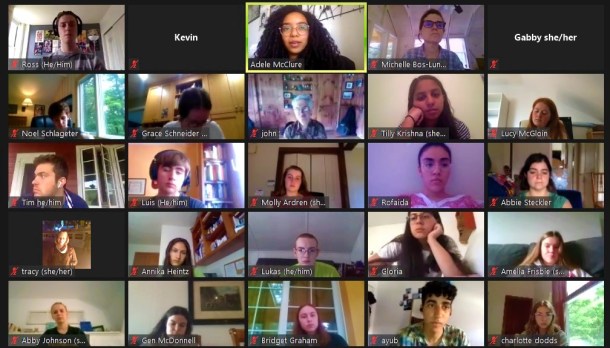
The Global Issues and Youth Action program is one of eight online offerings — ranging from the arts and astronomy to engineering and entrepreneurship — that the nonprofit Governor’s Institutes of Vermont is holding for 250 students.
“We built these not knowing whether people would come, and we’ve been thrilled with the turnout,” executive director Karen Taylor Mitchell says. “Our faculty has risen to the occasion, and students are engaged, excited and embracing the challenges.”
Occasional technical glitches haven’t fazed attendees. Global Issues and Youth Action staffer Abbie Steckler noted students usually cocooned themselves with equally curious peers for more than a week on campus, only to face a bumpy return to the rough-and-tumble real world. The online offerings, she said, help bridge the gap.
“Most people have to balance life and working on these issues, so I think this is really good practice,” Steckler said. “There are always going to be communication problems, whether language barriers or other issues. Together we’re learning how to best talk with each other so we can take these skills forward into the new post-Covid world.”
Williston 16-year-old Carmella Martone concurred.
“It’s really been amazing,” she said, “to see how we can all come together.”
