

The renewable energy industry has taken a big hit from the Covid-19 shutdowns and from an accompanying drop in consumer confidence. Nearly 600,000 people who work in the clean energy sector nationwide have lost their jobs since the crisis began in March, according to several renewable energy groups.
“I don’t know any company that provides energy services to residential customers or that does manufacturing in Vermont that has not had employment reductions and layoffs,” said Olivia Campbell Andersen, executive director of Renewable Energy Vermont, which has three employees working reduced hours.
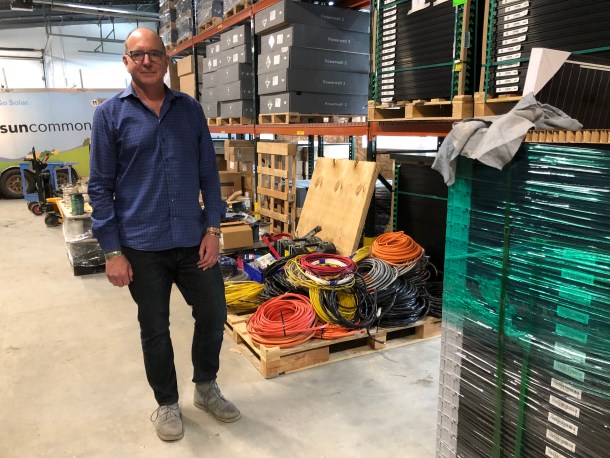
Among those in Vermont who have lost their jobs in the industry are 28 people who were furloughed from SunCommon, the Waterbury solar installer, in May and will not be returning to work. Those workers received health insurance until the end of June.
SunCommon Co-President Duane Peterson said June 29 that the company cut the jobs, 20 of them in Waterbury and eight in New York’s Hudson Valley, after two months of closure and then a lower-than-expected revenue forecast for the rest of the year.
“When the government mandated we shut down construction of clean energy projects, our revenue evaporated,” said Peterson, whose company received a Paycheck Protection Program loan this spring for $2.6 million. “We had to shrink the business to make sure we would survive.”
Analysis of unemployment data released in May shows that 594,000 U.S. workers in clean energy jobs, about 18% of that industry’s workforce, applied for unemployment insurance benefits in April and May, according to the American Council on Renewable Energy. ACORE worked with industry groups Environmental Entrepreneurs, or E2; E4TheFuture; and BW Research Partnership on its report.
The groups said in a statement that clean energy before the Covid-19 crisis was one of the biggest and fastest-growing employment sectors in the U.S., with 10% more jobs at the end of 2019 than in 2015. The sector employed 3.4 million people, the groups said. It called on Congress and the Trump administration to take quick action to support the industry.
“If nothing is done, the report forecasts that 850,000 clean energy workers will have filed for unemployment by June 30,” the groups said. “A loss of that magnitude would mean that one out of every four clean energy workers employed at the start of 2020 will have lost their jobs in just six months.”
Peterson said the fast-growing 8-year-old SunCommon had built its marketing on a community organizing approach, where information about solar installations was passed from person to person through gatherings and events. The company produced a climate action film festival this year. Many of the people who lost their jobs at SunCommon in May worked in digital marketing, he said.
“It was very well-received, novel and successful,” Peterson said of the marketing. “Well, that approach is kind of illegal now.”
SunCommon has offices in Waterbury and in Rhinebeck, New York, where the company acquired a business in 2018. The company focuses on residential solar installations, electric vehicles and power storage. After the layoffs, it now has 150 employees.
Nationally, more cuts expected
The 3% drop in clean energy jobs in March more than erased all of the job growth achieved industrywide for the entire year before, said the BW Research Partnership in Wrentham, Massachusetts, which also issued a report on the impact of the Covid-19 shutdowns on the clean energy industry.
“Unfortunately, this only captures the initial impacts of the Covid-19 crisis and does not include many temporarily furloughed or underemployed workers; job losses in clean energy will continue to grow into the coming months,” the report said.
A broad set of challenges
The industry’s problems aren’t all related to Covid-19. Tariffs on solar panels and on the steel used to support them and the stepping-down of a federal tax credit for solar installation are also hurting the industry, said Chad Farrell, the founder of Encore Renewable Energy, a Burlington company that develops, finances, permits and carries out construction management for large-scale renewable energy projects in several Northeastern states.
“Even prior to Covid, the market was challenged based on federal policy that has really been sort of supporting the fossil fuel industry and the coal industry at the expense of the burgeoning renewable energy economy,” Farrell said. He added that Vermont policy also hinders growth at Encore.

“Here in Vermont, we have project size limits that are just too small to be cost-effective,” he said of the company’s community-scale projects. “We have outdated legislation and regulatory policy and we’re still dealing with what everybody refers to as grandpa’s grid, trying to plug in 21st century energy generation technology to a grid that is over 100 years old.”
The state is also taking a new look at the reimbursement for net metering, the payment Vermonters can now receive for generating electricity, with the idea that this rate should be cut almost in half.
“If we were solely involved in the Vermont solar market, we’d be struggling mightily right now,” Farrell said.
Energy efficiency is big business in Vermont
Campbell Andersen estimated there are 500 companies in Vermont that build or install renewable energy, provide energy efficiency upgrades, or work on energy-efficient transportation and energy storage. An REV survey shows these companies saw a 40% drop in business after mid-March, when Gov. Phil Scott declared a state of emergency and ordered the closure of non-essential businesses, she said.
Even as construction was gradually allowed to begin again, starting in April, companies that install residential solar continued to experience a much bigger loss than those that install commercial projects, Campbell Andersen said.
“That has to do with comfort in terms of folks having work done inside their homes, consumer confidence in the economy, and the ability to get financing,” she said.
Paul Lesure, who started his Williston company Green Mountain Solar three years ago, said he installed 700 kW of solar last year, and expects to do about the same this year. Lesure, whose company has grown to 15 employees in that three years, furloughed almost all his workers in March, but has since brought them all back and hired two additional installers.
As a member of REV’s board, Lesure knows he’s lucky his company hasn’t suffered more.
“I guess I’m a bit of a unique story in that we have been small and growing and aggressive,” he said. But “a lot of these factors are still worrisome for me,” he said of changes to solar generation incentives and other factors.
Peterson, who now has 150 people working at SunCommon, said he’s hopeful about the future because concern about the environment hasn’t abated despite the focus now on Covid-19. He also sees a need for more energy storage.
“As resilience or independence become more important in this strange new world, lots of people are interested in solar plus storage to protect themselves from whatever the hell is going on out there,” he said. “There are some aspects of all of this that endure and allow our business to continue.”
