

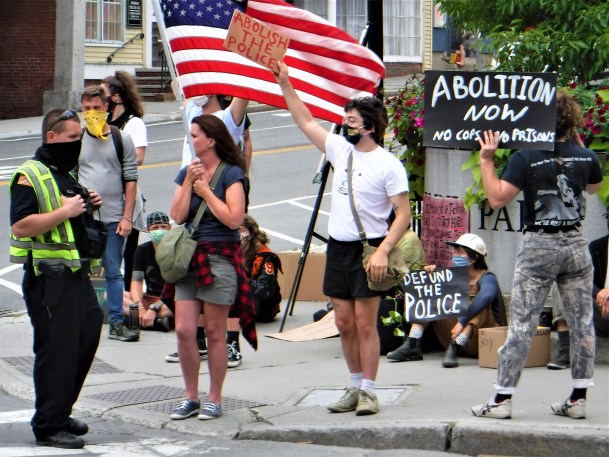
BRATTLEBORO — Activists aiming to defund local police are facing challenges as they seek to overturn this town’s recent decision to retain law enforcement’s 2020-21 budget as it reviews whether to make future changes.
The Brattleboro Selectboard listened to more than two dozen self-described abolitionists at an online meeting earlier this month before voting 3-2 to adopt an $18.4 municipal spending plan that includes $2.3 million for police.
Activists, however, vowed to fight on. This past weekend they promised to take over the town common for “The Occupation to Defund the Police” and not leave until the Selectboard endorses #8toAbolition campaign efforts to end police and prisons and “invest in care, not cops.”
Bystanders counted 20 people when the occupation began Friday afternoon, then four tents at nightfall and a few dozen activists Saturday who crashed a nearby downtown rally for President Donald Trump. But when the sun rose Sunday, the common was empty.
The occupation is “leaderless” and had “no organizers or spokespeople,” its Facebook page says, but would continue “for however long it takes.”
Although participants don’t have permission to camp in the municipally owned park, local leaders aren’t stopping the event.
“We understand and recognize this type of an event is political speech,” Assistant Town Manager Patrick Moreland said. “I’m confident in the town’s ability to keep everybody safe.”
A second group, Brattleboro Common Sense, spent the past week circulating a petition seeking a townwide vote on the approved budget that takes effect upon the start of the fiscal year, July 1.
“The organization hopes to get the signatures and demand a simple and clear compromise,” the group said in a statement. “For instance BPD (Brattleboro Police Department) begins patrols without holstered pistols, and then let the budget pass.”
But the group dropped its petition drive at the same time the town determined it wouldn’t be legally bound to schedule a public vote.
Most Vermont communities decide budgets at town meetings held in early March. Brattleboro, the state’s seventh most populous locality with about 11,000 people, aims to keep attendance manageable by electing 140 representatives who wait until later to debate an annual spending plan.
Local leaders had hoped to hold a town meeting before July 1, but found themselves unable to schedule one because of Covid-19 crowd size and safety guidelines. As a result, the Selectboard turned to a temporary state measure, Act 105, that allows it to adopt a budget to ensure operations continue.
The fact the spending plan was approved by the board sparked questions about the legality of the petition, as the local charter only allows referendums on issues decided by town meeting.
“The petition is moot and without force and effect,” the town’s attorney, Robert Fisher, wrote in an opinion to local leaders.
Regardless, the Selectboard doesn’t appear to be reconsidering its budget approval. Members aren’t scheduled to meet again until July 7 and haven’t signaled a change in their stance.
“The targeting of our police budget without a full examination of all of our town’s priorities is ill-informed, unwise and antidemocratic,” Selectboard Chairman Tim Wessel said upon approving the budget. “While I have the utmost respect for the principles behind movements that seek to make policing better and to reorganize how we as a society take care of our more vulnerable citizens, I cannot toss out a well-vetted budget from this very board here in order to make what will only be a symbolic gesture.”
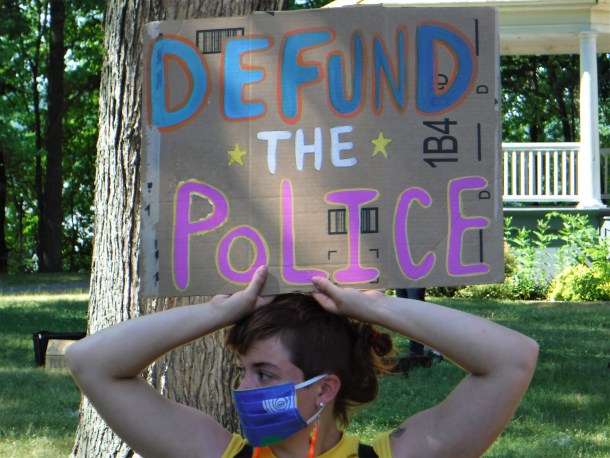
Many Brattleboro residents, spurred by the Minneapolis police killing of Black resident George Floyd, have attended three earlier demonstrations seeking racial justice and, in the case of the abolitionists, demanded municipal police money be reallocated for human services.
In response, Brattleboro Police Chief Michael Fitzgerald has knelt with attendees at a recent Black Lives Matter vigil, posted a letter on Facebook and held a public meeting on the common where he set up a microphone and invited the public to say anything.
“Make no mistake, there are things we can do better, there are things we’re working on, there are things that I don’t even know yet that we need to do,” Fitzgerald said at the meeting.
Police supporters have argued that while law enforcement needs review, it also offers protection in a town where opioid overdose deaths top state tallies and several local Black Lives Matter events have drawn verbally abusive opponents now facing charges of hate-motivated disorderly conduct.
“We recognize that different voices have different ideas about how defunding would work, but anyone who wants to defund the Brattleboro police had better have a plan to keep the two of us safe,” interracial couple Maclean and Shanta Lee Gander wrote in a recent essay in local newspapers.
“At the most recent Selectboard meeting, what we mainly heard was a bunch of well-intentioned progressive White people talking about something they don’t know so much about, based on what they have read in the national papers,” the couple continued. “Meanwhile, we are here and living our reality, and we think of our police as protection — not a danger.”
