

Jon Margolis is a VTDigger political columnist.
How many Burlington cops are too many? How many are too few?
That depends on who’s counting, and on the measuring device, if any.
There may have been no measuring device used to calculate the proposal to cut the number of uniformed officers by 30%.
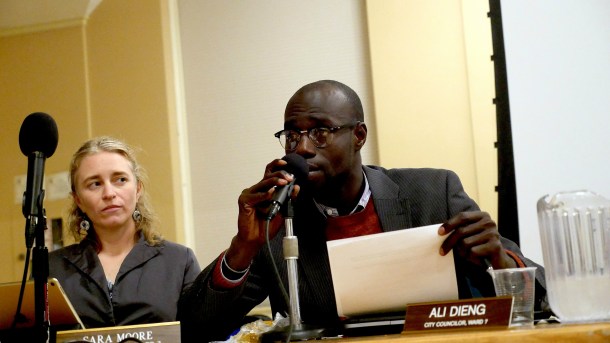
“I think it was just a demand from the (Vermont) Racial Just Alliance,” said Councilor Ali Dieng, I-Ward 7.
Not that the Alliance made up the 30% out of nothing.
“They based it on the number of police officers, based on the population,” he said. “They thought for that number to be in proportion to the population.”
Racial Justice Alliance coordinator Mark Hughes did not return calls and emails to explain how he and his associates arrived at the 30% demand. But they may have been right. From one perspective, the number of Burlington police officers is on the low side. According to the FBI’s Criminal Information Justice Services, for police departments “nationwide, the rate of sworn officers was 2.4 per 1,000 inhabitants” in 2018. At that rate, with a population of more than 42,000, Burlington would have about 100 officers. It has 91.
But together with Councilor Brian Pine, P-Ward 3, University of Vermont economics professor Stephanie Seguino prepared a comparison of Burlington with what she called “similarly situated cities,” state university cities such as State College, Pennsylvania, Charlottesville, Virginia, and Ames, Iowa.
Her data showed that to reach the median number of officers per population of these cities, the Burlington force would have to decline by 29%.
That’s not down 29% from the present 91 officers, Pine said (there are two vacancies) but from the 105 officers initially proposed in Mayor Miro Weinberger’s budget for next year. Weinberger has already agreed to cut those positions.
Cutting by roughly 30%, according to Seguino’s calculations, would bring the force down to 74 Burlington “sworn officers.”
Whether that’s enough, still too many, or not enough is open to debate. But the city wouldn’t really have 17 fewer officers patrolling its streets. Unlike most city police departments, Burlington’s is responsible for public safety at the airport. Pine said eight of the city’s officers are stationed there.

“They’re not patrolling the city,” he said. “We could set up a separate airport police authority which would not have any great impact. It would be revenue neutral.”
Still, that would be nine fewer officers, and Burlington is not crime-free. Its violent crime rate was at the median of the 11 college towns in Seguino’s comparison. But only four – Charlottesville; Manchester, New Hampshire; Madison, Wisconsin; and Ithaca, New York – had a higher violent crime rate than Burlington’s 2.8 per thousand.
But maybe none of those cities needs that many officers. Maybe cops are sent on missions that don’t require cops: a drunk weaving along the sidewalk, a person with mental illness shouting into the wind, a drug addict sleeping in a park. Even many law enforcement officers agree, including, it seems, acting Burlington Police Chief Jon Murad.
He’s against the 30% reduction, but willing to consider a smaller force in the future. “Head count can be decreased,” he said, “if it’s done intelligently and intentionally, in ways that are fair for officers and the neighbors we serve.”
So it seems possible that amidst all the turmoil and the anti-police fury that followed the killing of George Floyd in Minneapolis last month, Burlington may be approaching a compromise solution, under which the size of the uniformed force would fall gradually, through attrition. The city, Dieng said, would “go through the process of changing the scope of (police) work.”
Both Dieng and Pine acknowledged that the compromise would not please everyone. Perhaps not the police union (unions rarely like to lose members), or some of the hundreds of angry citizens who have called for “defunding the police” at recent city meetings.

“I’m sure some people would be upset,” Dieng said.
But how many is not clear. That was an impressive and emotional outpouring of public sentiment. Over three nights, 506 people spoke, according to Weinberger’s communications and projects coordinator, Olivia LaVecchia. Hundreds more expressed interest. But there are more than 37,000 adult Burlingtonians. Public comment sessions are valuable but not always representative. They favor the articulate, the outspoken, the mobilized.
And even some of them probably understand that a city needs an adequate police force. There can be too many cops. But there can be too few. Too few often means too tired, and some research indicates that officers who pull a lot of overtime are more likely to use (and perhaps abuse) force.
Besides, a great deal of social science research confirms the commonsense observation that one of the best ways to reduce crime is to have lots of cops visible in the neighborhood. To cite just one of several examples, a peer-reviewed 2016 study in the journal Plos One found that “saturating high crime blocs with police helped reduce crime in New York City” in the 1990s.
Less crime in that case did not lead to more arrests and more imprisonment. More cops can mean fewer people in jail. Most European countries employ far more police (per capita) than the U.S. but have many fewer convicts. They spend more on law enforcement, less on corrections.
Pine, Dieng and their allies can’t be certain their compromise suggestions will succeed. They can expect opposition from staunch defenders of the status quo and from activists trying to outdo each other on how anti-police they can be.
As an African-born Muslim who has been a bit of an agitator himself, Dieng has some appreciation of the anti-police sentiment. But he said, “as a black person who’s an elected official, I understand that some demands need to go through a process. They have to be vetted, taking into account all the stakeholders. Some want to just force it. But we should have a plan.”
The agitator as responsible elected official. There’s an interesting mix.
