


The Deeper Dig is a biweekly podcast from the VTDigger newsroom, hosted and produced by Sam Gale Rosen. Listen below, and subscribe on Apple Podcasts, Google Play, Spotify or anywhere you listen to podcasts.
Rae Rappold and her husband Mike first started experiencing Covid-19 symptoms on March 14, the day the University of Vermont men’s basketball team was supposed to face off against the University of Hartford. The game had been canceled due to concerns about the growing coronavirus outbreak.
The Rappolds, avid UVM fans, had been inside Patrick Gym on Tuesday, March 10, to watch the Catamounts advance in the playoffs. That Saturday morning, they sat down to breakfast, disappointed that the day’s game was called off. But neither one had any appetite.
“I said, ‘Do you think we’re sick? Or do you think we’re depressed?'” Rae remembers. “And he says, ‘I think we’re depressed.'”
In the following days, Mike, who had an existing respiratory condition, quickly started experiencing more severe symptoms. He was hospitalized, and he died at the University of Vermont Medical Center on March 24. Rae later tested positive for Covid-19.
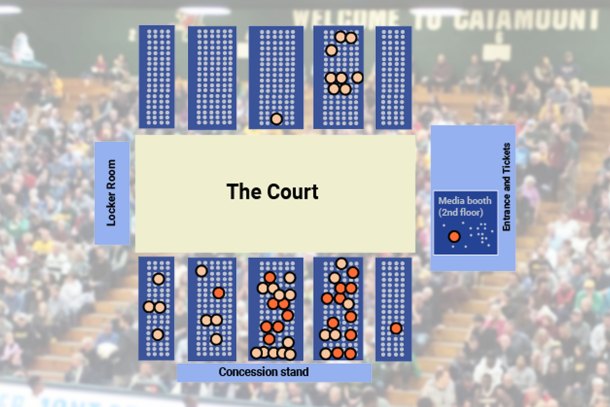
According to a VTDigger survey, the Rappolds were just two out of dozens of attendees who felt symptoms after the March 10 playoff game, which now appears to have been a major Covid-19 spreading event. Twenty attendees reported that they later tested positive, and an additional 34 people who responded said they experienced flu-like symptoms, but couldn’t get a test. Three people, including Mike Rappold, died from Covid-19.
On this week’s podcast, Rae Rappold recalls her experience with Mike’s illness following the game. Plus, VTDigger’s Katie Jickling explains what we’ve learned after weeks of tracking the spread.
**Podcast transcript**
This week: A University of Vermont basketball game in early March now appears to have been a major spreading event, with at least 54 people reporting Covid-19 symptoms after attending. Twenty of those people tested positive, and three of them died. Here’s what we’ve learned after weeks of tracking the spread.
Hi, is this Rae?
Rae Rappold: Yes, it is.
Hi Rae. It’s Mike Dougherty from VTDigger. How are you?
Rae Rappold: I’m here, Mike, how are you?
This is Rae Rappold. Back in April, I talked to Rae to learn more about her husband, Mike, who was one of the first Vermonters to die of Covid-19. He and Rae had been married for 29 years.
Rae Rappold: He just was so kind and, and compassionate. And he wanted to always take care of me.
Rae and Mike both had kids from previous marriages. She said the family spent a lot of their time on athletics.
Rae Rappold: My kids were involved in sports, big into basketball, tennis. Tennis and basketball were their biggest sports, but they played other things too. So we were constantly on the go. His boys were older, but they still played town team ball and whatever. So we were constantly on the go with sporting events.
Rae told me all about what a caring husband and dad Mike was. But late in our conversation, she said something that stuck out.
What was Mike’s favorite thing to do? You know, if he had total freedom, total free time, what would he do with it?
Rae Rappold: If he had total free time? Just, just everyday life? He loved to golf. And, we attended — seeing as the boys were up and grown and not playing basketball anymore themselves, we took up UVM, became season ticket holders there. And unfortunately, Mike, I think that’s where we all contracted it. That’s my thought on it.
Really, were you at the game, that latest game that they had there?
Rae Rappold: We sure were. And Bernie Juskiewicz, who was our neighbor, sat in the row right behind us.
Bernie Juskiewicz was a former state representative who also died of Covid-19.
Rae Rappold: It’s so sad to think that doing something we absolutely loved is where we contracted it, but I am really convinced that’s where we got it.
Wow.
About 3,200 people attended the March 10th game at UVM’s Patrick Gym. The Catamounts beat the UMBC Retrievers, 81 to 74.
Their next game was scheduled for Saturday, March 14th. But by then, the rest of the playoffs had been canceled.
Rae Rappold: That morning that the final game was supposed to take place…We love to have breakfast on the weekends. And I said, well, what do you want for breakfast? He said, I’m not really hungry. And I said, neither am I. And I said, do you feel okay? And he just says, well, you know, I’ve got this prickly feeling in my skin. And I kind of had that too. I almost thought that I had a recurrence of shingles, which I had had once before, with tingling down my back. He was describing something similar, but he was pointing to his arms. And I said, do you think we’re sick or do you think we’re depressed? And he said, I think we’re depressed.
We came out to the kitchen table, forced ourselves to eat something. And at 11 o’clock, when the game was supposed to start, my Facebook started beeping, and they had posted a thing on the UVM site. It was a hype-up that was supposed to be to hype the team up, spirit wise and whatever, to get them ramped up to go at 11 o’clock.
So instead they play the same thing, but: ‘this is what should have been.’ Oh god, it was heart wrenching.
Just to be clear, Rae means this was heartwrenching because she and Mike were really psyched about this game.
Rae Rappold: We had a passion for watching basketball.
But over the next few days, Mike’s symptoms escalated – he had a chronic respiratory condition already. He died at the UVM Medical Center ten days later.
Since we started reporting on this game, dozens of people have come forward to say they also had symptoms after attending. Our reporter Katie Jickling has been talking to them.
Katie Jickling: Early on, we started to notice that a few of the different cases and obituaries and anecdotes about Covid-19 were from people who were basketball fans or who had attended the UVM game on March 10th. And one of our editors, Jim Welch, is a season ticket holder and was keeping his eye out for those anecdotes. They just kept popping up.
We found cases in other news stories, in obituaries, and in just personal anecdotes of people who were feeling sick, and we just started reaching out to them. And as we started to have those conversations, more and more people came up who had been to the game and later had symptoms of the virus.
How many people are we now talking about?
Katie Jickling: VTDigger has reached out to, contacted and confirmed with 54 people who have said they had Covid-19 symptoms after the UVM basketball game. Twenty of that total tested positive for the virus, but it may be even higher.
We circulated a survey about whether people had been to the game and later fallen sick. And there were 47 more people, in addition to that 54, who had Covid related symptoms, but we were unable to reach those individuals to confirm their responses. So if all of those were accurate, it could be over a hundred.
Wow. And the reason some of those are not confirmed cases necessarily is because we’re talking about a time, pretty early on, when accessibility to testing was not as high as it is now?
Katie Jickling: Yes. On March 10th, when UVM was playing the University of Maryland Baltimore County, there was just one presumed positive Covid-19 case in Vermont, and that was a man who was sick in Southern Vermont. So at that time, nothing had been closed. There were really no questions about whether to hold the basketball game at all. No one was wearing masks, of course, at that time. We hadn’t even heard of social distancing, and Gov. Phil Scott wouldn’t impose his “stay home, stay safe” order for another two weeks.
So it feels like another world, but really that was pre-Covid, at least from what we had been told.
Right. I remember going to a press conference probably just days before then that was one of the first events from the Vermont Department of Health where Covid was even discussed. And I do remember that Mark Levine, the health commissioner, had mentioned this possibility of closing large gatherings and characterized it as something that may happen way down the line.
Mark Levine: We are continuing our monitoring to identify cases and planning for community wide strategies to slow disease transmission. These could include social distancing, also called non-pharmaceutical interventions. So limiting where and when people come together, such as teleworking, restricting mass gatherings, closing public facilities and the like. There’s no need to exercise any of these options at this time.
I remember that announcement being kind of striking when it happened. But it does seem like in the context of this game on March 10th, that that still felt like it was coming a ways off.
Katie Jickling: Exactly. And at that point, as you know, very few tests were available, and there were shortages around the country. People who were eligible were only those who had traveled to countries like China and Iran and Italy, who were experiencing outbreaks at the time. But no one else was really eligible. And so when we say confirmed, and talk about people who knew whether they had the virus after the game, many of those tried to get tests and were not able to.
In addition to that, when we talk about a confirmed case for this survey, we had also gotten responses from people and then also reached out again to make sure that those responses were accurate. And so when we say 54, that was the number where we could reach out and contact them and confirm that what they told us was indeed true.
Got it. These people that you’ve talked to that have either reached out to us, or that you’ve been able to track down, what do they remember about this game? When they look back on it now, knowing what we know, what things have stuck out to them?
Katie Jickling: They remember coming to the game and just being really excited to be there. They were excited because UVM had a really good season and they were coming into the playoffs strong. They had just defeated the University of Maine a few days before. A lot of the people who attended the March 10th game were season ticket holders and had been there on March 7th as well. Some of them thought about Covid, some of them didn’t.
At that point, UVM was doing some extra cleaning of the locker rooms and bathrooms and that kind of thing, and putting out hand sanitizing stations and saying, try not to high five your neighbors. That kind of guidance. But for the most part, other people just had no qualms at all.
There was one woman I spoke with who said the woman in front of her kept turning around and high fiving her after every major point. And she felt a little uncomfortable, but it wasn’t something that she really thought about until she got sick and thought that maybe it could have been Covid.
People described exactly what you think of for a playoff basketball game. People are crowded shoulder to shoulder, they’re yelling for the home team and they’re all decked out in their UVM garb. And they’re doing the things you do at college basketball games: that is, sharing pizza, and the raffles, and all that sort of communal gathering and sports traditions that really are not advisable in a pandemic.
The March 10th game we’re talking about here was the last game that the UVM team held. Within a couple of days, the America East conference and UVM canceled the rest of the season, and NCAA also canceled the tournament as well. And around that time was when Commissioner Mark Levine started banning larger gatherings, and we really started becoming aware of more cases around that time and realizing that cases were starting to arrive in Vermont. And the reality was, it seems now, that Covid had been here all along.
Mark Levine: The governor has provided you with a lot of information about what, in public health terms, we call social distancing. Social distancing measures include these cancellations of mass gatherings, adjustments to the way we work. We all know how disruptive these things can be for more normal day to day life.
Katie Jickling: It was that Friday when everyone started working at home, and really our lives changed just like that. We canceled all sorts of events, and schools closed the next week. So really when we think about it, the March 10th UVM game was the last major, big event perhaps in Vermont. At that game, Patrick Gym was filled to capacity with 3,200 people. It was really the last hurrah, so to speak, in terms of being out together and going to things like a sports game, which now looks like won’t happen for quite a while.
It’s striking, too, looking at what you found out from the people you’ve talked to about where they were sitting at the game — that so many of these people who later showed symptoms are clustered together in the stands.
Katie Jickling: Yeah, that was one of the things that was notable to us as well — that many of the people who fell sick later were in two sections, specifically section four and section six, which are right next to each other on one side of the gym. It was in section four where the three people who later died of Covid were all sitting, as well as the nearby section, section six, where we’ve had reports of several people who were hospitalized and just got really severe symptoms.
That seems to point even more to the fact that the game was a spreading event, because people near each other were more likely to get sick.
I’m curious, when you talk to the institutions that are involved here, like UVM and the state department of health, what do they say about this game?
Katie Jickling: Originally, the University of Vermont staff and spokespeople said that they had no evidence of any cases. And they said they were doing what they could given the information that they had at the time. They said they were following all of the guidance from the state department of health and that no other events or games had been canceled at that time. And that’s all true.
The state department of health said up until last week that they did not believe it was a spreading event. They had not traced any cases to the game itself. And they had no evidence to think that this event had been a place where people had contracted Covid. Since then, Commissioner Mark Levine has walked that back a little and said, yes, well, it looks like there were indeed cases of people who got the virus at this game. But even if the department of health had known about it, there was likely little they could have done to stop it.
Mark Levine: We knew literally so little — I didn’t want to say nothing, but literally so little about this virus when it first appeared than what we know now, even when we still don’t think we know enough, and where the gaps were.
Katie Jickling: The commissioner was saying that even if they had identified that game as a potential source of the virus, they wouldn’t have been able to test everybody because they just didn’t have enough tests. And so they would have had trouble identifying the scope of the spread if they had noticed it back then.
Mark Levine: I’ve said this many times: we didn’t have the opportunity to practice containment, the “box it in” business that’s always the primary mode of dealing with the viral infection in the population, that we had to go straight to the mitigation strategies, with social distancing and eventually masking and mass gatherings and all of that.
And so that’s where things started — within that week, the state was doing all of those things, and pretty soon the schools were closed and restaurants were closed and everything else. It was very, very fast.
Has Levine at all, in any of these conversations, entertained the idea that they could have canceled events sooner? Given what you found, it seems like if they had picked this out as a potential spreading event before it happened and said, ‘you can’t do this’ to UVM, that it really would have had a major impact on the curve early on.
Katie Jickling: I think you can make that argument — that if this game had been canceled, we may not have seen nearly as many people affected in Vermont. People come from all over the state and all over the county to see these games. And we know that three of the people who attended later died of the virus, and that is really significant.
Mark Levine talks about the way in which we just didn’t know much about the virus at this time.
Mark Levine: All of the exposures in the country at that point in time were believed to be from people who traveled to China or otherwise international travel. So those were the key risk factors everyone was asking about. No one was yet believing or thinking that there was community transmission in terms of how the virus was spreading. And certainly at the time of the basketball game exposure, we were not aware of community transmission, because all we knew is we had one case in the whole state.
Katie Jickling: We didn’t know how it could be spread. We didn’t know about asymptomatic carriers. Commissioner Levine just says that we really just didn’t have enough knowledge about the virus to have realistically been able to make that decision at that point.
I wonder, what do we learn from all this, given what you’ve found? What does this tell us about how the virus works, how the virus spreads, in a way that might be useful to us going forward?
Katie Jickling: I think understanding the virus and its spread at this UVM game indicates to us that the virus was in Vermont much earlier than we thought. And I think we should perhaps be going back even further if we want to understand the spread of Covid-19 in Vermont, to when exactly it did come here and how it might have led to the 55 deaths that we did see, even just from a public health standpoint in learning how to identify these things early on in the future.
But I think much of what we’ve learned about the virus since the game just confirms the approach that the Vermont Department of Health has taken. It highlights the danger of really big events, because this virus spread very widely as a result of this one gathering. I think it also just identifies the need for contact tracing and for really looking at who got it and when, as a way to help provide people with the information they need.
One thing that I’ve realized talking to people is they really just want to know whether they had it. And it’s helpful for them to know if they can go back to work, or if they should be worried about infecting their grandchildren. A lot of people say, I think I had it, but I’m not sure. And so I don’t know whether I should buy season tickets for next year. That kind of thing.
These people that you’ve talked to, how do they feel about this? I mean, they have this team that they’ve been intensely loyal to, but like you said, they’ve also had this one event cause such disruptions for them. What kind of mood are these people in right now?
Katie Jickling: Well, a lot of them were pretty relieved to talk to me and to hear that other people had also contracted the virus at this game, because like I said, it gives them this assurance just to know where they likely got the virus. And to know that they weren’t alone.
Overall, people aren’t angry. People aren’t frustrated at UVM, and they don’t think that the university or the American East conference could do anything differently. They sort of see this as a deeply tragic event, but a reality of a virus that we really still don’t know a lot about, but really didn’t know much at all about several months ago.
They are just, I think, throughout the course of this, just taking it one day at a time, and accepting what we do know, and acknowledging how much we don’t know about what happened.
Thanks, Katie, for your time.
Katie Jickling: Thanks Mike.
