


Like farmers and ski area operators, Vermont’s restaurant owners are now close followers of the weather forecast. Under the latest state guidance for restaurant opening, those who are lucky enough to have outdoor seating areas are counting on clear skies to make money despite occupancy restrictions.
“If it starts to rain, we can’t put them inside,” said Jamie Rozzi, who owns Rozzie’s Lakeshore Tavern in Colchester, on June 8. “Even that little burst that came in on Saturday was a huge hit on business for us.” Rozzi’s outdoor dining area, which has space for 50 people, has been open since restaurants got the go-ahead for limited outdoor dining on May 22.
Indoor dining is limited to 25% of capacity under the state rules designed to suppress the Covid-19 infection rate. Rozzi said many people who had reservations on Saturday night, when a storm came through, canceled or just didn’t show up.
Right now, even though Rozzi’s Lakeshore Tavern relies mostly on revenues from its takeout business, those diners are an important source of revenue. “And on weekends especially, Saturday and Sunday brunch, if we don’t get people out there at tables, it hurts.”
Vermont’s restaurants are a very diverse sector and an important economic engine for the state, employing about 30,000 people. They have been scrambling to find ways to survive since the governor on March 17 closed restaurants and bars to everything but takeout service.
In May, restaurants received the go-ahead to open outdoor restaurant dining, limited to 50 people or the licensed seating capacity, whichever is less. On June 5, citing a relatively stable Covid-19 infection rate in Vermont, restaurants got more leeway to seat people starting June 8.
For those who have outdoor tables, these incremental steps can make a big difference. Whetstone Station Restaurant and Brewery in Brattleboro had been in the process of developing a new online ordering system for takeout anyway when the pandemic hit in March, said owner Tim Brady.
“So we super-accelerated into that,” said Brady, whose restaurant has a rooftop beer garden and a lower-level patio as well that together seat about 200 people. One has a roof over it. Whetstone has offered takeout throughout the shutdown, and also used the down time this spring to paint and do other repairs on its building. As soon as it got the news that it could open to limited outdoor dining on May 22, it did so. Like other restaurant owners, Brady said he could have used more warning time.
“It was a bit chaotic, but we were actually really close,” Brady said.
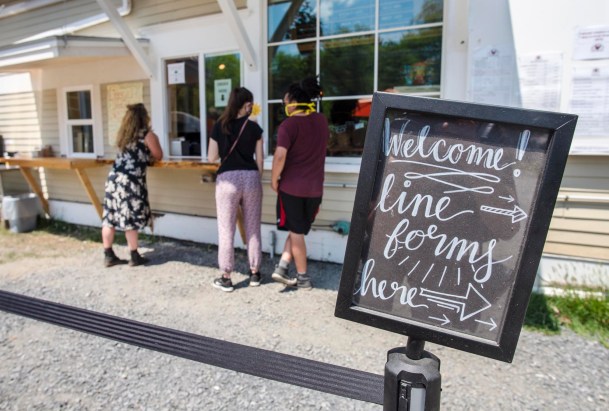
Randy George, co-owner of Red Hen in Middlesex, has installed a second window for takeout at his bakery, and plans to be open seven days a week. He has the good fortune of being situated in front of a 10-acre space with tables where people can sit after picking up their food. The tables are 12 to 15 feet apart, he said. Because it’s not part of the restaurant, it doesn’t exactly fit into the rules for restaurants. It falls under the general rules, which prohibit groups of more than 25.
“It’s a little bit of a gray area in terms of the constantly changing rules that have to keep evolving,” George said.
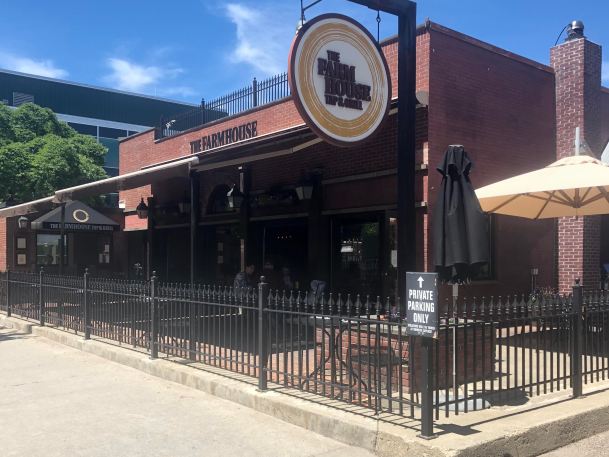
But not everybody has the seating or the setup to prosper right now. Jed Davis, owner and president of the Farmhouse Group of restaurants, which includes the Farmhouse Tap & Grill, Pascolo Ristorante, Guild Tavern, and El Cortijo Taqueria, said he was pleasantly surprised at the number of people who dined at the Farmhouse Tap & Grill on June 8, which has capacity for 50 outdoors and 200 indoors. But with limits on capacity, it wasn’t enough to make the operation profitable, said Davis.
Even recent changes to the guidelines for the Paycheck Protection Program, designed to make it easier for restaurants and lodging to use, aren’t enough to make a difference in the traditionally low-margin business, said Davis. Under the rules of the PPP program, restaurants have to meet certain hiring criteria in order to have the loans forgiven, and it’s not clear to all restaurateurs they can do that, even under a timeline that now extends to Dec. 31.
“The challenge is right now the capacity restrictions are so restrictive that for some restaurants, it’s going to make sense to wait (until they can be sure they will rehire their staff)” said Davis. “The PPP funds are really your runway, and you have to choose when you want to start the runway. I have to let operations make the decisions. When the volume is there, it makes sense to reopen and start using the funds.”
For Steven Sawyer, who owns Table 24 in Rutland, serving diners outdoors is out of the question. His restaurant is close to the bus station and the police station and shares a parking lot with a busy Domino’s franchise.
“It wouldn’t be neighborly” to use the parking lot, “nor would it be an appealing space to have dinner,” said Sawyer. “It’s not unusual for the cops to come flying down the street with sirens blaring.”
With seating for about 150 indoors, the limit on indoor dining makes opening the restaurant untenable, he said. He’s hoping the states lifts the limit soon.
“If we have to live at 25% for two months, that’s going to be a problem,” he said.

The cities of Barre and Northfield have tried to help the Cornerstone Group open some outdoor seating for their restaurants, said co-owner Keith Paxman. Right now, they have none.
Northfield Selectboard Chair David Maxwell called Paxman about creating an outdoor space for a few businesses. “He said, ‘how can we get you guys open? What can the town do for you?’” They are now talking to the town about blocking off part of a street to set up tables. The Barre City Council has been similarly helpful, Paxman said. He plans to open his restaurants on June 17 but he doesn’t know yet if or how he’ll integrate outdoor dining, because like others, he doesn’t know what he would do if it started to rain and diners couldn’t move to the indoor space.
Paxman used to own the Common Man in Waitsfield.
“The first thing I would do every morning was look at my weather app and figure out whether skiers were coming up,” he said. “I sold Common Man because I didn’t want to be weather-dependent … and here I am.”


