

The Vermont State Colleges could face operating deficits anywhere from $19 million to $46 million next year as the pandemic further depresses enrollment. That’s according to a pair of reports commissioned by lawmakers to help them decide how much to give the system to get it through next year.
The analyses were conducted by Vermont State Treasurer Beth Pearce and James Page, an education consultant and the former chancellor of the University of Maine system. Lawmakers requested the reports, which were released separately late Monday and Tuesday, after the system’s former chancellor proposed an explosively controversial plan to close three state college campuses for good in the wake of the coronavirus.
Jeb Spaulding, the former chancellor, ultimately shelved his proposal and resigned. Legislative leaders, meanwhile, committed to finding stop-gap funding to keep the system as-is for at least another year.
Sophie Zdatny, the VSC’s interim chancellor, called both reports “enormously helpful.”
“It sets the stage, it makes the case to the Legislature in terms of what we need and the consequences of how we’ve been funded in the past,” she said.
The colleges have launched several task forces and working groups at the school and system level to propose reforms, and Zdatny emphasized that school officials understood the need for a wider overhaul. Vermont spends less on public higher education than nearly every state in the country, and the heavily tuition-dependent schools have been on rocky financial footing for years as enrollments have steadily dwindled.
“We do know that we need to transform ourselves. And that’s really what we’re looking for with this bridge funding – to do the work that needs to be done,” she said.
Vermont received $1.25 billion in aid from Congress to help with Covid-19 expenses. But while the sum the state ultimately gets from the CARES Act is unprecedented, it has also come with a host of limitations on its use.
House Speaker Mitzi Johnson, D-South Hero, on Tuesday reiterated her hope that the federal government would either allow states more flexibility or send in additional relief aid.
“Then it becomes a whole lot easier,” she said. “If not, then we’ll figure that problem out when we get there.”
Page’s report recommends that lawmakers set aside $30 million for bridge-year funding in order to address worse-case enrollment scenarios. Another $10 million would be needed, he added, if the colleges must return to remote instruction and refund room and board fees, although these dollars could be more easily earmarked from the state’s federal relief package.
Both reports take note of about $15 million in reserves the system could dip into to offset the colleges’ steep declines in revenue. But Page and Pearce both urged lawmakers to be judicious in their use of the system’s relatively meager savings.
The projected deficits identified in both reports set aside about $27 million in coronavirus-related expenses the schools have already asked the state to help reimburse. Using CARES Act funding, the Legislature has already earmarked $12.5 million in a bill that is awaiting the governor’s signature. That money is expected to allow the colleges to end the current fiscal year – which ends June 30 – basically breaking even.
It is difficult to predict what the enrollment picture will look like come fall, especially since it is unknown at this point whether schools will be able to return to in-person instruction. But early indicators are not good.
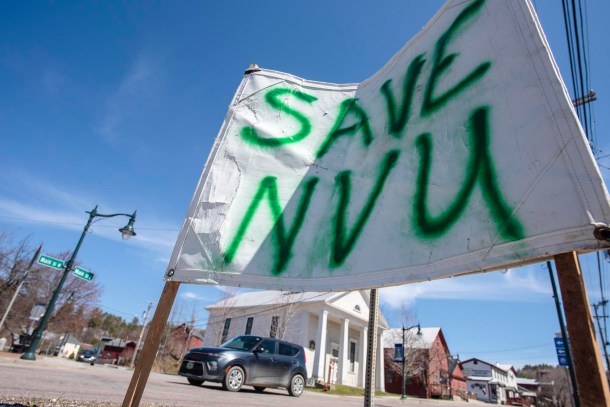
The most precipitous enrollment downswings are forecast at Northern Vermont University, where school officials say that headcounts could drop by as much as 30% next year. Pearce’s analysis notes that, as of May 15, only 99 accepted applicants at NVU-Lyndon had submitted deposits for the fall. That’s exactly half as many as had made deposits by this time last year.
Page’s report quotes one senior NVU official calling the net effect of the former chancellor’s proposal and the school’s preexisting demographic challenges “devastating.”
“One can appreciate why,” the report says. “Few, after all, want to invest themselves, their family members, or their money in an institution that might soon not be there. NVU needs meaningful messages of support, and it needs time.”
Pearce’s report divides projected deficits ranging from $19 million to $46 million into “best/middle,” “worse,” and “worst” options depending on enrollment.
Her analysis does not say explicitly how much lawmakers should allocate to the colleges in additional funding, and in an interview, the treasurer said she would leave it to lawmakers to look at the scenarios presented and make the appropriate call.
Still, she cautioned legislators against being too optimistic.
“I would recommend that the General Assembly should consider more the worse – or the worst case – in their deliberations,” she said.
Pearce also emphasized she did not recommend that the colleges lean too heavily on their reserves to plug the projected shortfalls, particularly since the financial fallout of the pandemic is expected to last well into 2022.
“Once you use them, they’re difficult to replenish,” she said.
Xander Landen contributed reporting.
