

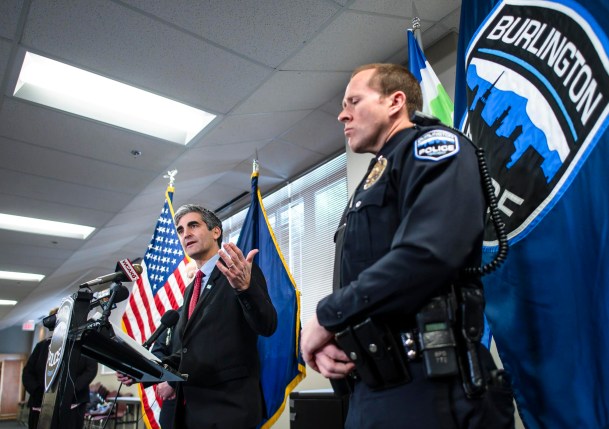
The Burlington Police Commission will consider updating the use of force policy for the city’s police department next week, Burlington Mayor Miro Weinberger announced Friday afternoon.
The unveiling of the policy comes amid protests across the nation, including in Burlington, after the killing of George Floyd by a Minneapolis police officer.
Weinberger said the current use of force policy trailed behind the department’s training and practices. The new use of force policy lines up with the national “8 can’t wait” effort by police reform organization Campaign Zero, he said.
“This new policy contains many key elements, including clear requirements for de-escalation, a duty to intervene, verbal warnings, reporting of all uses of force, and more,” he said.
Deputy Chief Jon Murad said the new policy explicitly introduces a duty to intervene and places an increased emphasis on de-escalation.
“When you go from a document that mentions de-escalation once to one that mentions it 18 times, you are explaining for your audience what it is that is important to you,” he said. “That is important, avoiding the use of force is important.”
The BPD disproportionately uses force on black residents, according to a report released by the department last year. The city is facing three federal use of force lawsuits filed by black men alleging police brutality, and body camera footage showed officers pushing and tackling the men.
The City Council set up a special committee to review the department policy and procedures following the filing of the lawsuits and release of the body camera footage last year.
The committee recommended that a new use of force policy prioritize de-escalation and emphasize that all use of force should be proportional. The committee also recommended that the policy articulate that officers have an affirmative duty to intervene when they witness excessive force and have an affirmative duty to provide care to those in their custody.
The committee also considered community oversight and recommended tweaks to the role of the police commission but did not call for an overhaul of the oversight model that some committee members had requested.
Weinberger said he also signed on to former President Barack Obama’s mayors pledge to review and reform police use of force policies.
“We know this work is far from complete here in Burlington, we know we have made mistakes,” he said. “We also know we have a role in doing everything we can here to encourage the rest of the country to do better, and to do better ourselves.”
Murad said that the language used in use of force policies is important.
“When we can give more emphasis to the things that matter to us, it really does affect the way in which officers work in the field and the ways we serve and work with our neighbors,” he said.
The policy states that the duty of police is to protect human life, and that force must be reasonable, proportional and used to accomplish law enforcement objectives, Murad said.
Under the policy, officers have a duty to intervene if they witness excessive force, a duty to report all uses of force and a duty to care for those in their custody, Murad said. The policy also requires officers to warn individuals if they are about to use force, he said.
“Officers have to be able to justify every time they do use force,” Murad said.
Discipline for improper use of force should be conducted in line with procedural justice, human resource rules and union contracts, he said.
Randall Harp, the chair of the special committee and a member of the police commission, said that he supports the new policy and said it conforms with the recommendations of the special committee.
But a policy is not enough, Harp said. He said it was also important to ensure that all officers see that the lives of those they are interacting with matter, and that there are principles in place to ensure those policies are being followed.
“A policy can tell an officer that it’s prohibited to leave your knee on someone’s neck for eight minutes, or two and a half minutes after someone is unconscious, but a policy itself can not impose any discipline after that has happened, and a policy itself can not get an officer to view the person who was under their custody as someone who is worthy of respect, someone whose life matters,” Harp said.


