

Jon Margolis is a VTDigger political columnist.
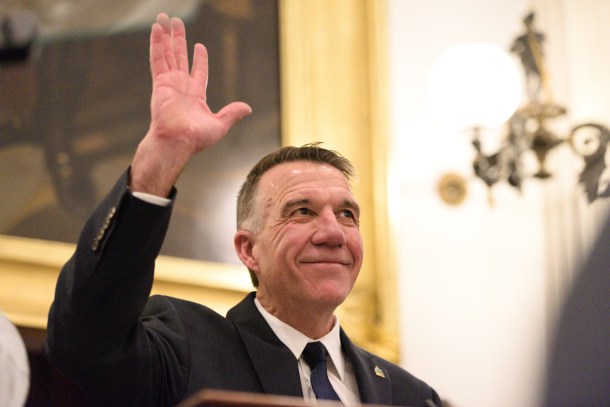
Stop the presses! Gov. Phil Scott is running for a third term.
Now that we’ve all gotten over the shock, let’s go to work on avoiding the temptation to wonder whether we need to hold an election at all.
A temptation always to be avoided because in a democracy elections should always be held as scheduled. But especially avoided this year because of reports that the White House might be planning to delay or evade an election, either because of the pandemic or because the president is behind in the polls.
Hardly likely, but when presidential adviser (and son-in-law) Jared Kushner was asked whether the election might be postponed he said, “I’m not sure I can commit one way or the other,” perhaps not the most reassuring reply.
Still, what with laws, constitutions, and traditions, it’s best to proceed as if there will be elections for both state and federal office. But they will be odd everywhere thanks to the pandemic and they will be odder yet in Vermont thanks to their lack of suspense.
Until now, political reporters seeking synonyms for “campaigning” were often reduced to calling what candidates did on the hustings (after first being reduced to using “hustings”) as “pressing the flesh.” That means, says the Grammarist website, “to shake hands, to mingle in a crowd of people in order to make personal, physical contact.”
Not for a while. At least until the Aug. 11 primary, expect little to no hand-shaking, crowd mingling, or personal contact. Instead the three candidates trying to be the Democrat who will (in all likelihood) lose to Scott will do what the four Democrats who want to be lieutenant governor (and one of whom will be) did last week – debate remotely and electronically, each in his or her own space.
Thereby raising the prospect that their debates will be as gripping as that one, in which the major disagreement was over whether the failure to pass a family and medical leave bill was due to Scott vetoing it or the House falling one vote short of overriding the veto. This is not a dispute likely to rivet the electorate.
This is a campaign that begins with the incumbent getting the approval of 82% of his state for the way he has handled the pandemic. If this does not make him unbeatable it is only because no one is ever unbeatable. But if the pandemic does not remain the only issue the voters care about this year, it is now – and as far as can be foreseen until Election Day, Nov. 3 – the dominant issue. An incumbent with an 82% approval rating on the dominant issue is in very good shape.
As he would and as he should, Lt. Gov. David Zuckerman says he still sees “a path to victory” assuming he wins the Democratic primary for governor. Such a path might emerge, but it’s hard to see how.
And about as hard to see how Zuckerman loses the primary. The pandemic has sucked up most of the state’s political oxygen, making it harder for former Education Secretary Rebecca Holcombe and the even less well-known Pat Winburn to get very much attention. Zuckerman, who has run and won two statewide races, is a familiar face.
The only caveat here is that turnout in the primary could be so low – even if Scott and the Legislature resolve their spat over voting by mail (a dispute which appears to be about nothing) – to make any outcome possible.
But Covid-19 is likely to have an impact on down-ballot races, too. Especially in primaries, candidates for legislative seats have commonly and effectively used door-to-door campaigning to win their races. Even if they wear masks, many of those doors will not open for them. So they may not even try.
Especially in legislative primaries, “people like to go see and hear candidates, to get a sense of them,” said Amy Shollenberger, a lobbyist who also has experience in electoral politics. “People are going to have to learn how to make decisions in a different way.”
As Shollenberger noted, the pandemic has already altered legislative politics. Usually, from January until mid-May, the Statehouse teems with people and activity. It is a community, with lawmakers, lobbyists, citizen activists, expert analysts, administration officials, and reporters constantly mingling with one another, sometimes in planned sessions, sometimes by chance.
“I miss all that,” she said, “the very brief interactions where you can clarify a point or share some information as you walk down the hall.”
Now the Statehouse is all but empty. Committees meet via Zoom or some other electronic process, the same way lobbyists and advocates inform their clients and organizations. By all indications the work is being done, and done reasonably well, perhaps because the sense of crisis has helped unite the often-squabbling factions, and because dealing with the pandemic is just about the only subject at hand. This was going to be a session with lots of talk and maybe some action on global warming. It’s been forgotten.
Zuckerman said some good has come out of the change.
“The remote meetings have expanded the opportunity for Vermonters in all corners of the state to follow and possibly participate in the proceedings,” he said. “One day maybe we can take advantage of the old with some of the new, allowing for a more informed public to participate.”
There’s a silver lining in almost every cloud. But the state will be better off if that community – for all its flaws and foibles – can reassemble next January.
It is all but certain to be the same folks: the Republican governor, the Democrats in all the other statewide offices, the strong Democratic majorities in both houses. If they can all get together under that Golden Dome in Montpelier next year, they will all know only one thing for sure: they’re going to have a very difficult two years.
