



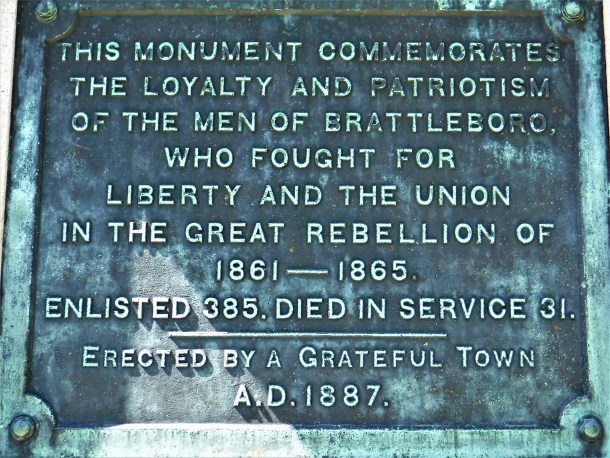
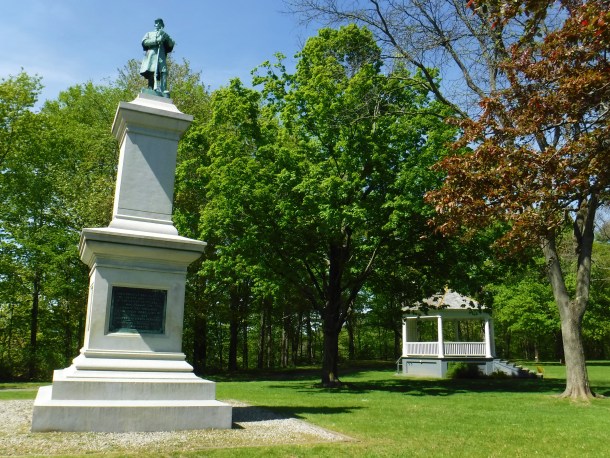
BRATTLEBORO — When this former hub town for Vermont’s Union troops first debated how to honor its Civil War soldiers a century and a half ago, some locals proposed a plaque listing names while others promoted and ultimately unveiled a bronze plate limited to numbers.
This Memorial Day, that conversation is continuing.
Residents woke earlier this month to see the since-removed words “POCs Lives Matter Too” — the abbreviation standing for people of color — spray-painted on a veterans’ monument on the town common.
Many didn’t understand why anyone would deface such a marker. But local leaders soon received an email asking that they update the town’s Civil War record to account for black soldiers unrecognized by past generations.
“Choosing silence of identity erasure,” the message concluded, “is committing genocide.”
In response, officials say they’re well aware of the discrepancy — as well as another involving white soldiers of lower class — and wish the vandal had known of their plans to correct it.
The issue first arose five years ago when students at Brattleboro Area Middle School — located on a Civil War military campground that hosted a third of all Vermont troops — began researching the record with help from the town historical society.
Students discovered the fact that although the plaque notes 385 locals enlisted and 31 died in service, revised rosters have reported both numbers to be higher.
“This caused us to look more deeply into the question of who served in the military for Brattleboro,” a recent historical society report noted. “Were African Americans part of the mix? Were they included in the Civil War Soldiers’ Monument totals?”
Students learned that although several local men of color joined the Army, they didn’t travel with Vermont regiments but instead with a U.S. Colored Troops infantry out of Massachusetts.
“It’s a challenge to locate accurate information about something that happened over 150 years ago,” the historical society report continued, “especially if what you’re researching is not part of the dominant narrative already established by others.”
Students turned to the website vermontcivilwar.org and the book “Men of Color, to Arms! Vermont African-Americans in the Civil War.” They found at least five Brattleboro soldiers of color — some born locally, others said to be escaped slaves — aren’t recognized on the plaque.
Students also learned that several local white men had arranged for black men to serve in their place.
All told, Brattleboro’s Civil War numbers are believed to include 65 more enlistees and 10 more deaths that initially reported.
“These are discrepancies that should be remedied,” the historical society report concluded.
Local leaders were set to discuss how to do so when the Covid-19 pandemic hit, stripping all unrelated subjects off the Selectboard agenda until the spray-painting incident thrust the issue into the spotlight.
“I regret that I didn’t do some sort of an update where people would have known that this work was underway,” Town Manager Peter Elwell said at a recent meeting. “Some individual made an unfortunate choice to protest in a manner that was meant to call attention to this and, in the process, was very degrading to veterans and others.”
Local leaders agree the monument includes “a number of omissions” — not only soldiers of color but also “a number of white men of limited means,” according to Elwell.
“The details of the omissions are still being researched and therefore the corrective action we will ultimately take isn’t 100% clear yet,” Elwell said. “There will need to be some collaborative work with people in the community to decide what feels like the best way forward to correct this error.”
Vermont Civil War historian Howard Coffin has followed public controversies over Confederate monuments in the South but had yet to see an issue about Union memorials in his home state.
“This is the first incident I’ve heard,” he says, “but it’s a perfectly legitimate complaint.”
Coffin notes although such problems have yet to be publicized elsewhere, “it certainly is a fair question to ask.” Of the more than 700 black Vermonters recorded by the 1860 census, at least a quarter — specifically, 193 — served in the Union army, with 10 losing their lives.
Brattleboro has cleaned the spray paint from the marker, which actually commemorates 20th-century battles but was mistaken for the nearby Civil War monument. Veterans and residents alike are voicing support for efforts to update local counts.
“We would be honored to dedicate the memorial when all have been identified,” Brattleboro American Legion Commander Thomas Costello said. “These are our brothers and our heart aches for any of them who have not had the proper recognition.”
“I’m hoping this becomes an opportunity for us to rally around the understanding that history isn’t always as it has been presented to us,” Elwell added. “It’s important for us to find the truth as best we can and speak that.”
