


Mia Schultz of Bennington asked the authors of a study of the town’s police department why they didn’t call for a change at the top after issuing critical findings about perceptions of racial bias.
Schultz was one of several people who called into a Bennington Selectboard meeting Monday night to raise questions to officials with the International Association of Chiefs of Police, the organization contracted by the town last summer to conduct a review of the police department.
“Why wouldn’t you recommend personnel changes,” Schultz asked, specifically talking about the leadership of the department, which is headed by Police Chief Paul Doucette.
“That was not our task to look at personnel issues,” replied Dr. Jessie Lee, the report’s lead subject matter expert.
That was a matter for the town and its leaders, Lee said.
Instead, Lee referred to the charge of his organization, which was to look at the department’s policies, procedures, and practices to determine whether they “created opportunities for unfair, discriminatory, or biased policing activities.”
Some callers questioned whether the findings and recommendations in the report went far enough, while others sought more details on how those recommendations would be implemented to address problems identified within the department.
Several callers also spoke up in support of the department.
Donald Campbell, Selectboard chair, started Monday’s video meeting aired on CAT-TV, the local public access channel, said the hearing was about “letting the public, the folks from Bennington, to get their questions answered.” The Selectboard will take up the report throughout the summer in a “thorough” manner, Campbell said.
“We don’t want to do it in a half-baked way,” he said later in the meeting.
The report found no specific policies in the department that would “encourage systemic bias” in the department. But, the findings talked about the actions, and in some cases, lack of actions, adding to a perception of bias.
For example, the report stated, “What was found is the lack of policies that would strengthen opportunities to support members of the community who are most at risk for disparate treatment.”
In addition, the report found the police department lacked “full and detailed data, policies, and vision and mission statements that clearly address bias-free practices.”
The IACP report also found that some of the department’s policies were nonexistent or in need of updating. There is no hate crime reporting protocol, for example.
The report made more than two dozen recommendations, from regularly updating policies to calling for the creation of a civilian oversight board with representation from diverse populations of the community.
Carl Maupin of the IACP said during the meeting that while parts of the report “may seem critical,” those items were meant to be “critical in a constructive way.”
Several callers Monday night talked of a part of the report that referred to the department as displaying a “warrior mentality,” which, the document stated, has helped to fuel mistrust.
The report added, “Over time, Bennington’s police practices have sown deep mistrust between parts of the community and the department, undermining the agency’s law enforcement legitimacy.”

One caller specifically asked how the department can move from that “warrior mentality” to a softer approach.
Lee said the department had already taken some steps to address that, including redesigning its website and allowing for a mechanism for people to submit complaints or praise.
Another caller didn’t pressed officials for more concrete cultural changes, beyond revamping the department website.
Lee said police uniforms could be made to look less “tactical,” training and hiring practices could be improved and the department could adopt community policing concepts.
Shawn Pratt, another caller, said the report didn’t tell him anything new.
“We already knew there was mistrust in the community,” Pratt said.
Pratt then talked about how many people in Bennington wanted to see the problems with the police department go away.
“But it’s not going to go away,” Pratt said.
There were callers who also offered praise for the department, including Tom Dee, Southwestern Vermont Health Care’s CEO and president.
Dee referred to his interaction with the department and its chief, Doucette, as “positive” and “collaborative.” He also said the department has been a “supportive partner in many initiatives.”
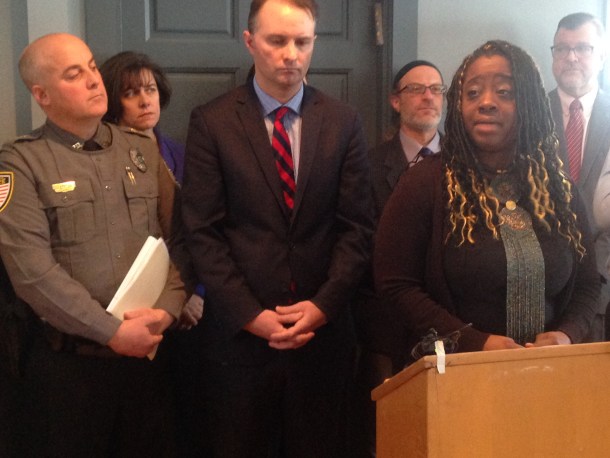
The report follows the American Civil Liberties Union and NAACP calling on Attorney General TJ Donovan more than a year ago to open an investigation into the handling of evidence related to allegations of threats against Kiah Morris.
Morris, in the summer of 2018, opted not to run for reelection to a third term in the state Legislature, citing, in part, racial harassment. No one was ever charged with a criminal offense stemming from the racial harassment or any other incidents that had been reported to police, including a break-in at her home.
Donovan declined to conduct that review. Instead, he told the town it would be better if it hired an outside entity to do that investigation.
The report conducted by the IACP takes a broader look at the policy and procedures of the department, and does not review the specifics of the department’s handling of the Morris cases.
One caller Monday questioned the size of the survey conducted of community members, with 404 responses in the town of roughly 15,000 residents.
“We made every effort to make it available,” Lee said, from pushing the surveys during meetings, and in the newspaper and on television.
Lee added some people offered him reasons for not taking part.
“Some people just did not believe the process was going to be fair,” he said, adding that others were afraid to speak out publicly about their concerns with the department.
“For those who have fear,” Lee said, “we hope one day they no longer have that fear.”
