


Editor’s note: Mark Bushnell is a Vermont journalist and historian. He is the author of “Hidden History of Vermont” and “It Happened in Vermont.”
The photograph gets much of the credit. But even without it, Ernest Gibson Jr. might still have transformed Vermont politics.
The picture isn’t pretty. It shows the handsome Vermonter, bloodied and perhaps slightly dazed, looking at a man tying a bandage around his head. The shot was taken moments after Gibson was wounded during a Japanese air raid on Rendova Island (part of the Pacific’s Solomon Islands) in 1943. The image appeared in the nation’s newspapers and in Life magazine, and forever linked the words “Gibson” and “war hero” in the public’s minds.
Gibson was already a minor celebrity before the photograph. National journalists regularly reported how this former U.S. senator, albeit an interim one, had enlisted in 1941, six months before the United States entered World War II, and was now serving as an officer overseas. Such selfless patriotism won him wide acclaim. For his valor, he was awarded a Silver Star and for his wound a Purple Heart.
The injury wasn’t severe enough to send him home. But his years in the military had been hard on his body and his nerves. He soon got word to his friend U.S. Sen. George Aiken that he wouldn’t mind returning stateside, and his transfer was soon arranged. Upon his return, Gibson spoke at war bond rallies and, two years later, returned to politics.
Gibson had met Aiken at the start of his legal career — Aiken was Gibson’s first client. During the 1930s, Gibson and Aiken, who were from Brattleboro and Putney, respectively, often carpooled to Montpelier, where Gibson worked as secretary of the Vermont Senate and Aiken as the speaker of the House, and later lieutenant governor and governor.
The foundation of their friendship may have been their shared political belief that government had a leading role to play in society. The Old Guard of the Vermont Republican Party, which wanted minimal government involvement, viewed them as liberals. But to Aiken and Gibson, the Old Guard was far too cozy with major industries, particularly power companies, which profited by harnessing and selling public resources.
Aiken was hardly the first major politician Gibson knew. He had grown up around politics. His father, Ernest Gibson Sr., served Vermont as a member of the U.S. House and later the U.S. Senate, and died in office in 1940. Gov. Aiken appointed the younger Gibson to serve out the final six months of his father’s Senate term. Some suspect that Gibson promised Aiken he wouldn’t run for the seat in that fall’s election. Aiken was eyeing the seat and won it in November.
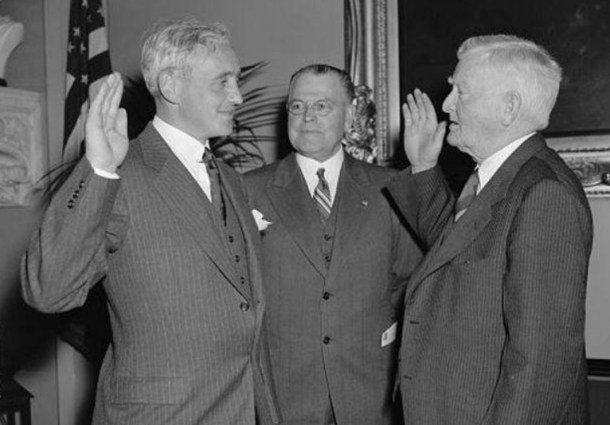
After completing his father’s term, Gibson joined the Vermont National Guard. Aiken tried to talk him out of it, pointing out that Gibson was 40 years old and had a wife and four children. Besides, Aiken argued, he needed a political ally. But Gibson was determined to serve.
While Gibson was overseas, Aiken wrote him letters suggesting that when the war ended, he and other returning veterans would have broad public support, especially among their fellow veterans, and could waltz into office. Perhaps Gibson would have ridden that tide to election even without the shrapnel wound, and the photograph.
Gibson had political ambitions, but was willing to wait his turn. His commander, fellow Vermonter Gen. Leonard “Red” Wing, gained fame leading troops in the Pacific and was greeted with parades when he returned to Vermont. People assumed he would run for governor in 1946. But Wing’s years of island fighting had taken their toll and he died of a heart attack in December 1945 at the age of 52.
After Wing’s death, Gibson decided to run for governor. It was a bold move. While he had been willing to step aside for a man who had outranked him in the military, he was unwilling to do so for a top-ranking member of the state Republican Party. Gov. Mortimer Proctor was seeking reelection. For the sake of party unity, many thought it was Gibson’s duty to let the governor run unopposed in the primary. (In those days, winning the primary was akin to winning the election. Vermont hadn’t elected a Democratic governor since before the Civil War.)
Opposing a sitting governor of one’s own party, especially one named Proctor, took guts. Mortimer Proctor was a member of a wealthy family of marble magnates and the fourth Proctor to hold the governor’s office.
By making his run, Gibson was also challenging the system by which Republicans engineered an orderly succession of top officeholders. Politicians were expected to work their way up from speaker of the House to lieutenant governor to governor. Gibson argued that this line of succession was “outmoded” and “unwholesome” and blocked “able men at the height of their ability” from higher office.
But Gibson wasn’t the first one to break Republican traditions. By running for lieutenant governor in 1940, Proctor had violated the so-called Mountain Rule, the tradition by which candidates from the east and west sides of the Green Mountains alternated who would hold statewide office. To balance power within the state, the lieutenant governor and governor were supposed to be from different sides, but Proctor, a west-sider, had served two terms under Gov. William Wills, a fellow west-sider. Then, in 1944, Proctor had succeeded Wills, another violation of the Mountain Rule. The system dated back to the late 1700s, a time when the entire Legislature would rotate where it met in the interest of balancing power between the state’s geographical regions.
Aiken declined to endorse either candidate, but predicted that Gibson would win, which was as good as an endorsement for many. Aiken was right. Gibson defeated Proctor in the primary with 57% of the vote. It marked the only time a sitting Vermont governor has ever lost a primary.
But Gibson did more than challenge how Republicans got elected; he also challenged what they stood for. Once in office, he made ambitious proposals involving education, health care, public safety and workers’ rights.
Gibson sought to improve education by advocating better pay and retirement packages for teachers and state support for bus service for high school students. He noted that roughly one third of Vermonters didn’t stay in school past eighth grade. Rural bus service, he argued, would reduce the number of dropouts.
Gibson proposed creating a state police force to improve law enforcement, a move that rankled local sheriff departments.
He pushed for more generous unemployment benefits for veterans and other workers.
Gibson advocated better health care for Vermonters. During the First and Second World Wars, Gibson said, almost half of Vermont draftees were rejected for physical or mental problems. He pushed for annual medical and dental exams for schoolchildren and the creation of mobile health clinics to serve rural areas.
Gibson also challenged the political clout wielded by power companies and opposed the flooding of Vermont farmland for the creation of dams that would generate power that would be sold to Vermonters.
To fund his programs, Gibson called for a more progressive income tax system, which he said would slightly raise taxes on the wealthy to lighten the tax load on poorer Vermonters.
Gibson managed to institute many of his proposals. Teachers got better pay and retirement benefits, the unemployed got more generous support, the state police was founded, the state’s normal schools became teachers colleges and, to help pay for it, the state’s income tax system became more progressive. The nation took note. Soon, the press was calling Gibson “Vermont’s New Dealing Yankee.”
Gibson’s most lasting legacy isn’t one particular policy. Rather, it is helping create what became known as the “Aiken-Gibson” wing of the Republican Party, which promoted a more modern and moderate vision for the Grand Old Party.
Postscript: Readers add details to Gibson saga
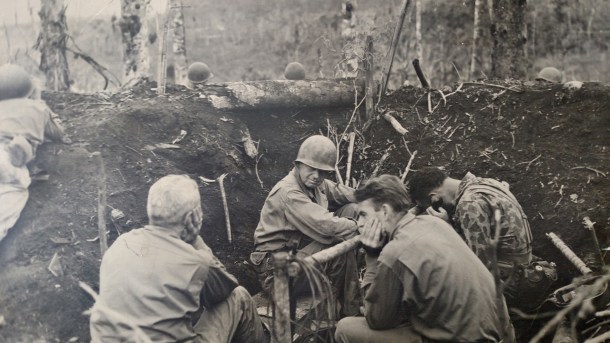
A pair of readers responded to this column by providing details that bookend the story. Margaret Gibson McCoy, the governor’s granddaughter, sent a photograph of Gibson talking with Gen. Leonard Wing, a fellow Vermonter, during World War II. Many people believed that Wing would be elected governor of Vermont after the war, but he died before the election. Gibson ran instead and won.
Coincidentally, McCoy works with a relative of Wing, who told her that the general’s son gave the nominating speech for Gibson at the Republican convention. “Small world Vermont,” she wrote.
Jim Leddy, a former state senator from Chittenden County, wrote to explain why President Harry Truman, a Democrat, nominated Gibson, a Republican, to a federal judgeship in Vermont after his time as governor. Presidents virtually always nominate candidates from their own parties. So when the judgeship for the U.S. District Court for Vermont became open in 1949, everyone assumed Truman would appoint a Democrat.
“The logical candidate and heir apparent was U.S. Attorney Joseph McNamara of Burlington,” Leddy wrote. “It looked like a slam dunk, until Governor Gibson worked some behind the scenes magic with President Truman, calling upon his friendship (and his father’s before him) with Truman.” Both Gibsons had known Truman while serving in the U.S. Senate.
Vermont Democrats reacted with anger to the surprise appointment, Leddy said, which Truman defended by citing his long-term friendships with Gibson, and “his confidence in Gibson’s considerable and broad experience over many years.
“Less public but more telling,” Leddy continued, “was a private comment from President Truman, to the effect that Gibson was his friend and besides, ‘What did the Democrats in Vermont ever do for me, or for Roosevelt?’ ”
Truman had a point. In FDR’s four presidential elections and Truman’s one, Vermont’s electoral votes always went to the Republican candidate.
Clarification: The headline on this article was changed to reflect that Gibson was not the first moderate Republican governor in Vermont. George Aiken.

