

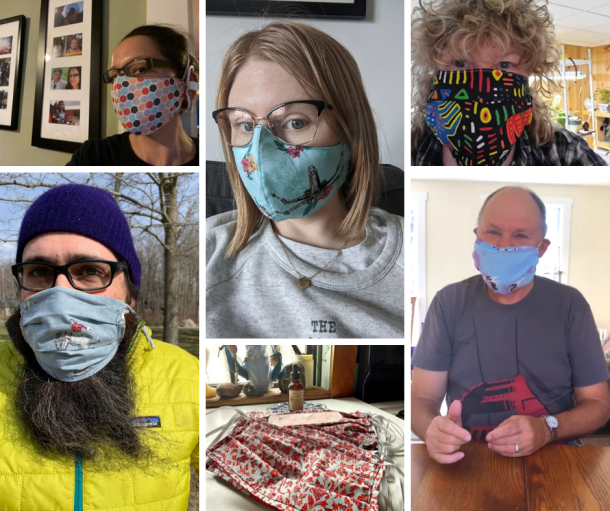
As mask shortages due to the coronavirus crisis began to make headlines around the world, many Vermonters stepped up to make cloth coverings for friends, neighbors and health care workers.
For Andy Kolovos, a folklorist at the Middlebury-based Vermont Folklife Center, the masks aren’t just a safety precaution — they are a physical manifestation of how Covid-19 is shaping our culture.
“They represent people’s need to form connections with others outside their immediate circle,” Kolovos said. “Masks become a way people can use skills to create something both aesthetic and functional.”

In the weeks since the CDC recommended that all Americans wear masks in public, the number of people making masks has mushroomed. Kolovos said it’s a transformative cultural shift worthy of remembering for posterity.
“We’re taking these traditional skills of tailoring and seamstressing, and we’re reinventing them to apply them to the needs of the present,” he said.
To document that trend, the Folklife Center earlier this month launched a new project: “Show Us Your Masks.” The Center is asking Vermonters to share pictures and designs online that will be added to an historical archive.
In the comment section, mask-makers compliment each other’s work, debate over fabrics and designs, and give tips for solving problems, like: How to make the best mask for glasses-wearers?
“Whether you’re giving them away to people in supermarkets or hospitals, or neighbors or family members, it’s a way of doing something when there’s not much we can actually do,” he said. “Mask creation becomes this extension of storytelling — it’s a way to communicate with something physical.”
As the photos come in, the Folklife Center adds the images to its archive, documenting this period in the state’s history.
“Right now, the experience of everyday living is super different for everybody compared to what it was a month ago,” Kolovos said. “This will hopefully give us the opportunity to be able to look back on this time period to help us preserve this sense of what it was like for people.”
The Center is also asking Vermonters to record their thoughts or interview friends and family about what life is like right now.
The audio project includes prompts like “How has your experience of time shifted or changed?” What are your feelings about school being closed?” and “What are you laughing about today?”
“It’s a really valuable way to understand life, understand our fellow Vermonters, and understand what it means to be human,” said Mary Wesley, education specialist for the Folklife Center. “We want to put those tools in everyone’s hands as much as we can.”
There are also regular “Story Circles,” Wesley said, where Vermonters can virtually gather to talk through those questions as a group.
Both projects are initial stages, but Wesley anticipates participation will grow.
“People will be responding to this time for months and years to come,” she said. “We’ll continue to do interviews and invite people to reflect on their experiences. There’ll be a need for those things to continue to exist even as we move out of these intense days.”
Get the latest statistics and live updates on our coronavirus page.
Sign up for our coronavirus email list.
Tell us your story or give feedback at coronavirus@vtdigger.org.
Support our nonprofit journalism with a donation.
