


VTDigger is posting regular updates on the coronavirus in Vermont on this page. You can also subscribe here for regular email updates on the coronavirus. If you have any questions, thoughts or updates on how Vermont is responding to Covid-19, contact us at coronavirus@vtdigger.org
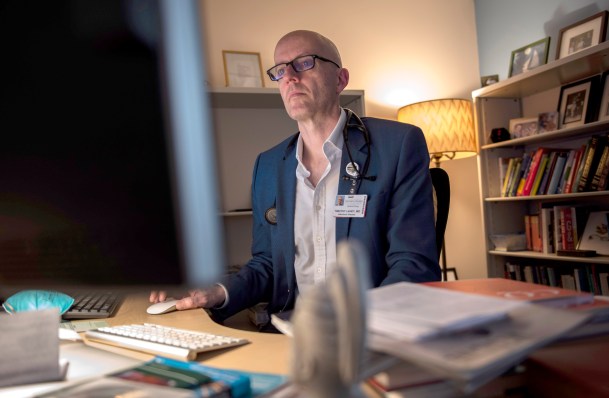
When Dr. Tim Lahey first heard about Chinese hospitals inundated with Covid-19 patients, he immediately started planning for a similar event in Vermont.
The infectious disease doctor and director of ethics at University of Vermont Medical Center convened his ethics team and posed a question: If the hospital didn’t have enough supplies to care for all of its patients, who would doctors prioritize? Who would live and who would die?
Lahey and his colleagues aren’t the only ones preparing for a surge scenario.
What was once an abstract philosophical question has become a pressing point of concern as rising numbers of desperate people sickened by the novel coronavirus have overwhelmed hospitals around the world. Doctors have had to make agonizing ethical choices about who gets treatment and who doesn’t. In Italy, doctors reportedly didn’t provide ventilators to those over the age of 60. Hospitals in China denied treatment to patients with other medical needs. New York has no statewide policy, leading to inconsistent outcomes between hospitals.
Vermont hasn’t yet seen a dramatic influx of patients; the state has identified 812 Covid-19 cases since the beginning of the outbreak. As of Sunday, 53 suspected or confirmed Covid-19 patients were hospitalized, well within the hospital system’s capacity. Thirty-eight people have died from the virus.
The infection rate appears to be flattening, but the state could still see a surge, said Tracy Dolan, deputy commissioner of the Vermont Department of Health. State officials have said that the number of Covid-19 cases is peaking, and hospitalizations will continue to rise through April. Dolan added that the situation could change rapidly if Vermonters don’t continue to follow social distancing guidelines.
Preparation for the worst case scenario can prevent — or at least mitigate — the most dire and traumatizing situations, so that health care workers aren’t “doing the thinking on the spot,” Lahey said.
Lahey and his team have developed new policies that prioritize access to ventilators based on medical criteria that indicate the likelihood of survival.
New ethical guidelines were issued last Friday for doctors at the UVM Health Network, which includes six hospitals in Vermont and New York. The goal? To “maximize life and reduce suffering” in a way that is “fair, transparent, legal and wise,” according to the draft document.
When advocates found a line in the UVM Health Network policy that could be construed as discriminating against those with developmental disabilities, Lahey and other leaders removed the language.
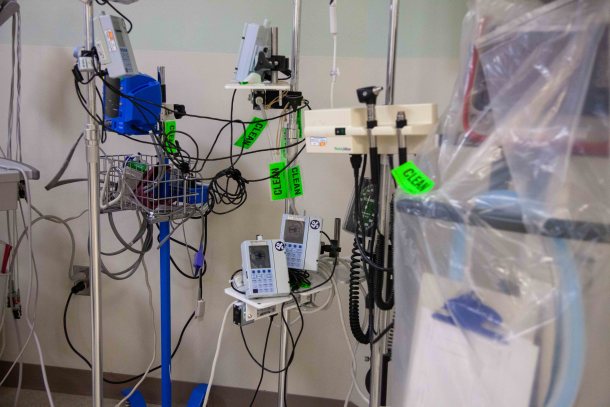
According to UVM Health Network’s policy, patients can be denied a ventilator outright if their chances of survival are low: if they have severe burns, for instance, are in cardiac arrest, have life-threatening cancer, or organ failure. To further narrow the field, patients are scored based on a set of medical criteria: kidney function, brain damage, blood pressure, and how well the individual can breathe on his own.
Those with the lowest scores will recover on their own. The highest scores are close to death and are discharged and given palliative care. Those in between are prioritized for care.
In the case of a tie, the process is randomized, based on a Google random number generator, a coin flip, or die toss.
Vermont hospital officials have discussed these “really difficult, vexing questions” with a growing sense of urgency, said Cindy Bruzzese, executive director of the Vermont Ethics Network.
It’s one thing to plan “when we aren’t in a crisis,” Bruzzese said. “It’s something else to be like okay, we have to now really figure this out to make a system that’s going to work for everyone.”
Who will recover?
This week, state health department will also release updated policies that will serve as guideposts for hospitals and health workers in the event of a Covid-19 surge.
The notion of prioritizing scarce patient resources is nothing new. A French surgeon developed the modern concept of triage during the Napoleonic wars. In theory, utilitarian ideals — doing the most good for the highest number of people — undergird policies across the country, said Nancy Berlinger, research scholar for the Hastings Institute, a New York-based bioethics institute.
The central question is: “Will this give this person a chance to recover from the illness?”
In a nation with diverse political and religious ideals, the answer to that question depends on who you ask.
Disability advocates have filed complaints with the federal government about rationing policies in several states. In Kansas, for instance, a disability group argued that hospitals would take away ventilators from people who regularly use their own ventilators, and wouldn’t provide care to those with neuromuscular disease. In the wake of complaints, Alabama removed language from its policy that stated that those with “severe mental retardation” or dementia would be “poor candidates” for receiving a ventilator.

Ethicists have debated whether a 20-year-old and a 60-year-old in similarly good health should be considered equally eligible for medical treatment, given that the younger person will likely live longer.
Many plans treat pregnant women as a higher priority for a ventilator. Some Catholic groups have called for hospitals to consider pregnant women as two lives rather than one.
Some states or hospital systems prioritize health care workers, as those who take on increased risk and will help others in the crisis, Berlinger said. But that policy raises questions about the value of community health care workers or hospital janitors, she said. Others have debated the treatment of political leaders, if the president or governor needed care.
The Vermont health department has been updating its Crisis Standards of Care policy, an 86-page document that addresses a wide array of disaster scenarios including natural disasters, terrorism, civil insurrection, and pandemic.
The most recent version of the policy, last updated in July 2019, included criteria that could have allowed doctors to deny patients with cystic fibrosis access to a ventilator. Under pressure from advocates, the state dropped that criteria in the updated version, according to Dolan.
The new policy sets standards unique to Covid-19, including policies to decide how to allocate intensive care unit beds or ventilators in the case of a shortage, and guidance for “fatality management” — how to treat and store dead bodies, said Dolan.
According to the state’s document, health care workers should provide care “without regard to factors such as race, gender, ethnicity, socioeconomic status, ethnicity, disability or region that are not medically relevant.” Hospitals can then implement more specific policies if they choose, Dolan said.
Some advocates are pressing for more explicit protection for people with disabilities.
Executive Director of Disability Rights Vermont Ed Paquin wrote two letters to Health Commissioner Mark Levine asking for even more explicit language to protect those with disabilities. There should be no room for alternative interpretation, Paquin explained.
“On the ground people are very busy doing what they do,” he said. “Unless they’ve really been given prior direction and are working under a plan, the kinds of consideration that they make may not be in their minds.”
Max Barrows, outreach director for Green Mountain Self-Advocates, made a similar request when he testified before the House Human Services Committee.
“We want the state to clearly say that decisions about who gets help should not be based on age or disability status,” he said. “That is discrimination.”
Dolan said she didn’t know whether the new policy addressed the concerns. The department would not share a draft policy. “We did get feedback, we’re taking it seriously, and we’ll take all of it into account, she said.
Others saw the policy as a step forward.
“Vermont has gone out of its way to remove all the implicit biases and [decisions about] whose life is worth saving,” said Susan Aranoff, a policy analyst for the Vermont Developmental Disabilities Council who helped lobby for the changes. The plan “is actually really good.”
A doctor’s prognosis

An impersonal, data-driven approach is better for doctors, too, said Josh White, chief medical officer at Gifford Medical Center. A scarcity of resources creates a tension: Doctors promise to care for the individuals in their care. But when resources are scarce, decisions must be made for the benefit of the community as a whole — at times, at the expense of an individual.
“In your career as a physician [prioritizing one patient over another] is the kind of thing you promised not to do,” White said.
In small communities such gut-wrenching decisions are even more traumatic, he added. The person who doesn’t get the ventilator could be your next door neighbor or the clerk at the grocery store. At Gifford, an ethics committee made up of board members, health care workers, and community members make the final decision.
They’ve made decisions about who gets personal protective equipment, White said. They’ve also decided which patients should come in for surgery. “We want to remove the decision from the provider at the bedside,” he said.
The same concern has led UVM Health Network to construct a system with multiple layers of bureaucracy, made to be as mechanistic and impersonal as possible.
A doctor scores the patient based on medical criteria in which “patients are compared on the same, impartial footing,” Lahey said. He can seek help from a team of doctors, and if they’re unsure, they can solicit advice from the Fair Resources Allocation Appeals Team.
That prevents an individual doctor from making decisions marred by emotion or implicit bias, and it shields the clinician from feeling “tortured by the decision,” he said.
The state and UVM Health Network have made wording changes in their protocols and are still in a back-and-forth with advocacy groups. Both aim to finalize and release their policies by next week.
Kirsten Murphy, executive director of the Vermont Developmental Disabilities Council, praised UVM Health Network in an April 9 email to advocates. The groups involved in creating the policy “have been remarkable for their responsiveness and quick action,” she said. “Because [the Health Network’s policy] is presented as a model, it seemed particularly urgent that there be no opening for misunderstanding regarding the rights of people with disabilities.”
That’s the Health Network’s goal as well, Lahey said.
“If I had a kid with cystic fibrosis or Down syndrome or [a condition that] has not been treated well in the history of medicine, I’d want some reassurance that someone’s thinking about me,” he said. “I’ve been encouraged that the consensus is a policy should be fair and transparent and treat everyone equally.”
Lahey hopes the policies won’t be needed at all. The increase in patients has leveled off; Gov. Phil Scott said Friday that the growth rate in new cases has averaged below 4% for the last 12 days. If Vermonters continue to remain at home, the UVM Medical Center may need surge sites or other facilities to care for patients, but Lahey said that “the most likely outcome” is that every patient will receive care.
The policies could stay on the shelf. “We hope it’s an academic exercise,” he said.
