


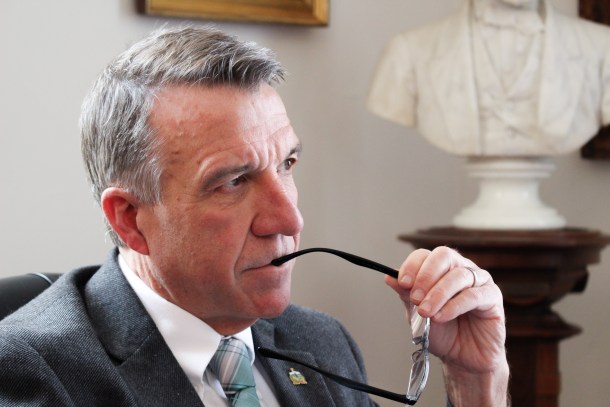
President Donald Trump on Monday set the stage for a showdown with the nation’s state governors, claiming it was up to the federal government to decide when to restart economic activity in the wake of Covid-19.
Gov. Phil Scott disagreed and said states — not the president — would decide when Vermont businesses could reopen and his “Stay Home” order lifted.
On Monday, the president appointed a new task force dedicated to getting people back to work and opening businesses and said the federal government would determine when states lift orders imposed to prevent the spread of the virus.
Scott pushed back at a press conference Monday.
“It didn’t take federal action to spur us into action and it’s not going to be the federal government that determines when we take appropriate steps here in Vermont,” Scott said.
Scott said he would rely on data and public health experts to determine how to slowly resume economic activity in Vermont. Picking an “arbitrary date” for states to reopen would be irresponsible, he said.
“If we have a false start, if all of a sudden we open up the spigot and people go back to work and all of a sudden everything spikes and gets out of control and we have to shut the spigot off again there’s going to be a lack of confidence in government,” he said.
However, Scott said Monday that it was his administration’s intention to open up all sectors of the state’s economy in the coming months. Last week, the governor extended his “stay home” order, which has temporarily shuttered many businesses, until May 15.
Scott said that his administration is looking for ways to send employees back to work “safely and responsibly” as soon as possible.
“Working closely with public health experts we’ll open up the economic spigot, a quarter turn at a time to do just that,” the governor said Monday.
The governors of New York, New Jersey, Connecticut, Pennsylvania, Delaware and Rhode Island announced Monday that they would be taking part in a regional approach to reopening their economies. Later in the day, Massachusetts said it would also take part in the coordinated plan.
The contiguous states will be working together on plans to open their schools and businesses at the same time, and carefully weigh public health risks before doing so, so one state’s action doesn’t cause the virus to flare up again.
“The reality is that this virus doesn’t care about state borders and our response shouldn’t either,” Rhode Island Gov. Gina Raimondo, a Democrat, said.
On the West Coast, Washington, California and Oregon also announced Monday that they would coordinate plans to reopen their economies. Washington Gov. Jay Inslee said a regional approach was needed to ensure the states have enough public health resources to prevent the virus from spreading as businesses open up again , The Seattle Times reported.
“This pact is about what do we do after we reduce some of our social-distancing, stay-home initiatives,” Inslee said. “It’s more of the issue of how are we going to have, as consistent as we can, testing and contact-tracing initiatives.”
The Scott administration has not been approached by any of the states involved in the Northeastern partnership, according to Rebecca Kelley, a spokesperson for the governor.
But she said that the governor is “open to a regional approach if it will benefit Vermonters and create consistency throughout the region.”
“So it is something we’d look at,” she said.
While Vermont hasn’t joined a regional group, Kelley said Scott had spoken with Govs. Charlie Baker of Massachusetts, Chris Sununu of New Hampshire and Janet Mills of Maine in the days leading up to their decisions to close down businesses and schools.
“Everybody’s made their own decisions, but they’ve at least been having those conversations,” Kelley said.
Meanwhile, Trump insisted Monday the decision to reopen economic activity was up to the federal government. The president has been angling to restart the U.S. economy as soon as May 1.
“It is the decision of the President, and for many good reasons,” Trump tweeted.
“With that being said, the Administration and I are working closely with Governors and this will continue. A decision by me in conjunction with the Governors and input from others, will be made shortly!”
Jared Carter, a professor at the Vermont Law School, and an expert in constitutional law, said the courts have generally ruled that states, and not the federal government, that have the authority to manage themselves during public health emergencies.
“I think it’s going to be very hard for the president to open up states, as he says, if the states deem that it’s not appropriate for them to do so at that time,” Carter said.
Carter said this precedent was set more than a hundred years ago, pointing to one 1902 case in Louisiana in which the U.S. Supreme Court found the state had the right to involuntarily quarantine a ship full of European passengers while New Orleans was facing an outbreak of yellow fever.
Another Supreme Court case he mentioned, Jacobson v. Massachusetts in 1905, determined that local officials could mandate vaccinations during a public health crisis. At the time smallpox was spreading throughout the state.
Carter noted that while there haven’t been cases dealing with a pandemic of this scale, these examples show that states have the authority to act independently during a public health emergency.
“If the precedent were followed, I think Trump would lose,” he said.
The governor is still declining to provide a timeline for when he expects he will allow business to start up again in Vermont.
However, when asked a question about farmers markets, which are currently unable to operate under Scott’s executive order, the governor said they would likely be “amongst some of the first” businesses to open up.
Lt. Gov. David Zuckerman, who owns Full Moon Farm in Hinesburg, called on the Scott administration Monday to deem farmers markets “essential” businesses during the pandemic.
Zuckerman argued that with their “open air and spread out nature,” farmers markets are safer than grocery stores.
“Also, farmers markets which provide basic food needs are at least as essential as liquor stores and convenience stores that are being allowed to remain open,” he wrote in a letter to Vermont Secretary of Agriculture Anson Tebbetts.
During his Monday press conference, the governor didn’t want to estimate when the markets would be allowed to operate to avoid “over promising.”
“There’s no one who wants to open the economic spigot more than me,” he said. “So we will do so just as quick as we possibly can.”
