

VTDigger is posting regular updates on the coronavirus in Vermont on this page. You can also subscribe here for regular email updates on the coronavirus. If you have any questions, thoughts or updates on how Vermont is responding to COVID-19, contact us at coronavirus@vtdigger.org
A month after Southwestern Vermont Medical Center in Bennington saw the state’s first coronavirus patient, hospital officials and peers in Brattleboro and Rutland are planning for a possible influx.
“Right now we’re seeing a slow transmission, but positive tests and sick patients are increasing,” SVMC chief medical officer Trey Dobson said. “We’re working together and coordinating planning efforts.”
The Bennington facility, Brattleboro Memorial Hospital and Rutland Regional Medical Center — southern Vermont’s three main health care providers — have stopped elective procedures and started to rearrange and repurpose space to accommodate a potential surge of Covid-19 patients.
“We’ve pretty much dismantled this place and put ourselves on war footings,” said Rutland Regional President Claudio Fort, who leads the state’s second largest hospital after the University of Vermont Medical Center in Burlington.
Rutland treats an average of 87 patients but could house as many as 132 with current staff, or 162 with outside help, and 195 with cots in public areas such as its conference center, Fort said.
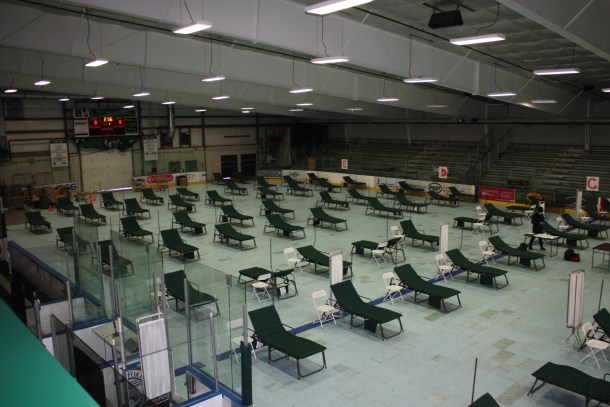
Rutland also has set up Castleton University’s nearby Spartan Arena to hold up to 150 cots, either for low-acuity non-Covid-19 patients or, in a worst case scenario, more with the disease.
Rutland has housed four coronavirus patients over the past week — three on ventilators — while its current overall census of around 60 totals only about two-thirds its normal number.
“It seems things have stabilized, but it’s still too early to tell,” said Fort, who continues to promote measures to prevent the spread of the virus including staying home and physical distancing.
Rutland’s biggest challenge so far is having to furlough about 150 of its 1,700 workers because of the curtailment of elective procedures.
“Our revenues are down by 60%,” Fort said. “We’ve had a strong financial balance sheet and reserves, so we’re in an OK position right now, but the future depends on the duration of this.”
Brattleboro Memorial Hospital recently received 50 cots from the state in case the local facility exceeds its capacity of 31 medical beds and 17 isolation-unit respiratory beds.
“We’ve totally retooled the hospital,” President Steven Gordon said. “We’re taking all precautions to prepare.”

Brattleboro has seen its patient census drop from an average of 30 to about a dozen. That has cut revenue by about 80% and led to furloughs for about 10% of its 600 employees.
Conversely, Brattleboro will face a shortage of professionals if it must care for people in cots as well as beds, so it’s seeking support from the Medical Reserve Corps, retired doctors and nurses, and health care students about to graduate.
The hospital also is partnering with the nearby Brattleboro Retreat, which is preparing space on its campus to serve as an isolation unit for people with both psychiatric and non-life-threatening symptoms.
In Bennington, the medical center is working to increase its patient capacity from its average of 35 to upward of 100.
“We’re opening up sections of the hospital that in the past have been used for other things,” said Dobson, using the example of its eight-bed endoscopy unit.
Although Bennington has generated state headlines for reporting two deaths among about a dozen Covid-19 patients, doctors can’t say whether the past foretells the future.
“The models that are used to predict this pandemic change every day but seem to be accurate for densely populated urban-core areas,” Dobson said. “What’s harder to predict is the rate of transmission if you live in a rural area.”
Likewise, the medical center won’t necessarily need to make room for most new cases.
“We’ve had around 35 people test positive in the community, but they’re doing just fine at home,” Dobson said. “The vast majority will not need hospitalization and can be managed by their physician over the telephone. If everyone stays at home and uses face masks in public, that will stall the spread of the disease to the point we can absorb the patients.”
Southern Vermont’s three main hospitals collectively have reported only three cases among employees. Local officials are working with the state to obtain both enough personal protective equipment to keep that number low as well as extra ventilators for a potential swell in coronavirus patients.
“There is a good spirit of cooperation and collaboration,” Fort said in Rutland. “Although we’ve had a pretty robust ongoing emergency preparedness plan, I have yet to find a chapter on this. This is a whole different deal. We’re planning for the worst and hoping for the best.”
