

VTDigger is posting regular updates on the coronavirus in Vermont on this page. You can also subscribe here for regular email updates on the coronavirus. If you have any questions, thoughts or updates on how Vermont is responding to Covid-19, contact us at coronavirus@vtdigger.org
Since Gov. Phil Scott issued an order last week aimed at reducing interstate travel during the COVID-19 pandemic, officials with the Vermont Agency of Transportation have been stationed at major state border crossings to monitor traffic.
Last week, the Agency of Transportation selected 28 “high-priority border crossings” along the New York, New Hampshire, and Massachusetts and Canada borders where officials are “counting vehicles,” according to a list compiled by the state.
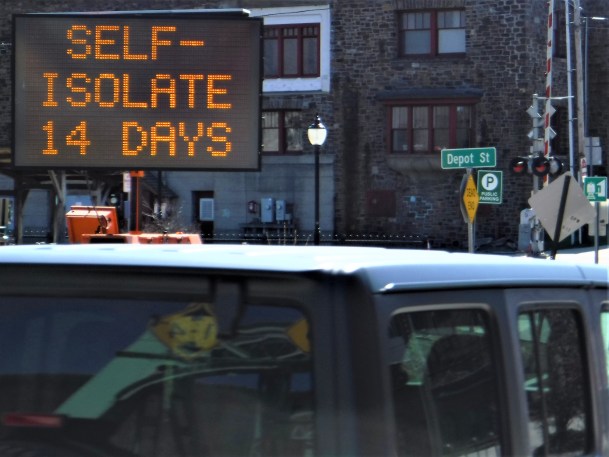
Scott’s order, which directs “non-essential” travelers from outside the state to self-quarantine for 14 days, came down March 30.
The governor said April 1 that the state had started to collect data about interstate traffic in Vermont because anecdotally, officials had heard that many people were still crossing the state border.
“We wanted to have some sort of baseline to determine that this was indeed the case,” Scott said during his press conference last Wednesday.
“And so we set up these points at the points of entry so that we could determine how people were coming into the state and from which states.”
The Agency of Transportation is not taking down out-of-state license plate numbers or referring information about drivers crossing the border to law enforcement officers, according to Stephanie Brackin, a spokesperson for the state.
Brackin added that the monitoring along the state’s borders “is not an effort to look at exclusively out of state traffic.”
“The State of Vermont is monitoring all traffic mobility to determine how effectively mitigation measures are reducing travel,” she wrote in an email.
Scott also said last week that officials weren’t taking down vehicle registration information, “just looking for colors of plates to determine who’s coming in.”
But the stops have raised concerns for some who live in the areas along Vermont’s border.
Sen. Dick Sears, D-Bennington, the chair of the Senate Judiciary Committee, said he’s heard from constituents in his district, and people in New York who commute over the border, who are worried about the presence of state officials.
He noted that one third of the people who work at Southwestern Vermont Medical Center, the local hospital in Bennington, live in New York state.
“I want to make sure people are still comfortable in going to work,” Sears said.
“I had one person tell me they’re going to rent a motel in Bennington because they’re an essential worker and they don’t want to keep going back and forth over the border,” he added.
Sears said that on Sunday he saw transportation officials on Route 279 in Bennington — which crosses into New York state — taking vehicle information down on clipboards.
The Bennington senator said he will be calling in state officials to testify to his committee later this week and wants to get a better sense of the information they’re collecting, and clarification on current border crossing policies.
Sears said he has “absolutely no problem” with efforts to see whether people are complying with Scott’s order.
“But on the other hand, those of us that live in border communities and that represent border communities I think need some assurance,” he said.

Senate Majority Leader Becca Balint, D-Windham, whose district falls along the state’s border with Massachusetts and New Hampshire, said she’s concerned about the message that stationing officials at the border could be sending inadvertently.
“I feel like just having that out there can fan what I see as already xenophobic impulses that some people have,” Balint said.
“I think it preys on our worst fears that we can somehow keep out a virus that’s already here,” she added.
“I don’t think that there should be an assumption that someone coming here is going to be acting in a malevant nature.”
While the Attorney General’s Office announced last week law enforcement had been directed to begin enforcing Scott’s stay-at-home order, the Vermont state police are not stopping drivers suspected of violating the governor’s Covid-19 mesures.
However, in recent days, the state police have received complaints about officers detaining drivers and telling Vermont residents to return to their homes, if they are not out on what is deemed essential business.
Adam Silverman, a Vermont state police spokesperson, said in a statement Friday the claims have been investigated and found to be unsubstantiated.
However, Silverman said police are worried that some may be pretending to be law enforcement during the Covid-19 crisis.
“The Vermont State Police also is concerned that individuals could exploit current circumstances to impersonate law enforcement officers,” Silverman said.
“Members of the public should ask for an officer’s ID if they are stopped and take note of the officer’s name and agency affiliation.”
“This would help police verify any subsequent complaints or investigate potential incidents of officer impersonation,” he said.
Kit Norton contributed reporting.

