

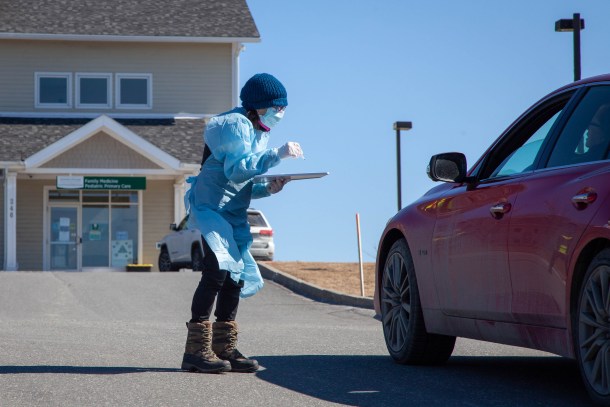
I am sitting in my car, number three in a line of seven. We’re in a Berlin parking lot outside two outpatient practice buildings that are part of the Central Vermont Medical Center system. To my left is an RV trailer that’s the temporary headquarters of CVMC’s coronavirus field testing station.
Two nurses outfitted head-to-toe in personal protective equipment (gowns, gloves, face masks, face shields and head coverings) make their way down the line, taking each person’s name and birthdate. This party is invitation-only; recent presidential statements notwithstanding, you can’t get a test just because you want one. You have to be referred by your health care provider.
Which I was. I spent most of last week with vague but powerful symptoms. They don’t match the usual coronavirus pattern of persistent dry cough and fever, but after several days of illness, my doctor made the referral. So here I am, along with my lucky compadres, waiting to receive our portion of this most precious resource: the coronavirus test.
We all stay in our cars, windows closed, advancing slowly every time a test is completed. Ahead of me is a big black pickup truck, so my view pretty much consists of a tailgate. As I wait, I listen to a press briefing by Gov. Phil Scott, which happened to be occurring at the time. The crisis in abstract comes out of the radio; it’s hard to concentrate given the reality I’m experiencing. It’s unlikely I have COVID-19, but I’m old enough to be at risk for serious illness.
The pickup pulls out. I pull up. A nurse stands outside. I roll down my window — a little — and again repeat my name and birthdate. She checks me off a list on her clipboard, then puts on a second pair of gloves and thoroughly scrubs her hands with sanitizer.
The second nurse goes to a window in the RV, and receives a plastic bag from a staffer within. She hands it to the first nurse, who carefully removes the bag’s contents — a long narrow test tube sort of thing, and a swab at the end of a comically long stem. She hands me a cheap facemask to cover my mouth, in case I happen to cough. I also receive a facial tissue and a printout telling me What To Do When You Might Have COVID-19.
I lean my head back a bit. The nurse gives fair warning: This will be uncomfortable, and the swab has to be in place for a full 20 seconds. She then carefully moves the swab all the way to the back of my nasal cavity. When it hits home, it is indeed uncomfortable — painful, even.
I start counting 20, fighting back the urge to sneeze. I don’t want to have to start this all over from scratch, nor do I want to waste a test. Or, for that matter, sneeze on a nurse.
My count, propelled by discomfort, is way too fast; it takes another five or six seconds past “20” before the swab is finally removed.
Immediately I sneeze — into the tissue and my elbow, facing away from the still-open car window. I sneeze again. The nurse tells me to expect results within 24-48 hours. I manage to stop sneezing long enough to thank the nurses for standing out in the cold windy March weather and dealing with all us potential carriers.
I drive off, sneezing several more times.
I return to my shelter in place … and wait.
I really don’t think I’ve got it, but there’s always that tiny seed of doubt — wondering if I could have been the Typhoid Mary of the Statehouse, or one of her victims. Thinking that maybe I got lucky and had a very mild case last week, but what if that was only Round One?
Still, I go about my work, thinking about the test at odd moments.
Almost exactly 48 hours after my swabbing, I get an incoming call while I’m on the phone. I let it go to voice mail. It’s labeled as “Unknown Number,” so I don’t check it until late afternoon. Finally I do. It’s a nurse at the COVID Information Center at CVMC.
“You are a ‘not detected,’ or a negative for coronavirus.”
Whew.
You know, that swab was worth it after all.
