


Jon Margolis is a political columnist for VTDigger.
Six United States senators did not vote Sunday when the Senate failed to invoke cloture on the $1.8 trillion economic stimulus bill. One of them, Republican Rand Paul of Kentucky, was in isolation, having been diagnosed with the COVID-19 virus. Four of the others were Republicans who had come into contact with people (including Paul) who had been carrying the virus, and were in voluntarily quarantine.
The other one is Sen. Bernie Sanders of Vermont. He wasn’t in Washington voting. He was in Burlington campaigning.
At about the time of the Senate vote on Sunday, Sanders hosted a livestreamed “roundtable” with three supporters of his presidential campaign: Democratic Reps. Alexandria Ocasio-Cortez of New York, Ilhan Omar of Minnesota and Rashida Tlaib of Michigan.
Assailing the Republican Senate bill as one that would give “handouts to large corporate interests without any strings attached,” (actually, there were a few strings attached) Sanders left little doubt that had he been in Washington he would have voted against cloture.
But he wasn’t.
The same question came to the floor Monday afternoon. This time Sanders was there. Like every Democrat except Doug Jones of Alabama, Sanders voted against cloture. All Republicans voted for it except the five absentees: Mitt Romney and Mike Lee of Utah, Cory Gardner of Colorado, Rick Scott of Florida, and Rand Paul.
Keane Bhatt, the communications director for Sanders’ Senate office, said Sanders did participate “remotely” in Sunday’s Senate activities.
“He was in communications with the Democratic leadership. He was on the phone with key Republicans. He was working through staff,” said Bhatt, who noted that in a “procedural” vote, a senator who is not there effectively casts “a no vote for cloture.”
Neither on Sunday nor on Monday was Sanders’ vote needed. It takes 60 votes to pass a “motion to proceed,” and this one didn’t come close. The vote on Sunday was 47-47, On Monday, it was 49-46.
Needed or not, in the not too distant past, a senator would try to avoid being the only absentee on a critical vote. Perhaps not wanting to be the only un-quarantined absentee two days in a row convinced Sanders to get back to Washington Monday.
Either way, his decision to campaign instead of legislate over the weekend provided some support for the suspicion that Sanders is still actively running for the Democratic presidential nomination.
Sanders may have said he was “assessing” his campaign after losing last week’s primaries in Florida, Illinois and Arizona. He may be way behind former Vice President Joseph Biden in the delegate count, with scant opportunity to catch up. The consensus among political observers – including some who are pro-Sanders – may be that Biden has the nomination sewed up.
But in the last few days, Sanders has not been acting like a candidate on the verge of surrendering. He’s been acting like the leader of a movement, asserting himself into the debate over the coronavirus, outlining an extensive set of proposals with his trademark populist flavor: “bail out working people, not corporate executives;” “prevent price gouging by pharmaceutical companies;” “cover all health care treatment for free.”
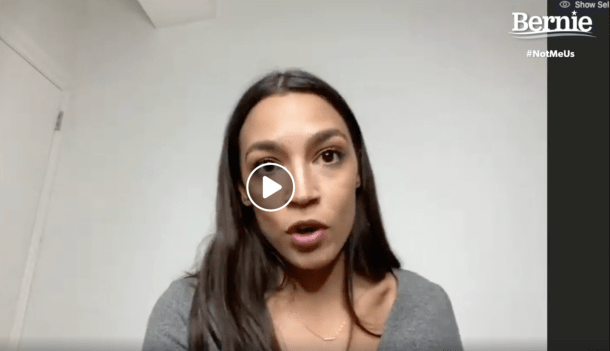
In these streamed online remarks, Sanders has tried to present himself as an authoritative leader, almost as if he were president rather than the likely runner-up for the other party’s nomination.
That’s a good strategy if Sanders is trying to use this virus-created “freeze” in the primary campaign to try to claw his way back into the race.
But it’s also not a bad strategy for pursuing his other option – to engineer a dignified surrender to Biden while not compromising his own position on the issues. Sanders appears to know that while what he calls his “movement” wasn’t big enough to win the nomination, it is sizable, and it is intense.
That intensity was evident during the Sunday roundtable as Sanders supporters “chatted” in their comments, many insulting to Biden, who hadn’t been visible since his victory statement last Tuesday, inspiring a “#whereisjoe” Twitter feed to percolate for a few days.
Perhaps in response, Biden livestreamed a 20-minute message Monday, expressing some downright Sanders-like sentiments. Congress, he said, should not “let big corporations off the hook” or provide any ”no-string corporate bailouts.”
Sanders, who has long had a cordial relationship with Biden, may know that it will be easier for him to get behind the former vice president than for some of his more fervent supporters.
One way or another, perhaps with lots of mail-in voting, the primary campaign is scheduled to resume soon. Democrats in Alaska, Hawaii and Wyoming are scheduled to vote on April 4. The Wisconsin primary is four days later. The New York, Delaware, Pennsylvania, and Rhode Island primaries are set for April 28. Biden is favored in most of those states. Sanders knows that.
But not everyone in his “movement” accepts it, and for now he seems to be paying as much attention to those supporters as he is to the rest of the Democratic Party.
Or to bills on the floor of the Senate.
