

VTDigger is posting regular updates on the coronavirus in Vermont on this page. You can also subscribe here for regular email updates on the coronavirus. If you have any questions, thoughts or updates on how Vermont is responding to COVID-19, contact us at coronavirus@vtdigger.org
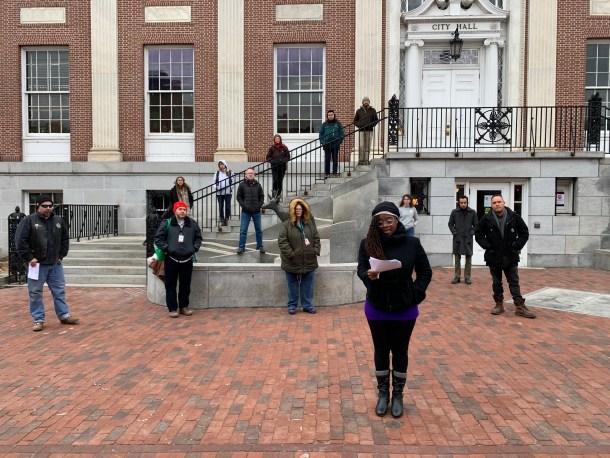
BURLINGTON — A group of social justice organizations gathered outside City Hall Tuesday to call for a community oriented response to the coronavirus outbreak and to read a list of demands.
“We just thought we should do one more thing before we go completely on lockdown,” said Rachel Siegel, executive director of the Peace & Justice Center.
The organizations included the Champlain Valley Democratic Socialists of America, Migrant Justice, Bread & Roses Collective, Burlington Progressive Party Steering Committee, Burlington Tenants Union and the Vermont AFL-CIO.
“What we’re trying to do here is share a message with the public but also model that we have to do things differently,” said state Rep. Brian Cina, P/D-Burlington. “This COVID-19 pandemic reminds us of our common humanity, and about how interconnected all people are to each other.”
The organizations’ demands were geared toward the social and economic impacts of the pandemic. The list included an immediate implementation of paid medical leave and unemployment benefits for public and private sector employees. They also demanded that workers receive child care now that schools are closed, and that schools provide food to children who rely on them for free or reduced breakfast and lunch.
They called for testing for the virus to be free and fully accessible to everyone, including farmworkers, domestic workers and gig workers regardless of their immigration status. They also demanded a moratorium on evictions and utilities payments, and called on the city and state government to provide housing, food and health care to people experiencing homelessness.
“The resources exist to meet all of these demands,” said Scarlett Moore of the Bread & Roses Collective. “Excuses based on fiscal responsibility are themselves grossly irresponsible and we have a unique opportunity to redirect funding to institutions for the public good.”
Kiah Morris, former state representative from Bennington, spoke about the need to tap into mutual aid networks to support neighbors in times of crisis.
“These efforts are underway to mitigate the devastating impacts that closures and disruptions are causing to those who will fall behind, the most vulnerable,” Morris said. “These are local responses, people willing to share their supplies, their food, their labor and their services to fill in the glaring holes within the social safety nets.”
Mutual aid networks have popped up around the state and on college campuses in recent days, and the Peace & Justice Center has a list of more than 20 places where people can post needs and offer services.
“We cannot all step back if we are all going to survive this present moment. We do this work for those who have no choice,” Morris said. “Mutual aid is not a spectator sport.”
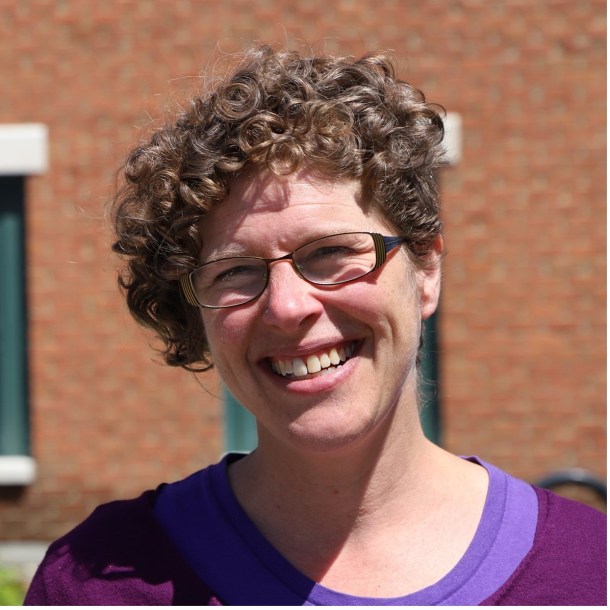
Siegel said that mutual aid has long been a survival strategy for vulnerable people, and this crisis has required organizers to ramp up their efforts.
“Poor and working class people, people who have been marginalized by society, have always done mutual aid,” she said. “At this point, there are more and more people being impacted by the situation so more and more people are going to need to tie into those mutual aid systems so as organizers we’re helping people access that and helping put the infrastructure into place.”
Speakers at the rally also called for unity, reminding people to practice basic precautions to keep everyone safe and reduce the risk of overwhelming the health care system. These precautions include frequently washing hands with soap and water for at least 20 seconds, avoiding public places when possible and remaining 6 feet away from others when in public.
“During this public health crisis we must come together to take better care of each other. Caring for the collective starts with caring for yourself by using universal precautions,” Cina said. “We need to be thinking about everyone right now.”
Siegel said that during this pandemic, local organizers are doing their best to meet the growing demand for their work.
“This is the work that organizers have always done,” she said. “It’s just a moment where our value is being seen by more people than when life is so-called normal.”
