


When Vermont artist Wolf Kahn won the U.S. State Department’s International Medal of Arts in 2017, the response was nearly — but not quite — unanimous.
“Wolf Kahn is to southern Vermont what Winslow Homer is to the coast of Maine, Georgia O’Keeffe to the New Mexico high desert and Claude Monet to the French countryside,” Brattleboro Museum & Art Center director Danny Lichtenfeld said at the time. “Wolf’s depictions of our barns, fields, trees and hillsides form the prevailing visual impression of our area for people all around the world.”
Only one person argued publicly with that: The artist himself, who died Sunday at age 92.
“I’m not trying to paint Vermont,” Kahn would say as he smeared pink, orange and purple oils and pastels on canvas to spark vivid thoughts of the Green Mountain State. “I’m painting paintings, and it turns out people think they look like Vermont.”
Kahn was born in Stuttgart, Germany, on Oct. 4, 1927, and by age 5 was drawing the musicians in the orchestra his father conducted. That stopped at 13, when he was beaten by a gang of Nazis (“they broke my bicycle, too,” he recalled) and was forced to flee his homeland on a “Kindertransport” train that saved Jewish children just weeks before the start of World War II.
Emigrating to the United States by way of England in 1940, Kahn graduated from New York City’s High School of Music and Art, served in the Navy and, under the GI Bill, studied with renowned painter Hans Hofmann before completing his bachelor’s degree in a single year at the University of Chicago and launching his six-decade career in 1951.
Kahn’s work can be found in the collections of New York’s Metropolitan Museum of Art, Washington, D.C.’s Smithsonian American Art Museum and the Los Angeles County Museum of Art, as well as those of President Bill Clinton, former New York City Mayor Michael Bloomberg and onetime U.S. Secretary of State Henry Kissinger.

Kahn’s work also is exhibited in Brattleboro, where he has spent each summer and fall since 1968, when a friend drove him around the region, only to recognize and follow a real estate agent’s vehicle to the hillside farm the artist soon made his second home.
Kahn liked to share the story of how the local newspaper introduced him to the community in a 1977 interview.
“The first question was, ‘How many paintings do you do a year?’ I said maybe 100. The second was, ‘How much do you charge?’ I said a couple of hundred bucks. The next time I had to have my barn re-shingled, all of a sudden the price went up.”
Kahn nevertheless thought highly of his neighbors, be they the farmers who lived next door or their cattle that grazed his land.
“I’ve gotten to feel like I’m no longer just a flatlander — I belong here and have a good time.”
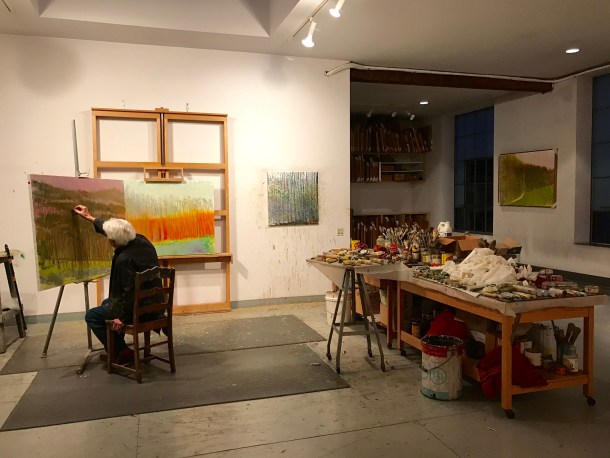
Critics were another matter. The late art historian Robert Rosenblum, visiting Kahn’s studio, once told the artist: “There is nothing here that Monet hasn’t done already.”
The New York Sun, for its part, wrote: “Can art this ingratiating be taken seriously? The question dogs critical appraisal of Wolf Kahn. His popularity with a broad public and the unclouded loveliness of his landscapes give rise to grumblings that he has not earned his keep.”
Then again, the latter newspaper folded in 2008, while Kahn traveled to Washington, D.C., in 2017 to receive the U.S. State Department’s International Medal of Arts for sharing his paintings with American diplomatic outposts worldwide.
When asked to describe his work, the artist usually demurred.
“I try not to — I never want to look at it the way an outsider would,” he said in an interview upon his medal win. “There’s a certain mystery in making paintings, and I don’t want to destroy that. What people think art’s about is not always what it’s about. Lately I’ve decided my painting isn’t about describing places or things, it’s much closer to just an expression of enthusiasm.”
Kahn voiced similar answers when asked personal questions.
“I’m really not interested in myself,” he says, “I’m interested in the world around me.”
Kahn and his wife, fellow artist Emily Mason, were married for 62 years before her death last December at age 87. Both continued to create to the end.
“I’m a bit of a workaholic — I don’t stop,” Kahn said recently. “People ask me, ‘You must be having a wonderful time.’ I say, ‘Sometimes I do, but more often I don’t because each painting has to go through stages. It’s not an easy profession. You’ve got to have a lot of perseverance.”
If not a problematic proclivity, he’d joke.
“Bad habit,” Kahn said of his work. “I don’t know how to do anything else very well.”
