

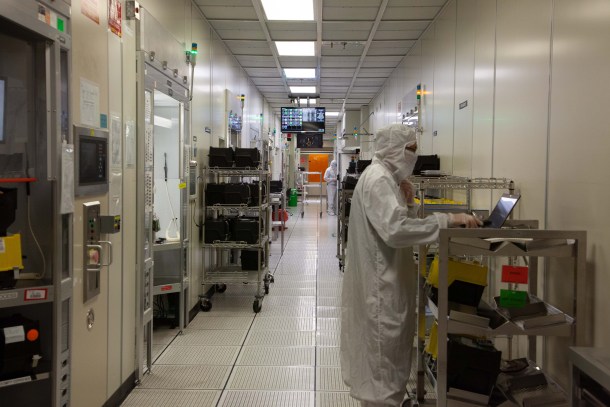
Starting Friday, workers who report to duty at Vermont’s largest employer are undergoing a quick body temperature check as they enter their building.
The body temperature check at Globalfoundries, the Essex Junction microchip maker, is one step of many aimed at curtailing the spread of COVID-19, the coronavirus that has shut down a selection of economic and social activity around the globe.
Globalfoundries, which has 2,300 Vermont employees, also took the step of creating a remote working policy for anybody who isn’t needed in the fabrication plant or in other areas. Other companies large and small around the state and the world have taken similar steps as they sought to heed calls from the U.S. Centers for Disease Control to minimize contact that leads to the spread of the disease.
“For our U.S. fabs in the Northeast, we have a work-from-home policy for what we call non-fab and non-operational employees,” said Laurie Kelly, vice president of global communications for the firm, which has 16,000 workers worldwide. Kelly had herself relocated her office to her home in Saratoga Springs, New York. “These are essentially people who are not part of the operations of producing our wafers, running our actual facilities … people like finance, legal, HR, communications.”
Discouraging situations that involve close contact with others is at the heart of the CDC’s strategy for mitigating the rapid spread of the virus. At the beginning of last week, as cases of the coronavirus started to multiply in the U.S. – and in Vermont 12 cases as of Monday afternoon – companies started to institute sanitizing and disinfecting policies. Almost all of Vermont’s colleges and universities asked students to leave the dorms and complete their classes online, at least for the foreseeable future.
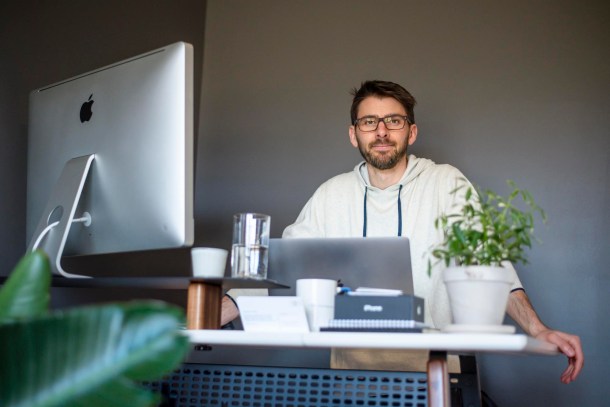
Ethan Bechtel, the CEO of OHMD, a health care communication platform with 20 employees, usually works with three others at the VCET co-working space in Burlington. Another 17 employees are already working remotely all over the country. Friday, Bechtel and his three Burlington colleagues decided to leave VCET for a while.
“We don’t want to be part of the spread of the disease,” said Bechtel, who is now learning how to share the home workspace with his wife, who works for a Big Four accounting company that’s based in New York City and always works at home. “We’re all relatively young, so we’re not worried about ourselves,” said Bechtel. “But we obviously work in health care and I’ve spent over a month at this point understanding the data with COVID-19 and what makes it dangerous.”
Companies as diverse as Vermont Gas, Mamava, Burton Snowboards, Northeast Organic Farming Association of Vermont, and Hubbardton Forge also sent home the workers who could do their jobs remotely or said they would do so starting this week.
The Scott administration is “strongly encouraging” state employees whose jobs can be done remotely to make plans to telework if it is possible.
For many people, remote work has long been a way of life. Michael Ly, who owns the Burlington-based accounting company Reconciled, has 29 employees, working from nine U.S. states. He just couldn’t find the people he needed within the candidates who applied from Vermont. Ly said he works actively to connect people so that they get a facsimile of the social and professional contact that workers do when they’re seeing colleagues regularly in the office. Reconciled uses programs like Slack and Zoom to connect and maintains what they call a virtual lunch room that anybody can enter at any time.

“There are pluses and challenges to working remotely, especially isolation,” said Ly. “If a company hasn’t created the culture and rhythms in order to engage employees, they can lose a ton of productivity.”
Jax Willey, a recruiter with the Derby-based Orion Global Talent, works from her home in Coventry. Four other recruiters work remotely from their homes in the Northeast Kingdom. She said when she’s recruiting for remote jobs, she can use that aspect of the position as a selling point.
“People feel empowered when they are not micromanaged, and they are more motivated to do a good job because they have that ownership,” Willey said. “When people are micromanaged or on a time clock, they just don’t feel trusted, so they are less likely to produce as well as somebody who is given that freedom.”
She added that when she’s recruiting, flexible and remote work is often more important than salary.
“The flexibility of having work-life balance empowers people,” she said. “If you have to clock out and get a black mark against you for taking your child to the doctor, the employee has resentment and won’t stay at the company long-term if they can help it.”
Remote work policies multiply
To avoid the spread of the virus, leaders of the Vermont Legislature announced Friday that lawmakers, too, will soon be working remotely – at least for a week. Lake Champlain Chamber of Commerce did as well. Dealerpolicy, the Burlington-based software company, announced Friday it will temporarily move its employees out of its national headquarters and call center on Monday.
“We have equipped and empowered our team members to work remotely,” the company said in a statement. “This will enable them to also execute personal plans to thwart transmission of the virus.”
Globalfoundries is going one step further. Kelly said that a member of the company’s Environmental Health and Safety Team will use an infrared thermometer to scan the forehead of every person who enters to make sure nobody’s coming in with a fever. The company has been doing something similar in their Singapore office for a while now, said Kelly. The new policy applies to Globalfoundries facilities in the U.S. Northeast. Globalfoundries also has U.S plants in East Fishkill and Malta, New York, as well as plants in Singapore and Germany.
“Because of working from home, there are obviously far fewer people coming in,” she noted of the temperature-taking.
“People are going to have to adapt to working differently for a little while,” she said. “The advice we have received from our colleagues in Singapore is that for the first couple of days, maybe a week, it’s unsettling. You’re trying to figure out how things operate. And then you settle into a new normal.”
VTDigger is posting regular updates on the coronavirus in Vermont on this page. You can also subscribe here for regular email updates on the coronavirus. If you have any questions, thoughts or updates on how Vermont is responding to COVID-19, contact us at coronavirus@vtdigger.org.

