

Editor’s note: VTDigger is posting regular updates on the coronavirus in Vermont on this page, where you can also subscribe for regular email updates.
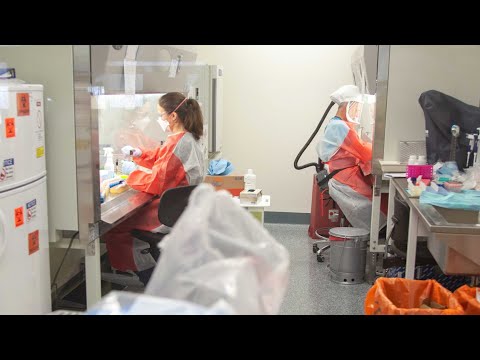
Microbiologists Alan Finn and Valarie Devlin peered at rows of possible coronavirus specimens in vials at the state Department of Health lab in Colchester.
Their protective gear made them appear like unidentifiable contours of people: clad in brightly colored smocks and gowns, gloves and masks, illuminated by the lab’s glaring light. Devlin transferred a set of vials from the fridge; a few feet away, Finn extracted the RNA from another set of samples to test for the virus.
In one instance Wednesday, they apparently found a case — that evening, the Department of Health announced results showed the state’s second presumed positive test.
As the virus has spread, the state’s lab is scaling up. The facility, which is responsible for all the state’s testing, is doubling its testing staff from the usual six employees, adding six of its microbiologists to help with work. Administrators and lab staff are also working longer hours, according to acting lab director Helen Reid.
By Thursday, the state had tested 99 patients. Two of those tests had come back positive — one in Chittenden County and one in Bennington County. Both patients are hospitalized.

As some states report a shortage of test kits, Reid said she believed Vermont is doing enough.
“I think we’re taking the right approach in terms of working very closely with health care providers to make sure they’re clear about what the [testing] guidelines are,” she said. “That’s the best we can do is have that really tight partnership with our health care providers. We’re absolutely doing that.”
Reid said she expected the lab would reach its capacity of 78 tests a day by later this week, but she downplayed concerns of testing backlogs; The capacity to do more tests will rise when the lab trains additional staff.
The state lab, a glossy building just off of I-89, is ground zero in Vermont’s coronavirus testing effort. Lab workers are following their pandemic flu plan, which they train for several times a year. They’ve set aside a training laboratory specifically for COVID-19, even while most of the lab’s 46 employees continued with their normal operations, testing samples including soil and water.
The lab gets testing deliveries multiple times a day, according to Reid. Most come from hospitals around the state. Some come from clinics, or from the drive-up tests offered at Southwestern Medical Center in Bennington.
A doctor first approves a patient for testing, based on travel history, symptoms, or risk for contracting the virus. Clinicians take a swab from the throat or nose, or ask the patient to spit in a cup so they can send in the sputum to the lab. Health care workers follow strict procedures for sampling: wear a mask, gloves and gown. And, of course, apply lots of hand sanitizer.
Most doctors submit at least two samples, according to Jessica Chenette, a microbiologist who helps with the process.
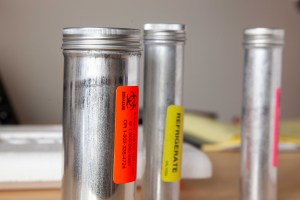
Samples go into a vial, along with a “transport media,” which preserves the virus. Vials go in a CDC-approved styrofoam box, complete with an ice pack to keep the contents cold. A courier service, hired by the state or by the hospital, crisscrosses the state driving samples to the state lab.
From the time of the test, patients can receive an initial result within 24 to 48 hours.
Lab workers such as Devlin and Finn take the samples through a three-step process. They extract genetic material, the RNA, from the patient cells. The lab then runs a molecular test that amplifies the genetic material, and determines whether coronavirus RNA is present. Then they analyze and interpret the results.
The lab only tests for the coronavirus — not influenza or other viruses, Chenette said.
Any positive test is considered “presumptive.” The lab then ships the tests overnight to the Centers for Disease Control and Prevention in Atlanta for confirmation. That takes roughly an additional 48 hours, Reid said.
The state has enough testing materials on hand now, but some shortages are expected. The CDC has notified the lab that there will be backlogs. For now, the state is receiving a two-week supply at a time and has enough test kits, pipettes, sterile cups and protective equipment, to last through the end of March, according to Reid.
Reid downplayed concerns of a shortage after that period. “We have what we need right now, and we’re monitoring it every day,” she said.

Should an outbreak occur in Vermont, the lab is ready, according to Reid. “Our staff, this is what they’re passionate about. We’re prepared to handle this. We know the precautions to take,” she said.
“Our staff have said from the beginning of this outbreak, ‘this is not our first rodeo.’”

