

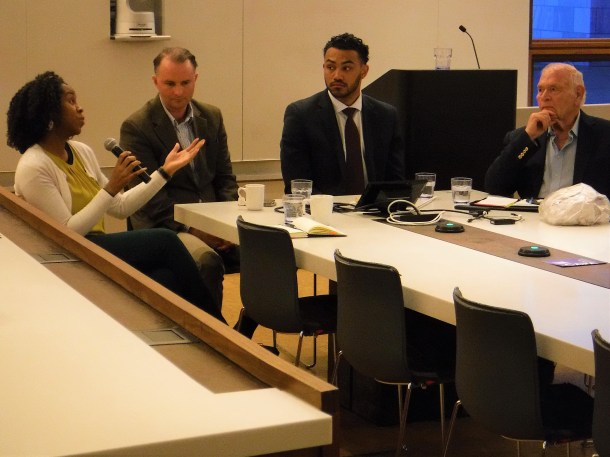
BENNINGTON — When Bennington College invited state leaders to speak about racial justice, many figured attendees would focus on lingering questions surrounding local harassment that spurred former Rep. Kiah Morris to resign two years ago as the state’s only black female legislator.
But the 40 people at the Center for the Advancement of Public Action Symposium on Monday night came with a list of other concerns — starting with the fact the event was scheduled on a private campus on the outskirts of town rather than at a public space in the community.
“Look at where we’re having this meeting,” said Bennington resident Shawn Pratt, wearing a black Muhammad Ali T-shirt. “There are people out there suffering — not only the black people, but the poor white people who can’t even be here. They can’t come all the way across town.”
Others at the “Conversation about Diversity and Racial Justice in Vermont” asked what leaders were doing to stop racism in the nation’s second whitest state, where the number of hate crimes reported by police is at its highest since the Federal Bureau of Investigation began collecting data in 1995.
“There’s a lot of talking going on, but what are we doing?” said Liz Filskov, a regional organizer with the grassroots group Rights & Democracy. “And is there evidence that what we’re doing is impactful?”
A panel that included Bennington County state senators Brian Campion and Dick Sears pointed to the recent hiring of fellow speaker Xusana Davis, the state’s new executive director of racial equity.
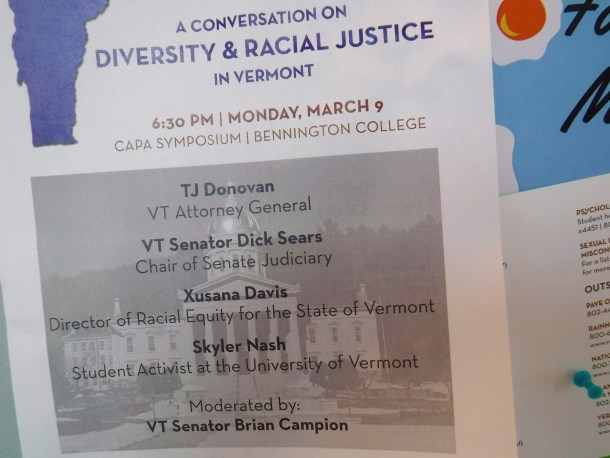
“When we think about race, we tend to think about the legacy of slavery in the United States,” Davis said. “But I do often encourage my partners in this dialogue to remember that we have Latinos here in Vermont, we have Asian people in Vermont, we have indigenous people in Vermont. So when we think about racial equity, I really encourage everyone to remember the variety of groups out there.”
One attendee asked Attorney General TJ Donovan to elaborate on why the state didn’t press criminal charges against those who racially harassed Morris.
“The question of whether or not racist words constitute a crime — no, they do not,” replied Donovan, citing freedom of speech rights in the First Amendment of the U.S. Constitution. “That is a harsh reality, but that is our law. I believe in the rule of law, even when it’s inconvenient, even when it’s unpopular.”
That brought a few words of disagreement from Davis.
“In this country, the rule of law has been wholly predicated upon so much inequity,” she said. “I believe that we could and should one day be able to believe in the rule of law. But first, we have to restructure the foundation upon which that law was built. Sometimes you’ve got to look at the legal framework and say, ‘You know what, we’ve got to do much more.’”
[Related: How the Kiah Morris case gripped Vermont, but hasn’t changed anything]
For all its contention, the event was cordial. Many mentioned the state’s first case of coronavirus, which is being treated at Bennington’s Southwestern Vermont Medical Center.
“As long as we avoid shaking hands, we’ll be fine,” Sears said as he welcomed people by bumping elbows.

Fellow panelist Skyler Nash, a student at the University of Vermont, ended the program by reaching out to Pratt.
“I hope people don’t get turned off by the intensity of the emotions that Shawn channels around these issues because it’s so valuable,” Nash posted on Twitter.
Donovan, for his part, took the hour and a half of questions in stride.
“Here’s our challenge when you talk about the issue of race from a white guy’s perspective,” the attorney general said. “Are we willing to be criticized? Are we willing to listen? Are we willing to stay at the table? Change is not going to come tomorrow, but change can come if we’re willing to put our differences aside and work together.”
