


At 12 years of age, Vermont College of Fine Arts is entering its teens at a transformative time in higher education. As many of its peers who offer undergraduate degrees struggle to survive, VCFA has installed a new president and plans to launch a major gift campaign in order to bolster its scholarship fund.
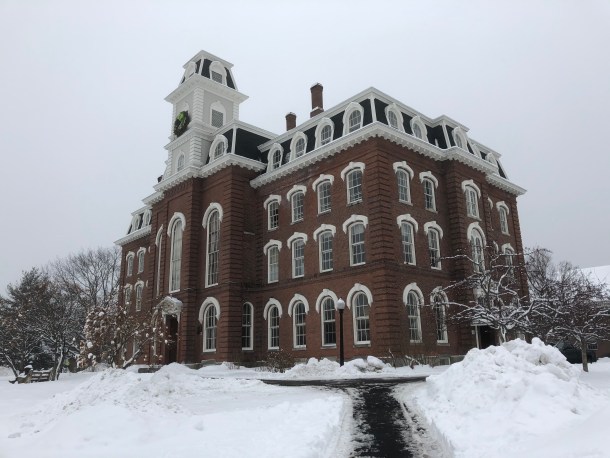
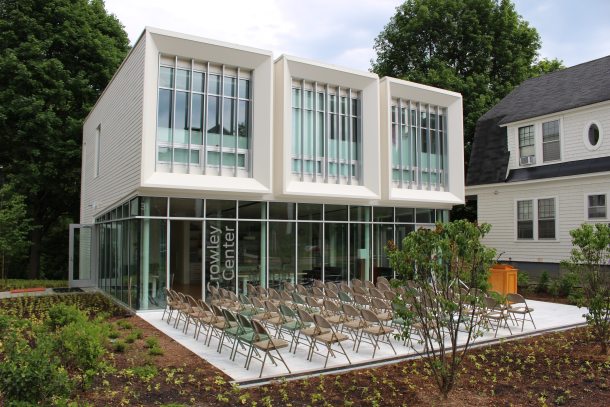
VCFA occupies a striking set of buildings on a Montpelier plateau that was once the site of the Civil War-era Sloan General Hospital. Its tall main building, now home to its administrative offices, classrooms, a bookstore, a gallery and a café, was built in 1872 as a seminary and served as Vermont Junior College and then Vermont College until the campus was purchased by Union Institute and University in 2001. In 2016, the college constructed the Crowley Center as space for faculty and the school’s 3,700 alumni.
Vermont’s newest higher ed institution
VCFA was created in 2008 by author Tom Greene, who raised and borrowed nearly $14 million to buy the Vermont College campus with its 250,000 square feet of indoor space, 33 acres, and three MFA programs from Union.
Greene left as president last summer to work on his seventh novel, though he’s planning to rejoin the school as a faculty member in August. He said a national newspaper reporter once asked him, “You started a college? What are you, from the 18th century?” But Greene was confident there was enough need for low-residency art education to keep the institution open.
Some of the arts faculty – most of whom teach at other institutions — had been teaching at the Montpelier school for 30 years through its many iterations, Greene said.

“This feels like home to them,” he said. “VCFA is fundamentally an experiment in community. Most of the faculty are not doing it for the money; they’re doing it for the love of that community and the broader experiment in the arts that’s happening up there.”
When Greene left as president last summer, board member Leslie Ward, a writer who has an MBA from Harvard, became interim president and then – in December – president.
Ward, a Calais resident who had studied at VCFA, is taking a pragmatic approach to the future of the small institution, which expects to serve 345 students this year. Like others in her field, she knows she’s competing for a small cohort of candidates who have limited time and money for a full-time master’s degree program. The college had 319 students enrolled in MFA programs in 2011, and a goal of increasing enrollment to 500 students in its 2009 strategic plan. That’s still a goal, said Ward.
“I’d love to see it grow slowly,” she said. “We have capacity for more.”
She’s optimistic that while several colleges have closed recently in Vermont, VCFA is in no danger of doing so.
“Here’s the beautiful thing about this particular school,” said Ward. “We are not tied to the 18- to 22-year old demographic. That’s a very, very hard demographic. We’re a 25- to 75-year-old demographic.”
Operating without tenured faculty gives VCFA flexibility other institutions don’t have to cut costs when enrollment for a particular program drops.
“That’s another reason we are in stronger shape than other colleges,” she said. She added that the low-residency model also widens the pool of prospective students by making it possible for people to continue working while they earn their degree. The school also offers workshops and retreats.
“The value proposition isn’t working for a lot of people in our country to pay what it costs to be at a residential college,” she said. With its low-residency model – where students spend seven to 10 days on campus five times over a two-year program — VCFA’s graphic design program costs $28,000 per year.
“At RISD, where you are a resident, by the time you pay tuition room and board, you have paid $70,000,” she said of the Rhode Island School of Design.
But VCFA is still out of reach for many, and Ward is focused on making the school more affordable. She’s working with the board to develop a scholarship fund, and the campus rents out some of its unused buildings. VCFA also sold 18 acres last year, leaving it with 15 acres and 11 buildings, including four dorms with 186 rooms. With an annual budget of $11 million, the school is operating at a slight deficit, she said. The school has 170 to 180 employees, about half faculty, and Ward doesn’t expect that to change.
Statewide concern about higher ed marketing
The state Agency of Commerce and Community Development is trying to help all of Vermont’s remaining colleges, including VCFA, find ways to attract more students, said Ted Brady, the ACCD’s deputy secretary. Last summer, after Green Mountain College, College of St. Joseph, and Southern Vermont College announced plans to close, Brady met with higher education leaders to come up with ways the state could help.
“The big one was marketing,” Brady said. The group also talked about technical assistance and about creating a better environment overall in the state for institutions of higher education. Data from the Bureau of Labor Statistics show that in recent decades, employment in higher education has risen steadily nationally in recent years while remaining relatively flat in Vermont.
Later last year, southern Vermont’s Marlboro College announced that it too would close.
“We were very clear the state is not going to solve this problem, but as the colleges themselves tackle this, and industry itself tackles this, our thought was, ‘How does the state play a role in complementing it?’” Brady said.
Vermont’s higher ed employment as a proportion of its private employment overall has been dropping in recent decades, while that proportion has risen nationally. Brady said in 2018, there were 11,000 people working in higher education in Vermont. He estimated that 300 people lost their jobs as a result of the recent college closures.
“Whether it’s 300, 600, or 900 — and I know for a fact there were 300 in the data I looked at — that’s too many people to lose from your workforce,” he said. “We know that these colleges are economic hubs. It’s not just the fact that these people are well-paid and create jobs, it’s also these people serve on selectboards, serve on fire departments, they are board members in cultural organizations.”
Money for arts activism
VCFA school recently started a full-time residential program in writing and publishing that has about two dozen students on campus year-round.
Right now, many students learn about VCFA from faculty referrals. Ward said marketing will focus on promoting the low-residency programs and improving VCFA’s presence on social media. The school hired a new fundraising director last spring. It typically raises $500,000 to $600,000 a year.
There are no plans to establish an endowment, but a major gifts effort that is being developed by the board will focus on raising money for scholarships; faculty development and alumni professional development; and for arts activism, Ward said. Arts activism is an antidote to the divisive environment of public discussion present now, she said.
“Art is the connection between your intellect and your heart,” she said. “You can throw all the numbers and all the charts in the world at somebody, and it probably won’t change their mind, but if you tell a story, if you visually express something, if you express that through either writing or visual art or design or film, you touch someone’s heart and open you up the path for empathy.”
VCFA has stayed leaner than many other institutions by avoiding the high cost of the gyms and other athletic infrastructure that colleges pay millions of dollars for. But that doesn’t mean the school lacks an athletic presence, said Greene, noting that for years the poets and the prose writers have faced off on the softball field. The series endured a long streak of apathy from the poets, said Greene, who coached the fiction writing team one year when he was president.
“But lately the poets have come back,” Greene said. “which is kind of indicative of what is happening with poetry in general.”
