


A ballot question in Essex has reignited a decades-long tension between the village of Essex Junction and the rest of the town.
The proposal seems simple enough: Two residents petitioned to put a question on the Essex Town Meeting Day ballot to change the representation of the selectboard. It would shift the makeup of the board from five at-large members to six members — three from the village of Essex Junction and three from the town outside the village.
Essex has both village and town governments. Five selectboard members oversee the town as a whole, which includes the cafes and shops of Essex Junction as well as 33 additional square miles of suburbs and farmland. In addition, five village trustees govern the Junction, which contains roughly half of the town’s 21,200 residents. Each entity can impose taxes for services.
Ken Signorello and Irene Wrenner, the two residents spearheading the change, say the measure will bring equal representation and mitigate a simmering resentment between village and town. Opponents of the measure, including a majority of the selectboard, assert that the change would engender, rather than alleviate, dissension. If it passes, they say, it would embed the division into the town’s charter and make unification even more difficult.
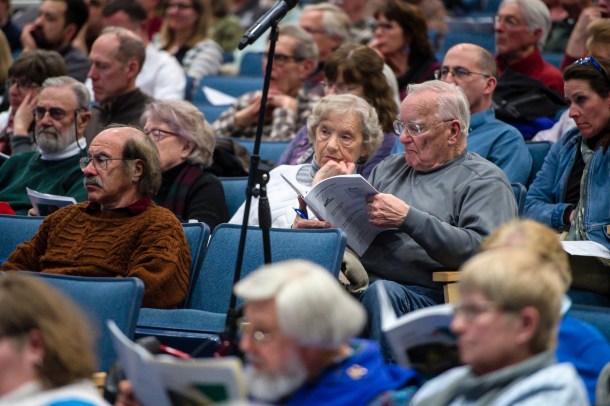
“It’s re-creating a tension for a town that should be getting along,” said resident Dustin Bruso on Monday. Residents discussed the measure at a packed Town Meeting at Essex High School, and will vote on a charter change Tuesday by Australian ballot. If the measure passes, the Legislature must also approve the change.
The debate is rooted in the very beginnings of the town.
Essex Junction was incorporated as a village in 1892, as a way to build downtown services such as sidewalks and a fire department that residents in the rural areas didn’t need.
As the town and the village grew, the distinction has led to duplication, and at times, confusion. The village and the town outside the village share a police department, but they have different noise ordinances, open container and fireworks rules, according to town manager Evan Teich.
When it comes to police enforcement, “it can be confusing,” he said.
The village and the town each have their own fire department, library, and Parks and Recreation department. At the meeting Monday, residents chafed at the possibility that they’d have to foot the tax bill for those across the village line. One resident, Daryl Stultz, suggested lowering the town budget $770,000 — the cost of duplicate services. Several speakers worried about the increased tax burden for town residents if a merger were to pass in November; village residents already pay taxes for town services in addition to their own, another speaker pointed out.

Outside the auditorium, both sides — for and against the proposed charter change — made their cases, with maps, slogans on yard signs, and colored graphs of town representation.
Because of the complications of operating two municipalities in one, most towns have done away with their villages. There were once 76 incorporated villages in the state; that number has since dropped in half as villages have dissolved, merged, or separated from their associated town.
Essex has tried to join that number. The town and village have voted to merge or separate 18 times since 1958. The merger was approved in the most recent vote in 2006; then Wrenner, who is leading the petition, led a successful bid for a revote. The measure failed on the January 2007 revote.
In 1999, the town voted to merge with the village and the village voted to separate from the town; the Legislature, which has to authorize the change to the town’s charter, refused to approve either change.
The selectboard aims to hold another merger vote in November, according to board chair Elaine Haney.
For Signorello, his proposed system is a matter of fairness. The 64-year-old information system designer had never attended a selectboard meeting before he got involved in the issue last summer. But he realized that if the village and town merged, residents from outside the village would have to pay for the municipal services that they had never approved at the ballot box.
“I couldn’t believe what I was hearing,” he said. “It was shocking.”
With a five-member selectboard, the majority can set policy that either benefits the village or the town outside it, according to Wrenner, who is also promoting the effort. For instance, villagers quashed a proposal for a shared town website, she said. Neither wants to bear the tax burden of the other, she said. Though two of the five selectboard members live in the village, that hasn’t always been the case; the board didn’t include a single villager from 2002 to 2011.
“Whoever can get control of the selectboard via majority, you can get control of the agenda,” she explained in an interview.
Besides she said, it’s hard for the two sides to relate. Villagers see themselves as more sophisticated; members of the town outside the village are more frugal, she said. Bridging those two cultures, she said, is “like asking the North and South to get over the Civil War.”
A better option would be equal representation. “If we could at least fix the representative piece, they could come together and hear each other as equals,” she said.
The two formed a public question organization, similar to a PAC, called FairnessFirst. They created a petition, and knocked on more than 1,000 doors to get the required 850 signatures to get the item on the ballot.
Brian Shelden, a candidate for state Legislature, has started an organization of his own, “Don’t Gerrymander Essex.” A six-member selectboard is “a recipe for gridlock, he said. “It continues to pit the [town outside the village] and village against each other.”
The selectboard has also opposed the initiative. Haney maintains any town-village differences don’t play out in the board’s policymaking. Of the selectboard’s 882 decisions over the last five years, 95% were unanimous.
“The problem this petition seeks to solve does not exist,” she said. “We’re all simply working to a unified community that’s financially sustainable for the future.”
That’s the goal of Teich, the town manager, as well. He has not picked sides and downplayed the divisiveness. “People think that the Village and the town of Essex fight all the time. We just don’t,” he said. So far, at least, “they’ve found ways to compromise.”

