

A Senate proposal to raise $30 million annually for climate action by taxing the wealthy appears dead for this year, despite a burning call by environmental activists to go forward.
With other major climate bills appearing more promising, key senators say passing S.311, also known as the Vermont “Green New Deal,” is not a priority this second year of the biennium. Senate President Tim Ashe said the additional funding may not be necessary and that Gov. Phil Scott has made clear he wouldn’t support an income tax increase.
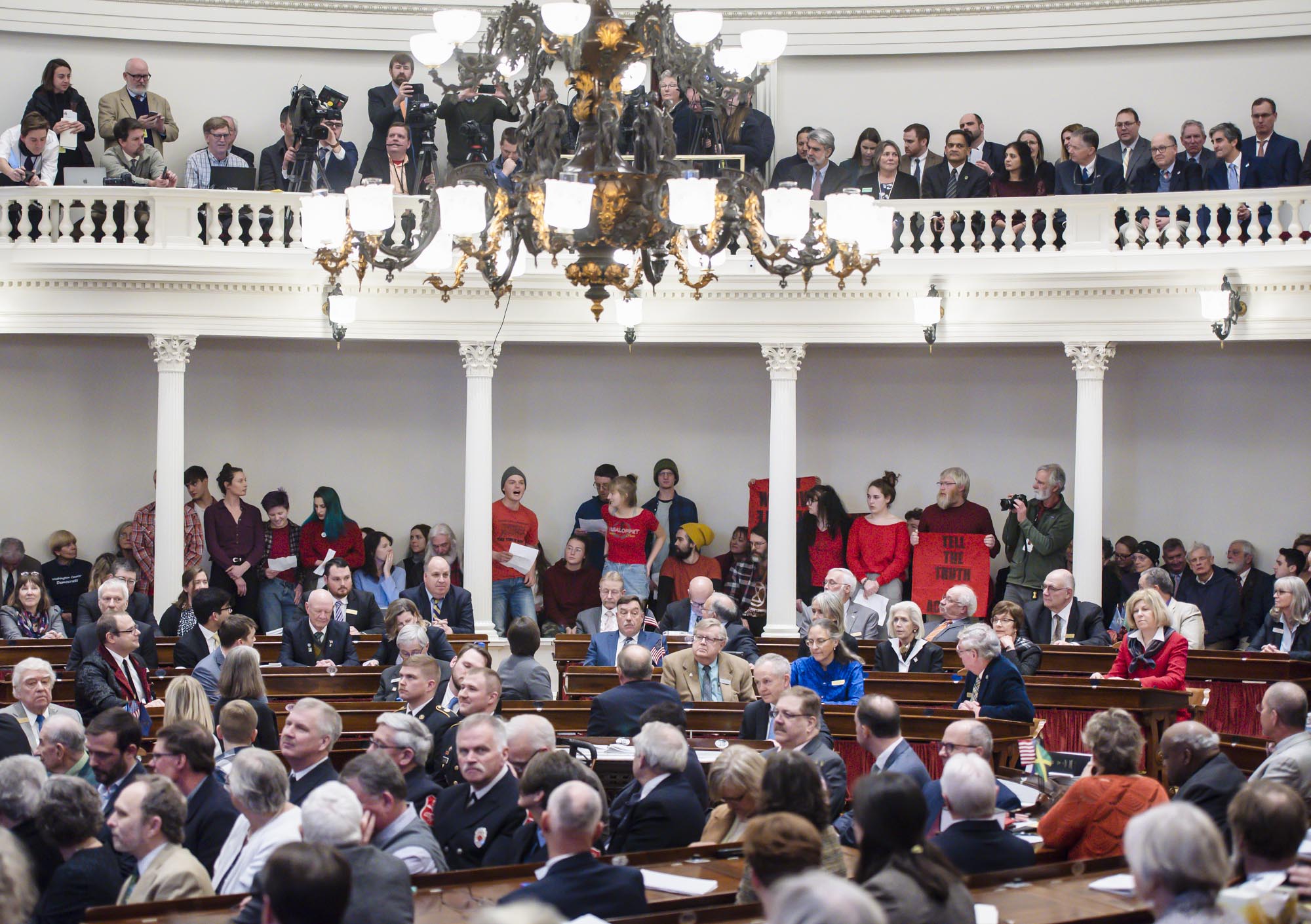
Earlier this month, climate activists with Vermont’s Youth Lobby came to the Statehouse to demand S.311 pass this year.
“You hear time and again the excuse that we don’t have the funding for any of these (climate) bills that we want to pass — and this bill gives us the funding,” Sydney Kulis, a senior at Harwood Union High School, told members of Senate Finance.
The Vermont Green New Deal would raise an additional $30 million a year from an income tax on the top 5% of earners in Vermont. Those earners — about 16,000 Vermont tax filers — have been paying roughly $240 million less in federal taxes per year since the Trump tax cuts, said bill sponsor Sen. Anthony Pollina, P/D-Washington.
“We’re not going to reduce carbon unless we can make big investments in electric vehicles, weatherization, public transportation, renewable energy, those kinds of things,” said Pollina. “And the Green New Deal bill is the only bill that actually generates the revenue needed to make these things happen.”
Other climate policy bills are expected to fare better this session. Last week, the Vermont House passed by a wide margin a bill, H.688, known as the “Global Warming Solutions Act,” that would mandate state compliance with strict carbon emissions reduction targets.
Meanwhile, the Democratically controlled Senate has been working on proposals to increase renewable energy requirements for electrical utilities and to put more efficiency dollars toward transportation and heating efficiency. Also, senators are moving ahead with a regional cap and trade emissions reduction effort known as the Transportation and Climate Initiative.
Jaiel Pulskamp, field organizer with environmental advocacy group 350Vermont, said in an interview last week that measures like the Global Warming Solutions Act are important, but work on a “longer timeline” than what her group thinks is needed.
“We feel like we don’t really have any more time to waste setting up committees and advisory boards,” she added.
350Vermont and other groups plan to hold a press conference on Thursday calling on the Senate Natural Resources Committee to take up S.311.
Sen. Chris Bray, D-Addison, committee chair and one of the bill sponsors, said in an interview last week that the Natural Resources Committee would “definitely” discuss the bill, and he hopes to hold a public hearing. But Bray said it’s unlikely the committee will be able to vote on the bill before crossover, the deadline for bills to move from the Senate to the House and vice versa.
Bray added that he shares “that sense of urgency” expressed by supporters of the Vermont Green New Deal, which is why his committee kicked off the session working on a bill, S.337, to redirect some state efficiency dollars starting next year.
Senate President Pro Tem Tim Ashe, D/P-Chittenden, said in an interview that he agrees with the bill’s “spirit” of fighting climate change, but he said the proposal came in late, after committees had scheduled their work for this session.
“The prospects for it becoming law under the current climate, both in terms of the governor (and) the appetite for a substantial income tax hike — I haven’t seen indications that that’s very high in either of those regards,” he said.
Regarding a major new revenue source, Ashe said he wasn’t sure if “anyone knows whether that’s needed right now” to curb emissions.
“Much of what we need to do to fight climate change aren’t massive public expenses in general,” he said. Ashe cited as an example the combination of “public and private activities” required to transition to electric vehicles. He said lawmakers had “existing efforts underway” to reduce emissions, including the proposal to redirect efficiency dollars, TCI, and a bill, S.220, to make sure certain professional licenses require energy consumption training.
“And so I’m not convinced that this is the bill to make it all happen, that it’s necessary to make those initial inroads,” Ashe said of Pollina’s bill.
Although the state is supposed to have reduced emissions a quarter below 1990 levels by 2012, emissions are 13% higher than that target.
Vermont’s total greenhouse gas emissions are the lowest in the country. However, the state now has the highest per capita emissions in New England. While emissions from electricity have declined slightly below 1990 levels, emissions from transportation and heating have gone up.
In a report out earlier this session, the state Public Utility Commission stated that Vermont would need “additional funding sources” to reduce greenhouse gas emissions from heating and transportation.
