

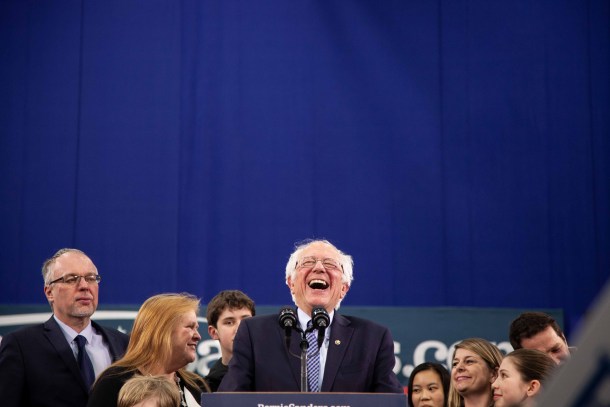
Coming off a victory in New Hampshire and a top two finish in the Iowa caucuses, Sen. Bernie Sanders moves forward as the front-runner to win the Democratic presidential nomination.
On Tuesday, the Vermont senator beat former South Bend, Indiana, Mayor Pete Buttigieg, in the Granite State, squeaking out a 2 point lead by the time all the votes were in.
But Sanders’ failure to collect a commanding number of delegates in either New Hampshire or Iowa means the outcome of the race is far from certain as candidates turn their attention to Nevada and South Carolina.
“At this juncture, he has cemented his place as the front-runner,” said Matthew Dickinson, a professor of political science at Middlebury College who has been closely following the primary.
“Having said that, it is not an overwhelming victory that shows he will clear the field,” Dickinson added. “It has muddled the field as much as it has winnowed it.”
Sanders took the New Hampshire victory with 25.73%, the lowest winning vote percentage in the modern era. Buttigieg was just behind with 24.43%, Sen. Amy Klobuchar, D-Minn., claimed 19.82% of the vote, Sen. Elizabeth Warren, D-Mass., received 9.23% and former Vice President Joe Biden ended the night with 8.4%.
“No major candidates have dropped out after New Hampshire and Iowa,” said Eric Davis, professor emeritus of political science at Middlebury College. “But I think the dynamic those people face has changed a lot. I think Biden’s has changed a lot. Unless he wins South Carolina, he’s in deep trouble.”
Sanders faced strong competition from Buttigieg in both the Granite State as well as in Iowa, and the two candidates are now separated by only one delegate.
In the race to 1,991 — the number needed to secure a first ballot nomination at the Democratic National Convention — Sanders currently has 21 delegates while Buttigieg has 22. Warren has eight, Klobuchar has seven and Biden six.
Davis said the dispersion of delegates among the top tier candidates will make Super Tuesday states very important for Sanders and Buttieg if they want to reach the number of delegates needed to win the nomination this summer in Milwaukee.
“This race is very fluid, there is a lot of uncertainty,” Davis said. “I think a lot is still up in the air.”
Moderate candidates, boosted by the strong showing by Buttigieg and Klobuchar, took more than 50% of the vote in New Hampshire while a little more than 30% supported the progressive candidates.
“Sanders’ more moderate alternatives, Buttigieg and Klobuchar, are in a better position to develop momentum since they exceeded expectations,” said Mia Costa, assistant professor of government at Dartmouth College.
“It’s a crowded field to be sure, but this is Bernie’s neighborhood. Anything other than a win would have been devastating,” she added.
But it is unclear if New Hampshire voters’ decision to vote for Buttigieg and Klobuchar is because of an ideological divide with Sanders.
In the weeks before the primary, voters throughout the state said they leaned more toward Sanders, but had decided to vote for Buttigieg because they believe he is more electable in a general election.


Photos of Sanders’ rallies on Monday by Anna Watts for VTDigger
Dickinson said he is not ready to say moderates have more support than progessive candidates moving forward in this election cycle. He sees people still struggling with what the best strategy is to beat President Donald Trump.
“I just don’t think the voters know how to get there yet,” he said.
In the run-up to the Feb. 11 primary in New Hampshire, Sanders said strong voter turnout would be the key to success, building on his argument that his campaign is best positioned to energize disaffected voters in a general election.
While more than 288,000 voters cast ballots Tuesday, surpassing the record-setting 287,556 voters in 2008 when Hillary Clinton claimed victory over Barack Obama, Sanders took the victory by a margin of just 3,845 votes more than Buttigieg.
On Wednesday, Sanders projected a sense of strength in the aftermath of the New Hampshire contest.
“Our campaign is successfully expanding the Democratic base,” Sanders said in a statement.
“Our campaign is successfully reaching out to working people, young people, communities of color and all those who believe in a government of compassion and justice. This is the coalition that wins elections,” he said.
The Vermont senator is now headed to the Super Tuesday states of North Carolina and Texas, where he begins a a three-day tour Friday. Then he travels to Nevada to make his final pitch to voters before the Feb. 22 caucus.
