

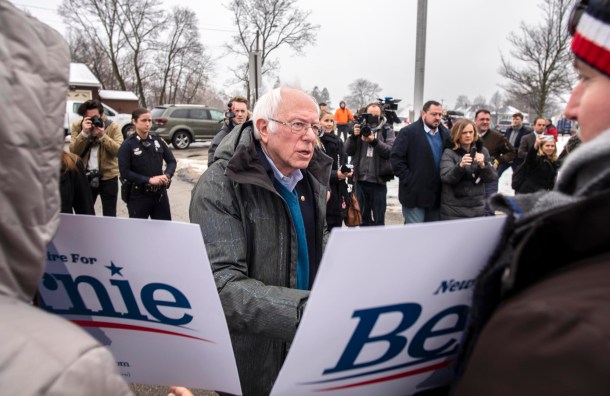
Jon Margolis is a political columnist for VTDigger.
MANCHESTER, N.H. — Front-runner.
Finally, that’s what Bernie Sanders is.
Almost five years after he declared his presidential candidacy for the 2016 race, Sanders victory in Tuesday’s New Hampshire primary makes him the front-runner in 2020.
He’s not yet the nominee or even the likely nominee. But he could be the nominee. If not, he seems to be the one the eventual nominee will have to beat.
Unlike the day after he won the primary here four years ago, this time it is Sanders who is leading in the national polls and who has raised more money than any other candidate.
Well, more than any other candidate who has raised money. Michael Bloomberg is financing his own campaign, and his effectively unlimited campaign treasury is one reason Sanders’ front-runner status is insecure.
But not the only reason. Sanders won here, but he shared some of the primary-night glory and the morning-after momentum with runner-up Pete Buttigieg and surprising third-place finisher Amy Klobuchar.
And it wasn’t as though Sanders put up big numbers. He got about a quarter of the vote, just as he gets about a quarter of the Democrats in those national polls. His strength is that he has that core of support. It’s his floor. So far, though, it’s also his ceiling.
His was not, then, the most impressive victory. He barely edged out Buttigieg, who was all but unknown just a few months ago. And the two of them weren’t that far ahead of Klobuchar, also little-known and all but written off just a few weeks ago.
In some ways, the results of her success may have had the most lasting impact on the campaign. Her third-place finish kept her in the race and seems to have knocked Elizabeth Warren and Joe Biden out of it.
It’s early, and it’s always healthy to resist the temptation to exaggerate the importance of what just happened. So far, only two small states, which together choose 65 of 4,051 pledged delegates, have voted. Both states are 90% white. The next two, Nevada (Feb. 22 caucuses) and South Carolina (Feb. 29 primary) are not.
The polls show that both Biden and Sanders have support from Hispanic and African American Democrats, and that Buttigieg and Klobuchar have almost none.
But African Americans and Hispanic Americans are watching the race play out on the same television programs and in the same newspapers as the rest of America. There’s no reason to suppose that some of them won’t take a look at one or both of these latest political phenoms and think about voting for them.

At any rate, this process does appear to be anywhere close to being over. Whatever happens for the rest of this month could be obliterated on March 3 – “Super Tuesday” — when 14 states (including Vermont) hold primaries. Those will be the first contests in which Bloomberg competes, and his huge bankroll makes him a factor in all of them.
But Sanders is well-positioned in those states, too. He has enough money. That money and the enthusiasm of his supporters has forged strong organizations in California and elsewhere. As a political performer, Sanders is better than Bloomberg. So are Buttigieg and Klobuchar. Biden and Warren are not, which explains why they are about out of the race. Political performance matters. Klobuchar is still around because she was so good in last Friday’s candidate debate.
Perhaps the biggest advantage Sanders enjoys is that he excites more Democrats than the others. But he still shares the same problem: Who can beat Donald Trump in November?
If anything was clear in the days leading up to the primary it was that Democratic voters were looking for a winner. It isn’t that their other reasons for preferring one contender over another are insincere. Some really want to “transform this country” as Sanders proposes. Others are wary of too much change too quickly.
But most would switch allegiance if they believed that another candidate had a better chance of winning the general election. Right now, though, partisans of each candidate have convinced themselves that the strongest candidate just happens to be their favorite.
No surprise. There is nothing new about people allowing their passions to overwhelm their judgement. So Sanders backers will argue – plausibly – that Democrats need a nominee who can fire up the party’s base. Just as plausibly, Sanders opponents will claim that only a more moderate nominee can win those suburbanites who gave the Democrats their House of Representatives majority in 2018.
To support their argument, they will point to a new Gallup Poll showing that 53% of the people would refuse to vote for even an otherwise “Well-Qualified” candidate who was a socialist.
Sanders calls himself a “democratic socialist.”
Leading the ticket with a socialist is a risk. But so is leading the ticket with a 38-year-old who’s held one minor public office; with a woman who’s been unable to appeal to voters who didn’t go to college; with a little-known senator from Minnesota. Whoever the nominee is will be savaged by the Trump campaign.
Here’s what to expect over the coming weeks. Champions of one candidate or another will argue that their favorite would not only be the best president, but also is most likely to win in November.
And not only that, but that other candidate over there (Sanders, Buttigieg, whoever) might lose 40 states, dragging Democratic candidates for the Senate, the House, and governorships down with him or her.
These claims will be expressed with vigor, with verve, with great confidence. They will often come from people with impressive credentials in academia, in the media, in politics.
Not one of them has the foggiest idea what will happen.
