

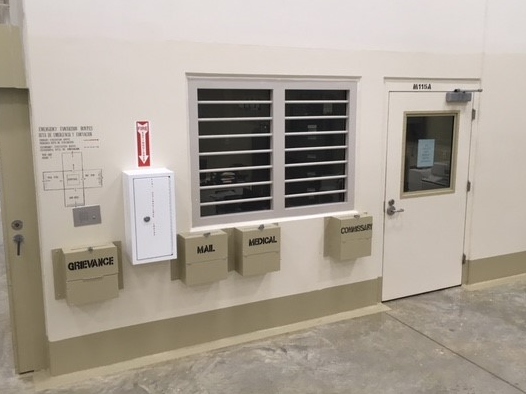
Mississippi prison officials have put Vermont’s out-of-state inmates housed there on notice that non-legal mail they send out of the facility would be subject to search, leaving one inmate to say the move will have a chilling effect.
It’s an issue that Vermont Department of Corrections officials say they first heard late last week and are trying to find out more about from leaders at that facility in the Tallahatchie County Correctional Facility in Tutwiler, Mississippi.
“We will talk with the warden down there and see what the rationale is behind it, see if there’s anything we can do to try to rectify that problem,” Alan Cormier, Vermont Department of Corrections facilities director, said Monday.
Rafael Vergara, warden at the Mississippi facility run by the Nashville-based CoreCivic, the country’s largest private prison contractor, could not immediately be reached Monday for comment.
Kirk Wool, one of about 260 Vermont inmates in the Mississippi facility, said in a phone interview that he and other prisoners were informed late last week by officials at the jail about the mail handling matter.
“All outgoing general correspondence is subject to being read in part or in full and searched for contraband before it is sent to the post office,” Wool said, adding, “They posted a notice on the wall here in the unit that told everybody this is what they’re doing.”
Legal correspondence, he said, is not subject to that same search policy.
However, Wool said, other outgoing mail is, with inmates told not to seal the envelopes they are sending out of the facility to allow the envelopes to be searched.
“A bunch of guys approached me,” Wool said in the interview, “and they said, ‘There’s no way, Kirk, I’m going to write to my family, let alone the media, or anybody else about conditions here because they’re going read it know exactly what I’m saying.”
Wool is a dogged jailhouse lawyer serving time for sex assault and kidnapping convictions.
He said since Vermont inmates were first sent to the privately run Mississippi facility in late 2018, CoreCivic has tried to implement a similar mail policy in the past only to change it once Vermont prisoners complained.
Wool said he’s not sure what prompted prison staff to try it again after not doing it for at least the past six months.
He added he’s particularly concerned given the turmoil that has taken place around the Vermont Department of Corrections regarding its treatment of inmates following an expose late last year in Seven Days.
The newspaper reported on allegations of sexual misconduct and drug use by staff at the Chittenden Regional Correctional Facility, the state’s only prison for women. Corrections Commissioner Mike Touchette resigned in the wake of those allegations.
Wool said while the conditions in the Mississippi facility are better than in many others he’s been housed in, that doesn’t mean that “reading our mail is OK.”
The policy at the out-of-state facility runs counter to the one for prisoners serving time in Vermont facilities.
According to the Vermont Department of Corrections inmate mail policy, “With the exception of inmate-to-inmate mail, outgoing mail will not be inspected or read except if the Superintendent or designee has reasonable suspicion to believe that the mail may pose a threat to the safety and security of the facility, its staff, inmates, or the public, or that the mail may contain contraband.”

The Vermont DOC policy does allow for the searching of incoming mail. CoreCivic, Wool said, does the same with incoming mail.
He questioned why such a search policy should apply to an inmate’s outgoing mail. “What are we going to be sending out?” he asked.
Cormier, of the Vermont Department of Corrections, said Monday it’s an issue that has come up a few times since Vermont began sending prisoners to the Mississippi starting in late 2018.
“It’s not a new policy, but it’s something that is once again being addressed and enforced by the facility there,” Cormier said.
He added that the Mississippi is not required to follow Vermont DOC’s mail policy.
“There are several policies that they are required to follow through our contract with them, but this is not one of them,” Cormier said.
He said there was a recent change in leadership at the CoreCivic facility and that may have led to the most recent change in how the mail is being handled.
Cormier said Monday the Vermont corrections department is trying to get in touch with the new warden at the Mississippi to discuss the matter and “see if it is something that that CoreCivic would be willing to take a look at in regards to not making it a mandatory.”
Asked if Vermont DOC wants to see that CoreCivic stop the practice, Cormier said he wanted to know more information before he could say.
“I would like to see what the rationale is,” Cormier said, “if it’s just because it’s the policy or is there something specific that has led them to believe that there may be a risk.”
Barry Kade, a Montgomery lawyer and prisoner advocate, wrote an email to Vermont Department of Corrections officials over the weekend about the mail policy at the Mississippi calling for them to intervene in the matter.
Kade, like Wool, said the policy in Mississippi would serve as a deterrence to Vermont prisoners from reporting to family members and others about the conditions at the out-of-state facility.
“The main thing would be that they might be discussing with family members or friends grievances against the facility and staff members,” Kade said.
The prisoner handbook for the Mississippi facility does state that incoming mail will be opened and inspected, but doesn’t specifically address the searching of outgoing general mail sent by inmates.
Asked if that could serve as a way for CoreCivic to legitimately search outgoing general mail from Vermont inmates, Kade replied, “That wouldn’t hold up in court.”
Kade cited a Vermont Supreme Court case from 2010, Nichols v. Hofmann, that he contends would prevent CoreCivic, a private entity, from setting policies that infringe on the rights under Vermont DOC policies.
That case dealt, in part, with whether out-state prisoners were entitled to the seven free stamps a month in-state prisoners receive. The high court ultimately rejected DOC’s arguments that the out-of-state prisoners were not entitled to the stamps.
Cormier, of the Vermont DOC, said Monday he was not aware of that case, but said he would research it.
