

A group of Brattleboro-area communities will use a recent planning grant from a Federal Reserve Bank of Boston program to help asylum-seekers from the nation’s southern border resettle in southeastern Vermont.
The Brattleboro Development Credit Corp. and the Bennington County Regional Commission will work with the Bellows Falls-based Community Asylum Seekers Project, or CASP, a group that finds Windham County hosts for individuals and families seeking asylum; helps with food and other daily needs as they resettle; and assists them in navigating the asylum claim process.
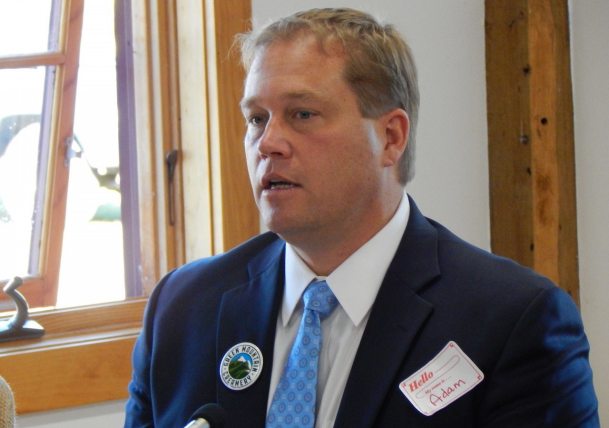
With a declining population, the southern Vermont region in 2014 identified increasing immigration as a top priority, said Adam Grinold, the executive director of the BDCC. That goal was repeated as a priority during a planning process with Bennington County last year.
The new arrivals are needed to inject life and workers into an economy that is being held back by low population growth and an aging population. But Grinold said learning about the experiences of other Vermont communities had shown the organizers that new arrivals need support.
“You can’t just flip a switch,” he said. “When you welcome new Americans to a region, you need to have a system that allows for transportation, English language classes, housing, employment. There are so many different aspects of having a welcoming community.”
The awards are part of a new three-phase program launched last year by the central bank of the United States, the Federal Reserve. The bank is stepping into the discussion of poverty and economic development in the nation’s neediest urban and rural areas. The Boston Fed’s program, which covers almost all of New England, is called the Working Communities Challenge.
Last fall, the Boston Fed released a request for proposals, or RFP, for Vermont planning grants. This month, it announced eight regions that have won the $15,000 grants. Those grantees will apply for larger, multi-year grants that will be awarded to three Vermont communities in the spring.
Applications for both sets of grants are judged by a steering committee of community development leaders, most of them from Vermont.
The fed and its national funding partners include the Doris Duke Charitable Foundation, Robert Wood Johnson Foundation, and NeighborWorks America. Several public and private Vermont entities are also funders, including the National Life Foundation, the Vermont Community Foundation, Green Mountain Power and Pomerleau Real Estate.
Stephen Michon, a senior community development analyst at the Boston Fed, said that while most areas of the state are represented, projects were chosen based on criteria laid out in the grant application. The eight regional teams selected include teams from the Greater Barre area, the Springfield area, Lamoille County, the Northeast Kingdom, northwestern Vermont, southern Vermont, White River Valley and Winooski.
Lamoille County Planning Commission, working with the local Capstone Community Action office, and other groups, also won a $15,000 planning grant. The money will be focused on the towns of Johnson, Morristown and Stowe, said Tasha Wallis, the executive director of the planning commission. Human service providers and other entities will examine transitions to work for groups such as young people who are just out of school; people who have struggled with opioid addiction; and older people.
“It’s important to remember that there are individuals in that community in need,” said Wallis of Stowe, a wealthy resort community. “Stowe is actually an important part of our application because it is an economic engine and many individuals throughout our county travel there to work in the various tourist-based industries.”
Winooski, like the Brattleboro region, wants underrepresented groups, such as foreign-born residents who make up 18% of the city’s population, to have more of a say in civic decision-making. There are 20 languages spoken in Winooski’s school system, which is a partner in the project, said Heather Carrington, the community and economic development officer for the city.
“The goal of these grants is to create systems change for low-income folks, so providing translation services, direct outreach to communities, access to transportation… there’s a broad variety of different things,” she said.
The eight groups that received planning grants will apply in March for larger grants, usually around $300,000, that they can use to implement their projects over three years.
The BDCC has a goal of adding 1,000 legal immigrants by 2030. The time is now, the group said in its application materials.
“No longer can we wait for others to make this happen,” the group said. “SoVermont is flush with assets to help build this network in support of our New Vermonters.
