

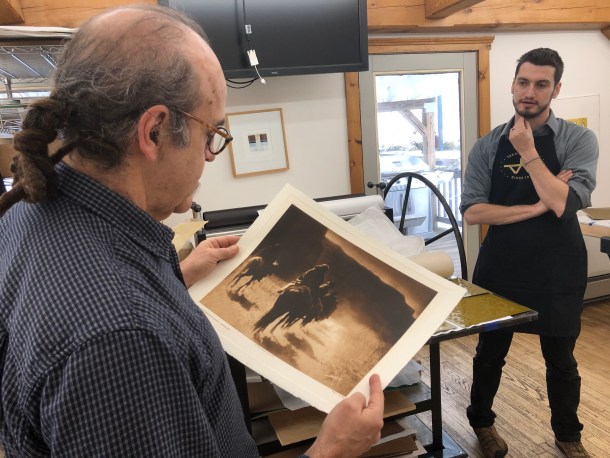
TOPSHAM — When the descendants of Seattle-based photographer Edward S. Curtis decided to create prints from glass negatives of Curtis’ work, they got in touch with a Vermont fine art and photographic printer that has gained renown for its advances in printing techniques.
Cone Editions Press turns out super high-resolution digital prints on a variety of devices from an unassuming shop that looks like a barn. The company lists among its clients celebrities like David Bowie and the painter Wolf Kahn, and institutions like National Geographic and Lincoln Center.
But what really interests founder Jon Cone, 62, is the technology he and his colleagues have developed since the company started serving artists in New York in 1980.
Apart from creating super-high-resolution prints on an inkjet laser printer and on an etching press, the eight-person central Vermont company now formulates its own inkjet inks, produces its own software, and sells materials to thousands of other printmakers around the world.
Cone and his wife and business partner Cathy also host several workshops for artists and photographers each year and run a darkroom where staff and visitors can make prints using the light-sensitive metals platinum and palladium in a method created around 1870.
Photographing a vanishing people
John Graybill, Edward S. Curtis’ great-grandson, found Cone Editions after he started the Curtis Legacy Foundation last year and started looking for a way to create a set of prints from glass negatives that his famous relative used at the turn of the 20th century. Graybill digitized the images and Cone has used those images to create high-quality photogravure prints.
In intaglio printing, the ink is held in lines that are etched into the surface of a plate. In Curtis’ time, those plates were copper and the prints were created through a process called photogravure; now Cone uses the material photopolymer – which changes when exposed to light – for the plate, and has an etching press force the damp paper into those lines to pick up the ink.
“For this type of printing process, Jon is the guy to go to,” said Graybill, a professional photographer who lives in Colorado.
Started in New York
Jon and Cathy Cone met at the Ohio University School of Art and started their business in 1980, collaborating with artists in experimental printing. Jon Cone started working with computers in his printmaking in 1984, and opened a gallery in SoHo in 1987.
But the family wanted to live in Vermont, a place where many of the New York artists they knew had homes, so they bought a farm in 1988 and built a 2,400-square-foot studio just steps from the village of East Topsham. They were an oddity in the rural town of about 1,000 residents when they moved there, said Jon Cone.
“Where we live hasn’t changed in the 30 years we’ve been here,” said Jon Cone. There was some adjustment, but he said he likes Topsham’s 19th-century appearance. Visitors from out of state or overseas love discovering Cone’s surroundings, he added.
“And that stability is really inspiring,” he said of Topsham’s timelessness. “You don’t have a lot of outside interference.”
Soon after the family moved to Topsham, Jon Cone started developing technology to go with a large digital printer he had acquired, and Cone Editions was born.

The company works for artists and businesses all over the world. On Jan. 15, staff were scanning a collection of very high-resolution film negatives of an Inuit village in Arctic Quebec. The images would be made later into prints. Unlike many of Vermont’s most rural corners, Topsham has a high-speed fiber optic cable that enables the company to upload a scanned image as large as 18 gigabytes (1 gigabyte is more typical) for printing. That connectivity enabled Cone’s leading salesperson to move to Montana last year but keep working for the company remotely.
Cone’s strong internet connection isn’t just luck, said Jon Cone.
“It was a pain for the phone company,” he said of the printing company’s early days with a low-speed modem. “We called every day for two years.”
Renowned photographer of Native Americans
Edward S. Curtis is just one of many artists whose work has been printed in Topsham, but Jon Cone handles his prints with reverence, examining the fine detail of images that were shot more than 100 years ago. He likes Curtis’ mission as a photographer who set out to humanize and validate a group of people who were often marginalized and ignored.
Curtis made a name for himself interviewing and photographing Native Americans from about 80 tribes. Some of his work was documentary; some was staged; many details of his three-decade quest are captured in a 2012 biography by Timothy Egan.
A few years ago, John and Coleen Graybill decided to interview the descendants of Curtis’ subjects, and traveled to reservations around the West to find them. They plan to publish a book with the original photographs and their own work, also printed by Cone Editions.
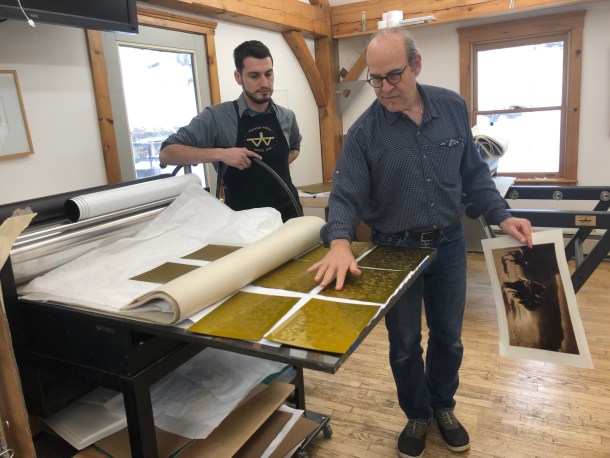
Jon Cone has developed his own photopolymer plate photogravure process and loves the fine detail and the shadings of color it reveals. The company has developed software to calibrate the process to ensure that the final print looks like the image on the original computer display. It’s also much faster than traditional copper photogravure. Where reproducing a print with a copper plate takes a week, with the new system you can make 55 prints in two days, he said.
To make prints of Curtis’ work, which was originally etched onto copper plates for printing, Cone first had John Graybill scan the restored glass negatives and email them to Topsham. Cone then printed the image directly onto the photopolymer plate with the inkjet ink formulated by Cone’s separate company, which is in the same studio.
“Inkjet ink isn’t normally that dark,” said Jon Cone. “We make a really dark black ink.”
The image is printed in that black ink in reverse on the plate, in dots so small they can’t be seen without a microscope.
The plate is exposed to UV light, which hardens the surface anywhere it’s not covered in ink. Then the ink is washed off, and the plate is exposed to more UV light. This process is a modern version of the traditional intaglio etching process, which has used copper since the early Renaissance.
“The way to think about intaglio versus a woodcut is intaglio means the ink goes in the groves, and woodcut means it sits on top of the grove,” said Nathanael Kooperkamp, a printmaker at Cone.
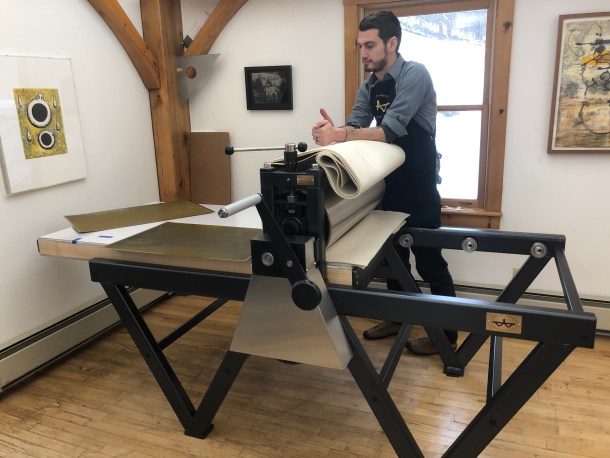
The end result is a sturdy plate that can be used for thousands of impressions. It prints under high pressure on the intaglio press on rag etching paper that was made in Europe. The paper has been soaked overnight; the ink is pushed deep into the paper to create an image that is finer, Jon Cone said, than the one produced by the original historical process that used copper.
The print “has a certain look that artists really like,” said Jon Cone. “Because of our software and our ink, it has much greater depth and richness. Even the way the ink is on the paper is gives an emotive impression.”
Revolutionary techniques
The company is now working on a color photogravure process. They made their first commercial color print Jan. 16, for Miami commercial and fine art photographer Vittorio Sacco.
Cone’s work on color photogravure is revolutionary, said Randy Hemminghaus, the master printer at Rutgers University in New Jersey.
“He’s able to print highly detailed photographic images, which is a difficult thing to do,” said Hemminghaus. “He’s created a new system.”
Two-thirds of photographers work in color, said Jon Cone, so opening up the photogravure process to color will likely change things for the fine art photographers who are looking for photogravure prints, he said.
“We’re in the process of inventing it at this moment,” he said.
Cone invites clients to the studio to watch their work being printed. And he enjoys the artists’ residencies, because he likes to show people what he’s up to in Topsham.
Jon Cone estimates he helped set up about 50 printmaking shops around the U.S. in the early 1990s. He thinks having other printers around the U.S. raises the consciousness of photographers that they can seek high-end printing services, and doesn’t see others in the field as competitors.

Cathy Cone works for the business and also creates her own art from tintypes, photographs made through a technique that was popular in the 1860s and 1870s.
Jon Cone, an avid mountain biker and cyclist who rides 2,500 miles a year, said he decided early on in his work not to patent or trademark any of his processes. Companies like Epson, he said, spend hundreds of millions of dollars a year defending their patents.
“I didn’t believe I could afford to defend them, and didn’t want to divulge what we have done,” he said. “If I had published anything we do about our calibration and linearization, Epson would be able to do the quality we do with their printers, or HP, or Canon. You can spend $50 million defending against someone like HP.”

