


Gov. Phil Scott on Thursday signaled that he remains opposed to many of the signature Democratic policy proposals that could reach his desk this year.
During his first press conference of 2020, the governor said he has major concerns with the latest minimum wage proposal and a bill that would mandate statewide carbon emissions reductions. He also said he isn’t interested in reconsidering a waiting period for firearm purchases.
His stances were predictable but problematic for Democratic leadership, which despite a large majority in both legislative chambers has struggled to rally the votes needed to override Scott’s veto pen.
Minimum wage
In a vote of 23-6, senators sent the latest minimum wage bill, which would raise the base pay for workers from $10.96 to $12.55 by 2022, to the governor on Thursday.
Democrats have been hopeful that the governor could support a $12.55 minimum wage — a more modest proposal than the $15 minimum wage bill Democrats passed, and he vetoed, in 2018.
“Despite the slippage, it’s still far better than us doing nothing and passing nothing, and facing yet another veto,” said Sen. Michael Sirotkin, D-Chittenden, the lead sponsor of the bill.
But the governor gave strong indications that he won’t be able to back the bill. While he wouldn’t say whether he would veto the legislation, Scott told reporters that he shared the concerns of Republicans in the Statehouse about how the measure would impact the rural economy and small businesses.
“I want people to make more money in Vermont. But our economy is sensitive and this point in time and I believe that there are businesses in some areas of the state that are under a lot of burden,” he said.
He added that the legislation has the “same trajectory” as the bill he vetoed in 2018, which would have raised the rate to $15 by 2024.
“It’s halfway to what they want it to be,” he said. “It’s the same trajectory, it’s the same thing, and next year I’m sure those same folks that say it’s a compromise are probably writing the bill right now.”
Scott said that he believes wages in the state are already rising due to the state’s tight labor market.
According to the Joint Fiscal Office, there are 40,000 jobs in the state that currently pay less than $12.55 per hour. Over a two-year wage phase-in, workers making less $12.55 would receive $5,000 more in take-home pay.
If Scott vetoed the bill, the Senate would easily have the two-thirds majority of votes required to override the governor. But in the House, where all but one Republican and many moderate Democrats voted against the bill, its future would be much more uncertain.
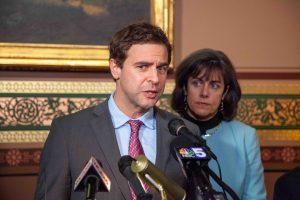
Sen. President Pro Tem Tim Ashe, D/P Chittenden, said Thursday that he hoped the governor would sign the bill, or let it become law.
“It clearly seems closer to his position than $15, which was discussed several years ago,” Ashe said. “And so the fate of tens of thousands of people and their economic well-being is sort of in his hands at this point.”
Ashe said that unlike the governor, he doesn’t believe it would strain rural areas of Vermont.
“We wouldn’t have done it if we believed that this was going to disadvantage the rural economy,” he said.
Climate change
The governor once again raised concerns about the Global Warming Solutions Act, a priority bill for Democrats seeking to take sweeping action on climate change this year.
The legislation would hold the state legally liable to slash carbon emissions by 25% over the next five years. It has the support of Vermont’s treasurer and attorney general, both Democrats.
Scott says he is concerned about putting the mandate in place before state officials and lawmakers come up with a plan to meet the emissions reduction requirements.
He added that the mandate could actually create costly legal battles that undermine climate efforts. “So if you put something in place that doesn’t meet that, then there’ll be a challenge from some environmental group, a lawsuit, and take resources away from the climate effort itself,” Scott said.
The Scott administration says it isn’t opposed in principle to a mandate for emissions reductions. But the governor believes the mandate shouldn’t be put in place until the state determines what initiatives are needed.
He added that Vermont should take the same approach to cutting carbon emissions as it did to creating its water quality plan.
It wasn’t until the state was sued, however, and the Environmental Protection Agency revoked approval of the state’s pollution reduction efforts in 2010, that Vermont developed a strict water quality plan. And it wasn’t until last year that policymakers came up with a long-term funding source for clean water efforts.

Rep. Sarah Copeland Hanzas, D-Bradford, one of the lead sponsors of the Global Warming Solutions Act, said the legislation and mandate are necessary because the governor hasn’t taken the initiative to cut emissions.
Lawmakers alone don’t have the resources to come up with a sweeping, technical proposal to cut emissions, she said.
“If he really wanted to write a plan, if he wanted to be showing leadership on this he could have done it,” Copeland Hanzas said. “It would be great if he had shown leadership that he wanted to do any of that, but he doesn’t and we know we don’t have time to wait.”
Gun sales
The governor said Thursday that his “feelings haven’t changed” on gun control.
Scott vetoed a 24-hour waiting period for handgun purchases last year, but Democrats in the Senate are planning on advancing another waiting period bill this year. Sen. Phil Baruth, D/P Chittenden, has proposed a bill that would establish a 48-hour waiting period for all gun sales.
The Senate heard from professors at the Harvard Business School last week, who have researched the effects of firearm waiting period policies around the country and found that they reduce gun-related homicides by 17%, and gun suicides by 7-11%.
Scott said last year that a lack of data showing that a 24-hour waiting period would reduce gun deaths contributed to his decision to block the bill. On Thursday, he said the Harvard research would not be enough to convince him to back the proposal.

“I believe the laws we have that we passed two years ago are sufficient and we should improve upon those, and make sure that everyone knows how to utilize them,” he said.
He added that his budget for 2021 includes suicide prevention initiatives. His proposed spending package has $1 million to boost mental health care, including $575,000 to expand suicide prevention initiatives for veterans, and a suicide prevention hotline.
“That’s the track I’m taking, and I’m not inclined to do anything more,” he said on gun legislation.
Despite headwinds from the governor, the Senate still plans to advance the waiting period legislation.
“We’re not going to just take no for an answer,” Baruth said. “We’re going to say we’re protecting the lives of Vermonters. The governor’s going to have to answer to his voters come November, about why he doesn’t find those statistics worth passing the measure.”

