

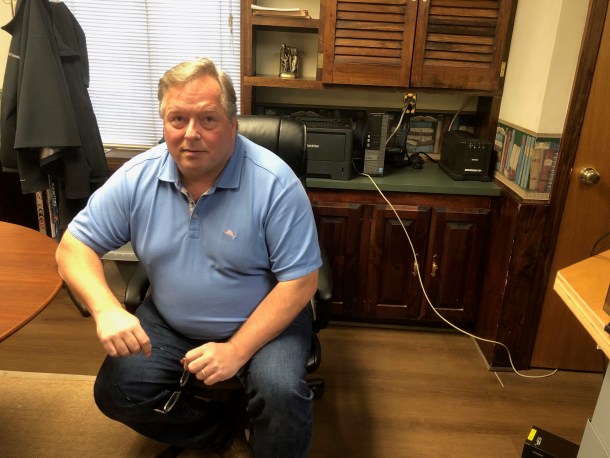
BURLINGTON — Jeffrey Peck is CEO of Peck Company Holdings, a South Burlington solar energy company that went public in June.
Peck is a solar EPC company, a business that provides engineering, procurement, and construction of solar energy systems. The former electric company, founded in 1972, started installing solar systems in 2012, and now provides services for residential and commercial solar projects.
Peck has installed more than 125 megawatts worth of solar, most of it in Vermont. The company also owns about 3 megawatts of solar, all in Vermont.
Jeff Peck grew up in the family business, which was started by his father in 1972, and he joined it as an employee after graduating from Champlain College with a business degree. His mother had taken over as CEO in 1983 and stayed with the company until around 2000, at which point Peck took over. In 2012, the company started building solar installations, and now the company does that work, as well as the original contracting work.
Peck Company is one of the larger players nationally, according to Solar Power World magazine. Peck changed its name from Peck Electric Co. last summer after becoming a wholly owned subsidiary of a company called Jensyn Acquisition Group in Freehold, New Jersey, and became the fifth publicly traded company based in Vermont. Officials from Peck rang the closing bell at NASDAQ in New York City to mark the occasion.
Thanks to a national solar investment tax credit, these are good times for solar companies, according to the Solar Energy Industry Association. Peck has about 100 employees now and said in a presentation to investors in May that it is the largest commercial solar contractor in the Northeast, with about $27 million in revenues. Vermont’s net metering rules, which enable some distributed generators — individuals or companies that install solar arrays on a rooftop or in a field — to offset the electricity they use with the power they produce. If there is extra, they are paid for power going back to the grid. Most net metering projects in Vermont are solar.
In 2011, Vermont passed a law setting net metering compensation at 19 to 20 cents per kWh depending on the size of the system. After a few subsequent reductions, net metering compensation for new systems dropped to around 14 cents to 18 cents this July.
These rules have proven lucrative for companies that finance, design, install and own solar arrays.
Peck spent some time talking to VTDigger about the business. The interview has been edited for length and clarity.
VTDigger: Did you always want to go into the family business?
Jeffrey Peck: As a kid growing up, I assumed I would go off and do something else. But there’s something about growing up in a family business. You feel part of it all the time.
When I was really young, I delivered materials to jobs and got familiar with the business that way, and then when I got out of college I came in and tried to solve problems. I was an assistant to a project manager.
VTD: Why did the company switch to installing solar?
JP: Prior to 2012, we were an industrial and commercial electrical contractor, and we did a lot of communications work, and work for semiconductor facilities, for IBM/Globalfoundries, for the University of Vermont, for Husky Injection Molding. Our focus was on larger-scale industrial electrical projects.
We had been talking about installing solar for years, and there just sort of became this point where you could really start to see the return for people who invested and built it. In 2012 we started bidding on solar projects, and working with developers who were developing projects. It wasn’t just my decision. There was a lot of input from people at the company who were pounding the table saying that we should do this.
VTD: Where do the panels come from?
JP: Sometimes we buy panels through distributors like Green Mountain Electric Supply in Vermont; sometimes we buy direct from the manufacturer. Some are made in the U.S., some in Canada, Turkey, China and India.
We purchase tier 1 panels, which meets a certain grade so you can get them financed. We’re sort of solar panel agnostic.
VTD: What role do incentives play?
We see the incentives as being there to help an industry get off the ground. The state incentives sunsetted three or four years ago, and then the state passed a net metering law that allows the credits that are created to be applied to peoples’ bills.
VTD: There are critics who want to change the net metering reimbursement rate. Do you support the net metering law as it stands now?
JP: We are involved in Renewable Energy Vermont, or REV, which has a voice on that. You know, from the whole political side, there’s always going to be change. Our focus is to provide value anywhere in the chain that we can. So if we’re working with a large developer, we want to make sure we install that project the best, most efficient way we can to keep costs down. The utilities and the legislators and the stakeholders will all debate what’s best for Vermont. I think what we all can agree on is more renewable energy is needed, and how do we find the right balance to make sure that the goal that the state’s put in place can be met.
VTD: So what are you seeing when it comes to solar development?
JP: There has been a much more of a focus on making sure the sites are placed in responsible areas. We just did a project on an old slate mine in Pawlet.
Oftentimes we will try to work with developers at any place that we can in the whole value chain. We’ll work with developers who have a project who want to get a project off the ground; we’ll construct it for them, and help them find financing. Sometimes we’ll build the solar array and own the solar array ourselves.

VTD: Does Peck Company initiate any projects?
JP: We have been involved at all stages of it. For example, we own the solar array that’s on the Vermont Public Radio building, and the power that is generated gives them a discount on their electricity, and then they pay us for the credits they receive. That’s how we end up getting paid over time, is through these long-term recurring revenues.
VTD: Who are the investors?
JP: It depends. Sometimes it’s an investment group or a real estate developer. Warren Buffett has recently gotten into investment in solar, in Nevada. Apple, Google, Amazon… I don’t know if they own any in Vermont, or if they want to. Big companies like that invest in solar. They have a lot of capital, and they have tax credit offsets when they build and own solar.
VTD: A lot of people in Vermont criticise solar projects. What do you hear?
JP: I do understand why it makes people nervous. Somebody thinks if their neighbor puts solar on his house, it’s somehow going to make their house less attractive. Or if they put it in a field, somehow their house will be worth less. I just don’t see it. I don’t see that having a fixed solar array sitting in a farm field, how that will impact the community, other than to be a visual representation of what their values are.
Potentially there could be some density concerns. People don’t want their neighborhoods looking like an industrial facility; I understand that. Those decisions should be made at the state and local level. There is plenty of land available in Vermont where we could build solar and in a really good, responsible way that all Vermonters could benefit from, in local jobs and energy independence.
VTD: Doesn’t your work make you an obvious supporter of social arrays?
JP: Look, we can’t separate the fact that I’m in the business, so of course I feel this way. I understand the critics would say that. But it’s 2020 … there are going to be needs for electricity and we need to find out the best blend of how we produce it. Distributed renewable energy in Vermont should be a large portion of our energy usage.
But the alternatives to solar are less attractive to Vermont in the long term. When you have a solar array, you have something that’s going to produce energy for the next 30 years with zero impact once it’s installed. The alternatives are coal, oil, natural gas, nuclear, hydro – and most of these are sourced somewhere else not in Vermont. So we’re sending that money to another state or country. Some of that, we fight wars over.
If we can invest locally using local people with local jobs to produce our own electricity, in the long run I think we could agree that’s a good goal. The state goal is to be 90% renewable by 2050, and we agree on the overall direction. How we get there will be decided by the state and local governments, in conjunction with utilities.
VTD: Is Vermont similar to neighboring states when it comes to solar?
JP: Vermont is the leader in this, and other states are playing catch-up. The public utilities and the Legislature embraced solar early on, and the other states are just now embracing it the way Vermont has.
Each state and geographical area has its own unique set of rules. They vary so much. In Vermont there is legislation about siting solar. Rooftops are good, and they want to put them in brownfields.
When we decide to invest in renewables and energy independence, there will always be debate about where and how and when. The debates should probably exist at the state and local level. For me, solar is really a visual representation of what our values are. When you drive down Route 7 or 22a, for generations we were strictly a farming community; you saw the silos and the red barns and the manure piles. That was part of our landscape, part of what our values were. Solar is in some ways becoming that. You’re going to see solar arrays dotted in our communities. We’ve decided climate change is important, and they are really a visual representation of what our values are.
VTD: So has going public changed anything at Peck Company?
JP: Not really. We have access to the capital markets now to make new investments. But we are a Vermont company; we construct things. We want to align our people with purpose and profitability for shareholders and stakeholders, and we get to choose how we do that. It doesn’t mean we have a big expensive boardrooms and offices.
VTD: What is in the company’s future?
JP: We want to become a regional EPC company in the Northeast and help developers anywhere we can on the value chain, whether it’s buying from them or building for them
VTD: Do you have any trouble finding workers?
JP: About 95% of our workforce is part of the IBEW, the International Brotherhood of Electrical Workers. We work with them on sourcing workers and training them. We are always actively looking for workers, especially with experience.
They don’t have to be based here, and that helps. We see fewer and fewer people entering the trades, for whatever reason, and that makes it difficult. Our responsibility going forward is to educate people on why trades are good, with a good standard of living, good wages, benefits, pension.
VTD: What’s the average size of a project you do?
We’re much more of a commercial and industrial solar EPC, so the size of the projects vary from 100 kw to 7 megawatts. The average size would be 500 kw.
VTD: What is going to happen with industry?
I think we can continue to invest in solar throughout the state of Vermont and Northeast and beyond. In time, the US will become renewable energy-dependent. When we talk about energy independence, I think we should be talking about renewable energy.
Advancement in battery technology will help for sure.
No U.S. military force is required to build solar in the US. We always talk about the cost of solar. What’s the cost of 20 years of war in the Middle East and how do you add that to your gallon of gas or your home heating oil?
You have the human cost and the financial cost of being involved in the Middle East to keep the price of oil reasonable. The U.S. wouldn’t necessarily have to do that anymore if we were truly renewable energy independent.
Vermont is this great place where we can decide to take leadership roles as a community on things we decide to do. The state is pretty well aligned on the big picture. Obviously, agreeing on the details is the difficulty. But from a big picture point of view in Vermont we agree.
VTD: It must have been hard for your mom to take over the company in the 1980’s.
JP: She was courageous.

