

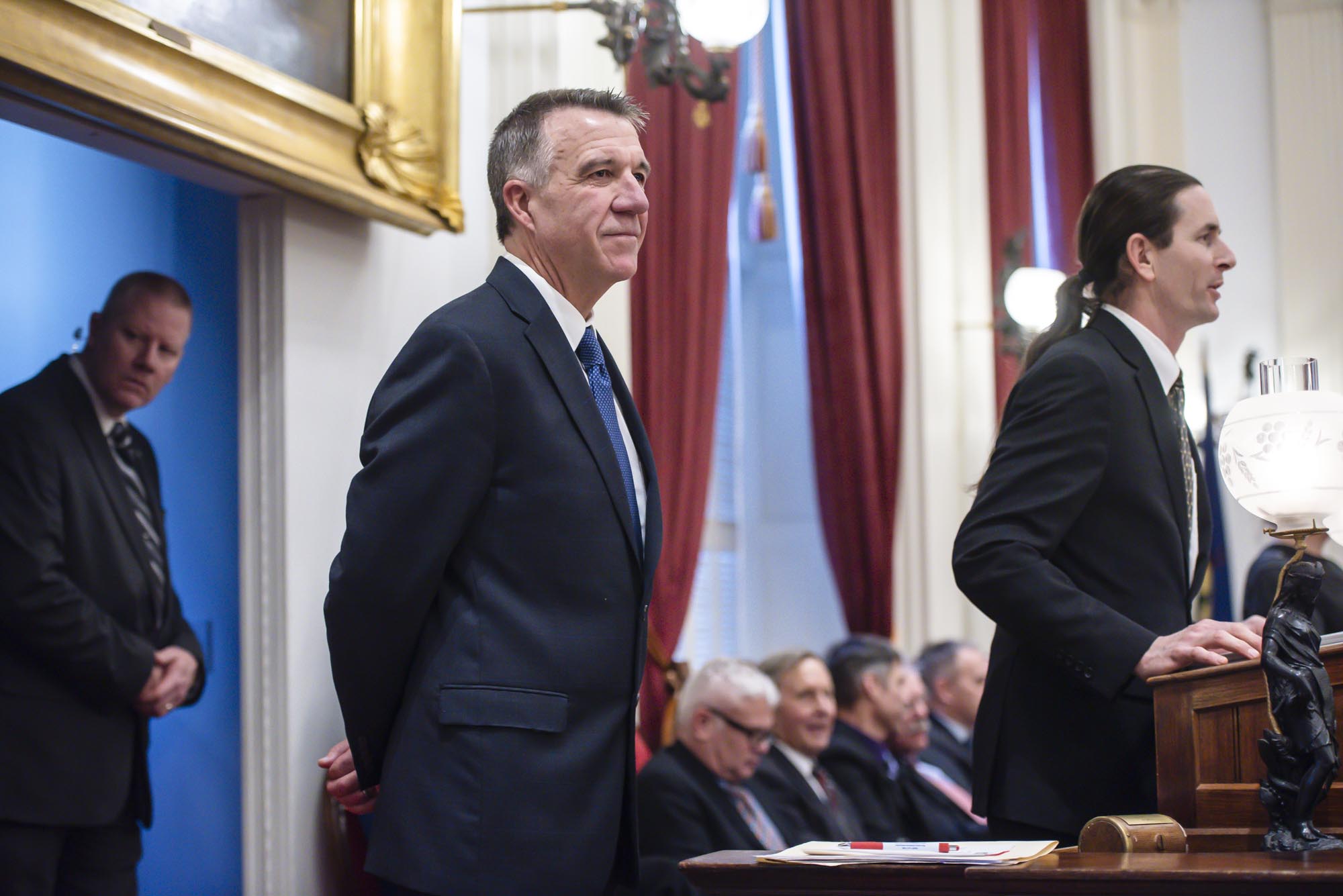
Gov. Phil Scott has not yet announced whether he’s running for reelection, but that was one humdinger of a campaign speech he made Thursday.
Officially, it was his annual State of the State address, and as is all but required in such speeches, it had some public policy proposals: more incentives for people to buy electric vehicles, “waiving license reinstatement fees for suspended drivers,” and a “universal after-school network” that would make sure “every child has access to enrichment opportunities outside of current classroom time.”
He didn’t say how he would pay for that.
For the most part, though, the relatively brief (about 45-minute) speech was short on specifics and long on inspiration, on the assurance that “the state of the state is strong,” and the hope that “our future and our people will be stronger than ever.”
Especially if they “reclaim the middle,” where Scott has always stood politically, and where he stood again opening his fourth year as governor.
And, even these days, a very good place to stand while running for office.
Just as his speech was beginning, the governor got a bit of unintended political help when he was interrupted for about 20 minutes by a small band of climate change activists who sat in the rear of the House of Representatives chamber and began shouting.
“Listen to the people” they chanted over and over again, apparently oblivious of the fact that there were only 16 of them and they were interrupting an official proceeding of the elected representatives of the people.
Scott kept his cool and after about seven minutes Lt. Gov. David Zuckerman (Scott’s likely opponent in November) called a recess and asked Capitol Police to remove the protesters. No one was hurt.
Considering that the governor went on to call for more civility in government, the contrast between him and the protesters is likely to make him look like a calm and cautious leader, patient but firm in the face of rudeness.
Scott did not attack a single political opponent. Instead he criticized those who are “choosing confrontation and partisan politics over collaboration and progress.”
He didn’t name the “too many elected officials” making that choice, but everyone who hears the speech will understand that Scott was describing the national leader of his own party, President Donald Trump.
Running statewide in Vermont, the first thing a Republican has to do is make sure voters know he is not a fan of Trump, whose approval rating in the state is dismal.
Scott seems to know this, and if this speech was effectively the opening speech of his campaign, he seems to be running as the anti-Trump.
“Honest efforts and thoughtful ideas from good people are too often mischaracterized, misrepresented and belittled,” he said. “And all of this is intended to divide us and bully us into an ‘us versus them’ mentality.”
He didn’t belittle anyone, but he was firm about what he would and would not accept. What he will not accept is what he has refused to accept since he took office: anything that makes life more expensive for, it seems, anyone. That includes programs to provide less expensive housing and more job opportunities for low-income people. But mostly it means no new or higher taxes.
That includes a carbon tax or any other government program that might raise the cost of gasoline and heating fuel. Too many Vermonters, Scott said “struggle to fill their gas tanks and heat their homes. I simply cannot support proposals that will make things more expensive for them.”
That would appear to rule out his support for the Transportation and Climate Initiative, the 12-state (Maine southward through Virginia) collaboration to reduce greenhouse gas emissions. One of its proposals would probably lead to higher prices for both gasoline and home heating oil.
As he made clear, Scott is not a global warming denier. He proposed more spending to subsidize electric car purchases and to install more charging stations for those cars.
That’s something, but for many — representing far more people than the protesters both in the chamber and the larger, calmer, contingent that assembled outside the Statehouse, it is not nearly enough. The speech displayed “a stunning lack of urgency” about climate, said Rep. Sarah Copeland Hanzas, D-Bradford, chair of the Government Operations Committee.
Scott and the Democrats who control both chambers will disagree over many issues this year. This is the one on which even Phil Scott may have to choose confrontation.
